
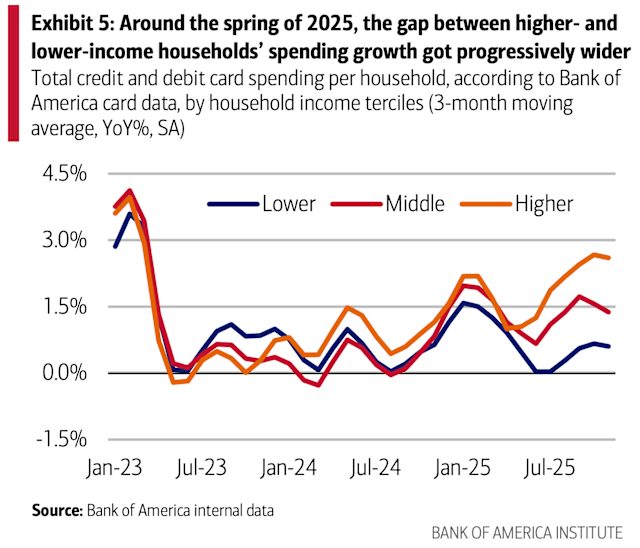


American retail sales went nowhere in December, the weakest holiday shopping finish since 2018. The Commerce Department reported $735 billion in sales—unchanged from November—while economists expected 0.4% growth. Eight of thirteen retail categories declined, with furniture and auto sales hit hardest by tariff-driven price increases. The data, delayed more than a month by a 43-day government shutdown, sent money markets repricing Federal Reserve rate cuts from two to three for 2026. New analysis from Bank of America reveals the structural fracture runs deeper than initially understood: in January, higher-income households' spending grew 2.5% year-over-year, while middle-income households managed just 1% and lower-income households only 0.3%.
The K-shaped economy is now fracturing into nested divergence. The wealthiest 20% of households account for 59% of all consumer spending—a record—while the bottom 80% have pulled back to historic lows. More troubling, middle-income households ($40,000–$125,000) are now experiencing spending weakness comparable to lower-income groups, creating what economists describe as 'a K within a K' or an emerging 'E-shaped' economy. Wage growth tells the same story: higher-income households saw 3.7% year-over-year wage growth in January, while middle-income families managed just 1.6% and lower-income workers 1.4%. Delta Air Lines reports premium seat revenue up 9% as basic economy falls 7%. Fast-food chains push value meals while airlines race to add luxury cabins. The question is no longer whether the top can carry the bottom, but whether concentrated spending at the very top can sustain overall economic momentum as the middle class joins the lower-income squeeze.