


Pull to refresh
Logo
Daily Brief
Following
Why Ranks Sign Up
America's productivity rate doubles to 2% as economists debate the cause

America's productivity rate doubles to 2% as economists debate the cause

New Capabilities

Five straight years of high productivity growth have surprised the Fed. Nobody agrees whether AI, remote work, or a business-creation boom is responsible.

Yesterday: Bloom: remote work, not AI, explains the boom

Overview

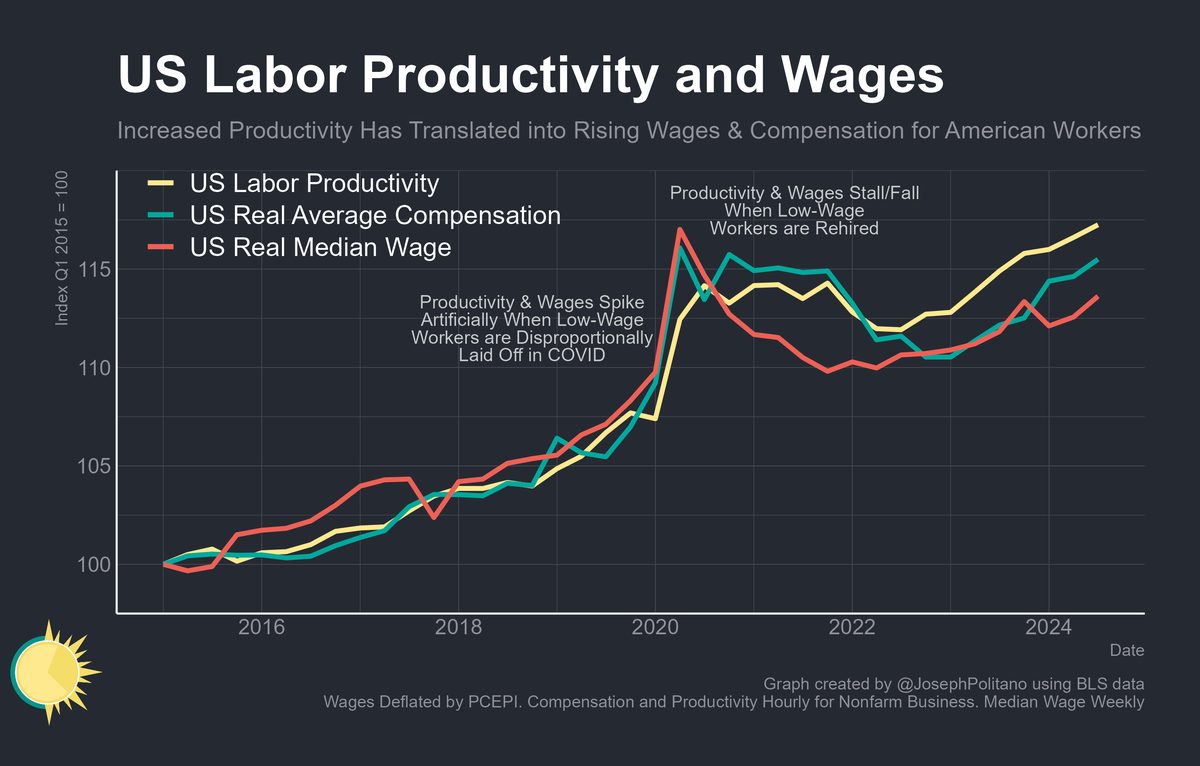
For most of the 2010s, American workers produced about 1% more output per hour each year. Since the third quarter of 2022, that figure has roughly doubled. The Federal Reserve confirmed this week that the 2% annual pace has now held for nearly four years.

Higher productivity lets wages rise without inflation rising with them. The fight now is over the cause. Stanford economist Nicholas Bloom credits remote work. The Kansas City Fed points to a surge in new business formation. Most headlines credit artificial intelligence, but Fed researchers say the AI effect has not yet shown up clearly in the data.

Why it matters

Sustained 2% productivity growth, double the 2010s pace, raises real wages by roughly $10,000 over a decade for a median worker without forcing the Fed to fight inflation.

Key Indicators

2.0%
Annual productivity growth, 2022-2026
Nonfarm business output per hour, a doubling from the 2010s average of about 1%.
2.9%
Q1 2026 productivity growth, year-over-year
Bureau of Labor Statistics figure released May 7, 2026.
54.1%
Labor share of output
Lowest reading since the BLS series began in 1947. Capital is capturing more of the gains than workers.
5,000+
Executives surveyed by Bloom on AI use
Stanford research covering CFOs and CEOs in the US, UK, Germany, and Australia found firm-level AI productivity effects still small.

Interactive

Exploring all sides of a story is often best achieved with Play.

Ever wondered what historical figures would say about today's headlines?

Sign up to generate historical perspectives on this story.

People Involved

Organizations Involved

Timeline

  1. Bloom: remote work, not AI, explains the boom

    Analysis

    Fortune publishes Bloom's case that work-from-home adoption tracks the productivity surge more closely than AI deployment does.

  2. Federal Reserve confirms 2% annual productivity pace

    Statement

    Fed communications confirm productivity has averaged roughly 2% a year since 2022, double the 2010s pace. Powell calls it one of the biggest positive surprises of the recovery.

  3. BLS releases Q1 2026 productivity report

    Economic Data

    Nonfarm business productivity up 0.8% from the prior quarter and 2.9% from a year earlier. Labor share at 54.1%, the lowest since 1947.

  4. Bloom presents AI-productivity analysis at SF Fed

    Research

    Stanford's Nicholas Bloom shows survey data from over 5,000 executives suggesting firm-level AI productivity effects are still small.

  5. Fed begins cutting rates

    Monetary Policy

    Cooling inflation and a sustained productivity climb give the Federal Reserve room to cut rates without reigniting price pressures.

  6. ChatGPT launches publicly

    Technology

    OpenAI releases ChatGPT, marking the commercial debut of widely accessible generative AI. The timing coincides with the start of the productivity climb but precedes most enterprise rollouts.

  7. Productivity uptrend begins

    Economic Data

    BLS data later shows the post-pandemic productivity climb starting in the third quarter of 2022, the same quarter ChatGPT was being readied for public release.

Scenarios

Predict which scenario wins. Contrarian picks score more — points lock in when the scenario resolves.

Log in to predict. Track your picks, climb the leaderboard. Log in Sign Up
1

AI productivity gains finally show up in 2027 data

Fed researchers expect the AI rollout to start showing measurable effects in 2027, with the largest gains in high-skill services and finance. If that hits, the 2% rate could climb to 2.5% or more on the annual BLS series.

Resolves by: 2028-03-31
Source: BLS annual productivity report for full-year 2027
Discussed by: San Francisco Fed (Feb 2026 Economic Letter), Kansas City Fed industry analysis
Consensus
2

Productivity reverts to its 2010s pace

The remote-work productivity bonus could be a one-time level shift, not an ongoing rate of growth. New-business formation could fade. If neither AI nor structural change picks up the slack, growth could fall back toward 1%.

Resolves by: 2028-03-31
Source: BLS annual productivity report for full-year 2027
Discussed by: Skeptics including some former Fed officials and macro forecasters who treat the post-2022 climb as a one-off rebound
Consensus
3

Powell cites productivity in justifying further rate cuts this year

If productivity stays strong, Powell has cover to cut rates further without inflation alarm. A direct reference to productivity in an FOMC statement or post-meeting press conference would mark a shift from the inflation-focused language of recent years.

Resolves by: 2026-12-31
Source: FOMC official statements and Powell post-meeting press conference transcripts
Discussed by: Fed-watchers at major banks tracking Powell's public remarks on the economy's speed limit
Consensus
4

Recession ends the productivity run

A downturn would normally drag productivity down with output, ending the multi-year streak. The NBER Business Cycle Dating Committee would mark it, usually months after the fact.

Resolves by: 2027-12-31
Source: National Bureau of Economic Research Business Cycle Dating Committee
Discussed by: Bearish forecasters citing tariff impacts, labor-market softening, or financial-market stress
Consensus

Higher or Lower

Two numbers from this story. Guess which is bigger. Up to 5 rounds — one wrong call ends the streak.

Log in to play. Track your streak, climb the leaderboard. Log in Sign Up
Example
Anchor
EU tariff revenue
$52B
Mystery
Pentagon AI contract
?

Historical Context

The 1990s IT productivity boom (1995-2004)

1995-2004

What Happened

After two decades of stagnant productivity, US output per hour grew at 2.7% a year for nearly a decade. Economists credited personal computers, business software, and the buildout of corporate IT networks. Fed Chair Alan Greenspan famously bet on the boom and kept rates lower than his board wanted.

Outcome

Short Term

Real wages rose strongly, unemployment fell below 4%, and the federal budget moved into surplus.

Long Term

Productivity growth slowed sharply after 2004 and averaged near 1% for the 2010s. The IT boom turned out to be a one-time payoff, not a permanent step up.

Why It's Relevant Today

The current debate mirrors the 1990s: a new general-purpose technology arrives, productivity climbs, and economists argue over whether the gains will compound or fade. Greenspan's bet that the trend was real, not noise, looks a lot like the choice Powell faces now.

Post-war productivity boom (1948-1973)

1948-1973

What Happened

US labor productivity grew at 2.8% a year for a quarter-century. Drivers included electrification of factories, the interstate highway system, and college access through the GI Bill. Real median wages roughly doubled.

Outcome

Short Term

Rising real wages built the post-war middle class and funded a large expansion of homeownership.

Long Term

Productivity growth collapsed in 1973 and did not return to that pace for nearly three decades. Economists still argue about why.

Why It's Relevant Today

Shows that productivity booms can run for decades, but also that they can end abruptly without obvious cause. Bloom's WFH thesis is essentially that a single technology shift, like electrification, can reset the trend.

The Solow paradox (1987)

1987

What Happened

Economist Robert Solow observed: "You can see the computer age everywhere but in the productivity statistics." Despite heavy corporate IT spending in the 1980s, measured productivity stayed weak. Then in the mid-1990s, the gains finally appeared.

Outcome

Short Term

Sparked years of debate over whether productivity statistics were missing the value of new technology.

Long Term

Solow's paradox resolved itself when the 1990s boom arrived, vindicating those who argued the lag was real.

Why It's Relevant Today

Today's debate is a near-mirror image: AI hype is everywhere, but Fed researchers say it has not shown up clearly in the data. The Solow lesson is that general-purpose technologies often take a decade or more to register in productivity statistics.

Sources

(6)