

Pull to refresh
Logo
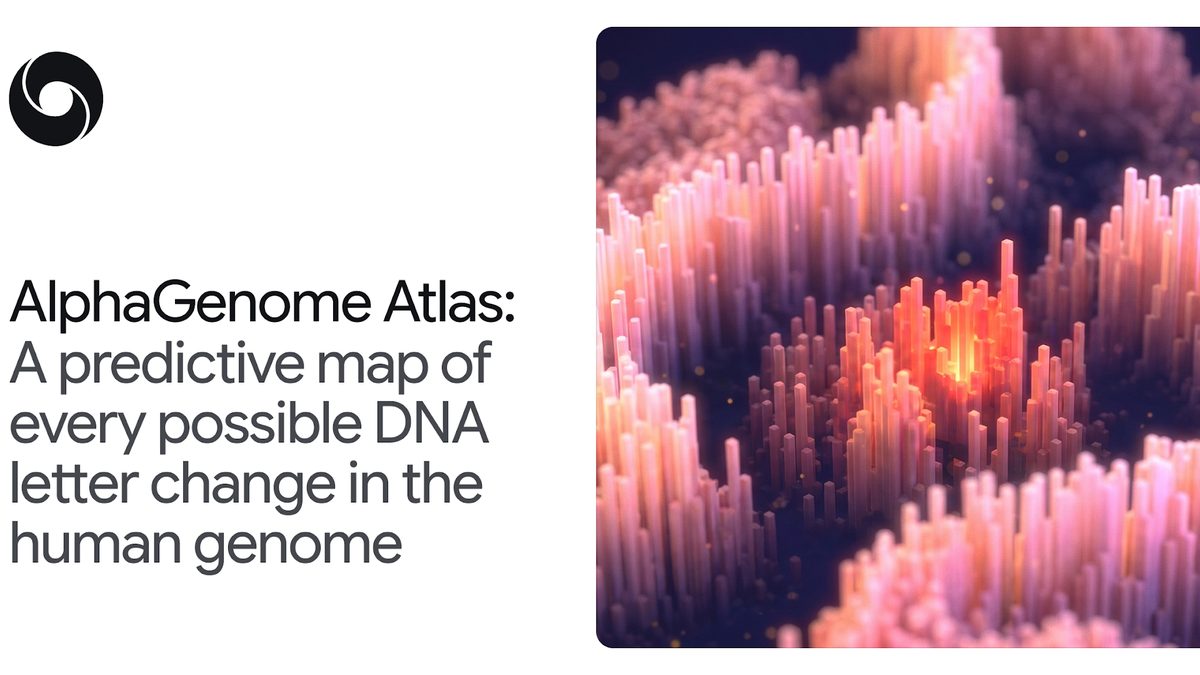
Google DeepMind releases AlphaGenome Atlas, a predictive map of all 9 billion human DNA variants

Google DeepMind releases AlphaGenome Atlas, a predictive map of all 9 billion human DNA variants

New Capabilities

Free database precomputes the effects of every possible single-letter change in the human genome

4 days ago: AlphaGenome Atlas launches

Overview

Updated 3 days ago

Google DeepMind released AlphaGenome Atlas on Tuesday, a free online database that predicts the effects of all 9 billion possible single-letter changes to human DNA. The 1-petabyte resource, built on the AlphaGenome AI model, is the most complete catalogue of human genetic variation ever built.

Researchers working on the 98% of the genome that doesn't code for proteins used to run predictive models one variant at a time. The Atlas precomputes everything, so any researcher can look up a variant in a web browser and see an impact score and the biological details. DeepMind's genomics lead Žiga Avsec cautioned that the predictions are a guide for research, not a substitute for lab experiments.

Why it matters

Researchers can now instantly rank any of 9 billion DNA variants by predicted impact, narrowing rare disease searches from thousands of candidates to a handful.

Questions about this story

Free account needed to ask — your question is kept and asked for you right after sign-up. Answers are public.

No questions yet — be the first to ask.

Key Indicators

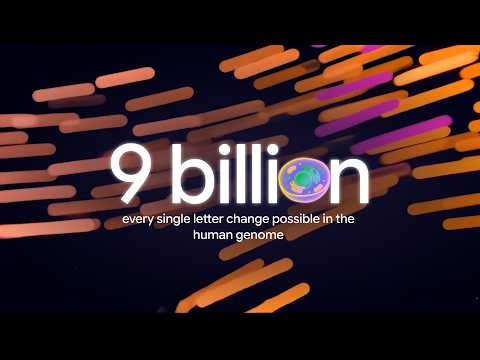
9 billion
Single-nucleotide variants with predicted effects
Every possible single-letter change in the human genome, precomputed by the AlphaGenome AI model.
1 petabyte
Dataset size
Molecular effect predictions across hundreds of human and mouse cell types and tissues.
22%
More non-coding genetic associations found
Gareth Hawkes of the University of Exeter found the gain by grouping rare UK Biobank variants by predicted effect.
2,500+
DNA sequence motifs catalogued
Recurrent DNA sequences, the 'words' of the genome, mapped across the human genome.

Voices

Curated perspectives — historical figures and your fellow readers.

Ever wondered what historical figures would say about today's headlines?

Sign up to generate historical perspectives on this story.

People Involved

Organizations Involved

Timeline

September 2023 September 2026

4 events Latest: 4 days ago
Tap a bar to jump to that date
  1. AlphaGenome Atlas launches

    Latest Product launch

    Free database goes live with 9 billion precomputed DNA variant predictions, the AVI score, and 2,500+ motifs.

  2. DeepMind cautions Atlas predictions need lab validation

    Statement

    Žiga Avsec, DeepMind's genomics lead, said the Atlas works well for some variant types but not others, and predictions should not be treated as universal truth.

  3. AlphaGenome model developed

    Model release

    DeepMind developed the AlphaGenome model that powers the Atlas. The exact release date is not confirmed.

  4. AlphaMissense released

    Model release

    DeepMind launches an AI model predicting effects of protein-altering DNA variants across the human proteome.

Scenarios

1

Atlas becomes a standard tool for rare disease gene discovery

Likely Resolves by Sep 8, 2027

Discussed by: Broad Institute's GREGoR Consortium, Stowers Institute collaborators, Nature coverage

The DNM1 discovery shows the AVI score can surface variants earlier methods missed. If the tool spreads through the rare disease community, expect a stream of studies crediting the Atlas for newly found disease genes. The GREGoR Consortium is already using it to re-examine unsolved cases.

2

Clinical adoption waits for lab validation

Likely Resolves by Sep 8, 2027

Discussed by: Stowers Institute communications, DeepMind's own disclaimer

DeepMind states the Atlas's predictions are not validated or approved for clinical use. Every hit still needs experimental confirmation. If labs treat the Atlas as a hypothesis generator rather than a diagnostic, clinical integration will lag behind the research uptake.

3

DeepMind extends the Atlas to other species

Possible Resolves by Sep 8, 2027

Discussed by: DeepMind's own framing, The Register coverage

DeepMind calls the Atlas 'a baseline rather than an endpoint.' Improved AlphaGenome models or a push into model organisms like mouse could follow. The company also plans commercial access via Google Cloud.

4

Atlas predictions face a validation bottleneck

Likely Resolves by Sep 8, 2027

Discussed by: Žiga Avsec, SiliconANGLE

Avsec said the Atlas works well for promoters and splicing variants but less so for enhancers. If experimental screens fail to confirm a large share of predictions, researchers may treat the Atlas as a hypothesis generator rather than a reliable map.

Historical Context

3 moments from history that rhyme with this story — and how they unfolded.

October 1990 - April 2003

Human Genome Project (1990-2003)

An international consortium of 20 institutions spent 13 years and roughly $3 billion sequencing the first complete human genome. The project produced a reference sequence, not a map of individual variation.

Then

Transformed biology by giving researchers a shared reference genome.

Now

Set the foundation for modern genomics, but left the harder question of what variation means largely open.

Why this matters now

AlphaGenome Atlas answers the question the Human Genome Project couldn't: what each variation does at the molecular level.

January 2008 - September 2015

1000 Genomes Project (2008-2015)

An international effort sequenced over 2,500 genomes from 26 populations to catalogue human genetic variation. It found tens of millions of variants but couldn't say what most of them did.

Then

Built the variant database researchers still use today.

Now

Functional interpretation of variants remained the field's bottleneck.

Why this matters now

The Atlas adds the missing layer: predicted molecular effects for every single-nucleotide variant.

November 2020 - July 2022

AlphaFold (2020-2022)

DeepMind's AlphaFold2 solved the 50-year protein folding problem, predicting 3D structures for nearly all of the human proteome. The team released 350,000 predicted structures in 2021, expanding to 200 million proteins by 2022.

Then

Turned a problem that took years per protein into one solvable in minutes.

Now

Became the standard starting point for structural biology and a template for DeepMind's biology program.

Why this matters now

AlphaGenome Atlas follows the same playbook: precompute predictions at genome scale, then give researchers instant access.

Sources

(12)