Anchor

AlphaGenome Atlas maps every possible human DNA letter change
New CapabilitiesGoogle DeepMind's new database predicts molecular effects of all 9 billion single-nucleotide variants
3 days ago: Atlas sparks broad research coverageNew here? Follow stories to track developments over time. Create a free account to get updates when stories you care about change.
Overview
Updated 16 hours agoGoogle DeepMind opened AlphaGenome Atlas to researchers on September 8. The searchable database predicts the molecular consequences of all 9 billion possible single-letter changes in the human genome — the result of testing all three alternative DNA bases at every position across the 3-billion-letter genome.
Each variant carries an AlphaGenome Variant Impact (AVI) score, a single number ranking its biological impact. The resource turns what previously required running AI models and writing code into a simple lookup. Early applications have already found a rare disease variant that earlier methods missed, and researchers found 22% more noncoding genetic associations in UK Biobank data than standard approaches.
Why it matters
Any researcher can now look up the predicted effect of any single-letter DNA change in seconds, shortening the search for disease-causing variants and linking noncoding DNA to common diseases.
Questions about this story
Free account needed to ask — your question is kept and asked for you right after sign-up. Answers are public.
No questions yet — be the first to ask.
Key Indicators
9 billion
Single-nucleotide variants mapped
All three possible single-letter changes at every position in the human genome.
1 petabyte
Prediction data volume
Total size of precomputed molecular effect predictions stored in the atlas.
22%
Increase in noncoding genetic associations found
University of Exeter analysis of 54,000 UK Biobank genomes found more signals using atlas predictions.
9,000
Researchers using AlphaGenome API before atlas launch
DeepMind product manager Dhavi Hariharan reported the API user count ahead of the September release.
Related Media
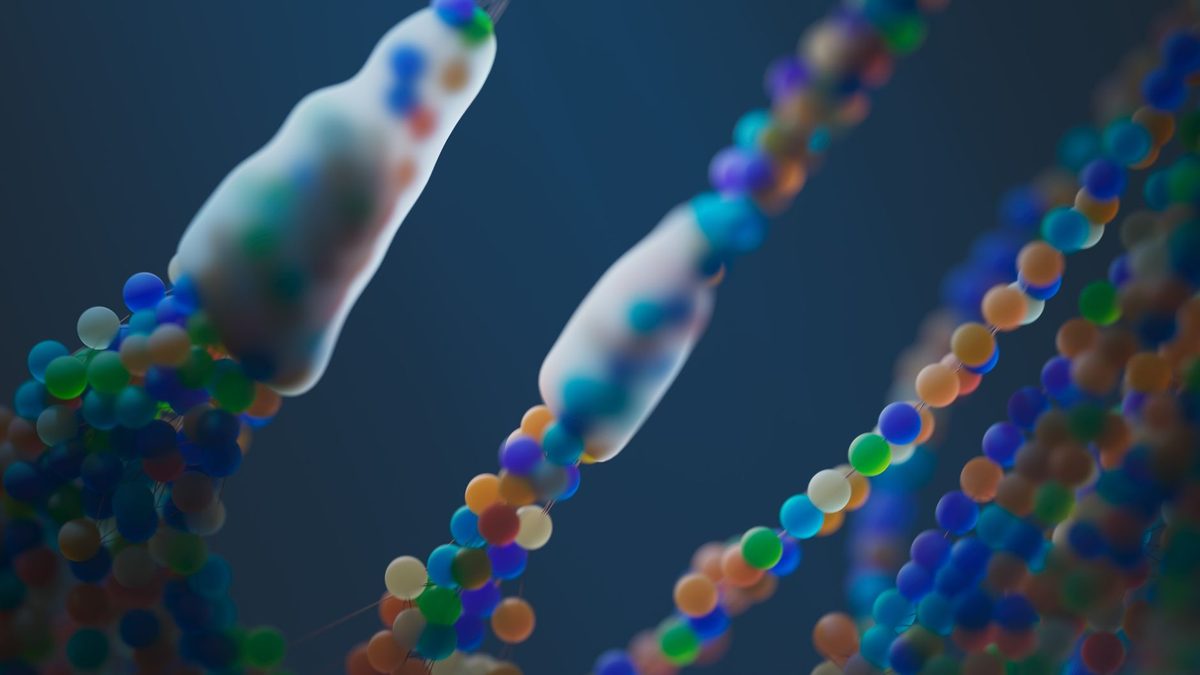
Close-up of a colorful abstract representation of DNA strands, illustrating science and genetics.

An artist’s illustration of artificial intelligence (AI). This image depicts how AI could assist in genomic studies and its applications. It was created by artist Nidia Dias as part of the Visualising AI project launched by Google DeepMind.

45.9K views
4:31
Google Cracks Genetics by Mapping Every Possible DNA ...
AIM Network

47 views
3:08
DeepMind Maps Every DNA Letter Change, Highlighted
Standarity
141.7K views
3:37
AlphaGenome Atlas: Understanding the human genome
Google DeepMind
Images from Openverse under Creative Commons licenses. Videos from YouTube.
Voices
Curated perspectives — historical figures and your fellow readers.
Play
Exploring all sides of a story is often best achieved with Play.
Most of these play right now — no account needed. Sign up to save scores, keep a streak, and unlock Debate and Predict.
Log in
Sign Up
Higher or Lower
A number from this story, against one from elsewhere in the news — guess which is bigger, then keep the chain going. 5 rounds, 3 strikes; a miss costs a strike and resets your streak.
Example
Anchor
EU tariff revenue
$52B
Big for this kind of number
Mystery
Pentagon AI contract
?
Round 1
Streak: 0
Mystery
?
Keyboard: ↓/L lower · ↑/H higher
0 pts
Best streak: 0 · Rounds: 0
0 points — sign up to put that on the leaderboard.
Now try on this story
Connections
Sixteen names from the news. Find the four hidden groups of four. Four mistakes max.
Loading today's puzzle…
0/4 groups
Mistakes
Sign up to keep a daily streak — a new puzzle lands every day.
Now try on this story
Exit debate?
Your progress in this debate will be lost.
How it works
- 1 Two AI personas square off on this story.
- 2 You predict who'll win each round — correct picks earn XP.
- 3 One crossfire question is yours to fire. Pick it carefully.
Couldn't generate a topic
Select Your Champions
Choose one persona for each side of the debate
DEBATE TOPIC
Choose personas with different perspectives for a more dynamic debate.
SIDE A (PRO)
Select debater for this side:
No debate personas available right now.
SIDE B (CON)
Select debater for this side:
No debate personas available right now.
VS
Get ready to make your prediction...
Round of
Claim
Evidence
Stakes
Crossfire Answer
Closing Statement
Claim
Evidence
Stakes
Crossfire Answer
Closing Statement
Your Crossfire Question
Generating arguments...
Who's Got This Round?
Make your prediction before the referee scores
The referee scores both sides on
Correct predictions earn +20 XP
· Press 1 or 2 to pick
Evidence
40%
Logic
30%
Detail
20%
Style
10%
Round Results
Your Pick
Not this time
(%)
Overall Score
/10
Your Pick
Not this time
(%)
Overall Score
/10
Set the Crossfire
Pick the question both personas must answer in the final round
Crafting crossfire questions...
Choosing a question earns +10 XP crossfire bonus
🏆
Total XP Earned
Cred Change
Predictions
Debate Oracle! You called every round!
Sharp Instincts! You know your debaters!
The Coin Flip Strategist! Perfectly balanced!
The Contrarian! Bold predictions!
Inverse Genius! Try betting the opposite next time!
XP Breakdown
Base completion
+20 XP
Rounds played ( rounds x 5 XP)
+ XP
Correct predictions ( correct x 20 XP)
+ XP
Crossfire bonus
+10 XP
Accuracy
%
Prediction History
Round
You picked:
✓
✗
Now try on this story
Keep debating to level up your credibility and unlock achievements
People Involved
DH
Dhavi Hariharan
Product manager, Google DeepMind
Overseeing AlphaGenome Atlas release
Anne O'Donnell-Luria
Researcher, Broad Institute
Leading rare disease collaboration with GREGoR Consortium
Gareth Hawkes
Medical Research Council fellow, University of Exeter
Applied atlas to UK Biobank whole-genome data
Martin Kircher
Bioinformatician
Independent commentator
JZ
Julia Zeitlinger
Molecular biologist
Preprint co-author; spoke at the AlphaGenome Atlas press briefing
Organizations Involved
Google DeepMind
AI research laboratory
Developer and publisher of AlphaGenome Atlas
AI research lab that released the AlphaGenome model in 2025 and the AlphaGenome Atlas database in September 2026.
GREGoR Consortium
Rare disease research collaboration
Beta tester applying AVI scores to unsolved cases
Research consortium that applied AlphaGenome AVI scores to prioritize causal variants in unsolved rare disease cases.
Timeline
2025 September 2026
4 events
Latest: 3 days ago
Tap a bar to jump to that date
-
Atlas sparks broad research coverage
Latest ResponseNature, Scientific American, and Ars Technica covered the release; GREGoR and Exeter findings demonstrated early applications in rare disease and common trait genetics.
-
AlphaGenome Atlas launched
Product LaunchDeepMind unveiled the Atlas: predictions for all 9 billion single-nucleotide variants, a 1-petabyte searchable database with AVI impact scores.
-
AlphaGenome model released
Model ReleaseDeepMind released AlphaGenome, an AI model analyzing noncoding DNA and predicting variant effects on gene regulation.
-
API use grows among researchers
AdoptionAround 9,000 researchers accessed AlphaGenome predictions through the programming interface after the model's 2025 release, though it required writing code.
Scenarios
1
AlphaGenome Atlas accelerates rare disease diagnosis
Likely
Resolves by Sep 8, 2027
Discussed by: GREGoR Consortium, Broad Institute, University of Exeter researchers
The AVI score shortens variant prioritization from months to minutes. The DNM1 finding validated the approach end to end, from prediction to experimental confirmation. Widespread clinical adoption hinges on replication studies and integration into diagnostic pipelines at medical genetics centers.
2
Experimental validation exposes prediction gaps
Possible
Resolves by Sep 8, 2027
Discussed by: Martin Kircher, Max Delbrück Centre for Molecular Medicine
Kircher cautioned that predictions won't replace laboratory experiments or case-specific clinical detail. Some AlphaGenome predictions, especially in regulatory regions, may not survive experimental testing. Even a modest failure rate could slow clinical adoption and shift researchers toward hybrid prediction-plus-validation workflows.
3
DeepMind expands atlas beyond single-letter variants
Possible
Resolves by Sep 8, 2027
Discussed by: DeepMind, genomics research community
The current atlas covers single-nucleotide variants and 100 million short insertions or deletions. DeepMind could extend coverage to structural variants, additional populations beyond the reference genome, or other species. The company said the base model is available commercially via Google Cloud, which could fund further expansion.
Historical Context
3 moments from history that rhyme with this story — and how they unfolded.
1990-2003
Human Genome Project (1990-2003)
An international consortium sequenced the human genome's 3 billion base pairs, completing the reference genome in 2003. The project cost roughly $3 billion and took 13 years.
Then
Researchers gained a reference genome but no systematic map of how variations affect function.
Now
Enabled a decade of genome-wide association studies linking variants to diseases, though most hits fell in noncoding DNA that researchers couldn't interpret.
Why this matters now
AlphaGenome Atlas extends the Human Genome Project's goal from reading the genome to interpreting its variations, covering the noncoding majority that GWAS could not explain.
2003-present
ENCODE project (2003-present)
The National Human Genome Research Institute launched ENCODE to catalog functional elements in the human genome — promoters, enhancers, and regulatory regions. Phase 3 mapped these across hundreds of cell types.
Then
Produced the first systematic functional annotation of the noncoding genome.
Now
Gave researchers tissue-specific regulatory maps but no direct predictions of how individual DNA variants perturb those elements.
Why this matters now
AlphaGenome Atlas builds on ENCODE-style annotations by predicting variant effects across hundreds of human and mouse cell types, adding the impact dimension ENCODE lacked.
2020-2021
AlphaFold protein structure prediction (2020-2021)
DeepMind's AlphaFold solved the protein folding problem, predicting 3D structures for hundreds of millions of proteins. CASP14 judges scored it near experimental accuracy in 2020.
Then
Structural biologists gained instant access to predicted protein shapes that previously required years of lab work.
Now
AlphaFold became a standard resource cited in tens of thousands of papers, establishing DeepMind's pattern of releasing large prediction databases to the research community.
Why this matters now
AlphaGenome Atlas follows the same playbook: a massive precomputed prediction resource, free for academics, built on a model DeepMind released earlier.
Sources
(10)Related Stories
Google DeepMind releases AlphaGenome Atlas, a predictive map of all 9 billion human DNA variants
New Capabilities
Updated 3 days ago
AI decodes the genome's dark matter
New Capabilities
Updated May 26
AI models learn to read, predict, and write the genetic code of life
New Capabilities
Updated May 30
AI closes in on biology's last structural puzzles
New Capabilities
Updated May 30
RNA polymerase reads eight-letter DNA alphabet in UC San Diego studies
New Capabilities
Updated 5 days ago
AI transforms drug discovery from years to hours
New Capabilities
Updated Jun 27