


Pull to refresh
Logo
Daily Brief
Following
Why Ranks Sign Up
Bacteria's expanding antiviral arsenal

Bacteria's expanding antiviral arsenal

New Capabilities

Researchers keep uncovering defense systems bacteria use to fight viruses—and each one is a candidate tool for medicine and gene editing

April 23rd, 2026: Nature publishes peer-reviewed Clover paper

Overview

For billions of years bacteria have fought viruses. Until 2018, scientists could name only a handful of the tools they use—mostly restriction enzymes and CRISPR. The catalog has since grown to more than 150 defense systems, and on April 23 Nature added another: Clover, a bacterial system that starves invading viruses of DNA building blocks without poisoning the bacterium itself.

The new paper solves the control problem that makes this kind of defense workable. An enzyme called CloA destroys deoxyguanosine triphosphate—a raw material viruses need to copy their genomes—but only when it detects a viral signal. A partner enzyme, CloB, produces a small molecule that switches CloA off once the threat passes. Every bacterial defense system described in the past decade has become a candidate gene-editing tool or antibiotic lead; CRISPR began the same way.

Why it matters

Bacterial defense systems are where the next CRISPR will come from—each new mechanism is a potential gene-editing tool or antibiotic scaffold.

Play on this story Voices Debate Predict

Key Indicators

150+
Bacterial defense systems catalogued
Up from roughly a dozen known before 2018, when systematic genomic screens began.
2
Signals controlling Clover
Viral dTTP turns the CloA enzyme on; a CloB-produced molecule called p3diT turns it off.
~3B years
Bacteria-virus arms race
Bacteriophages are the most abundant biological entities on Earth; bacterial defenses are equally ancient.
1
Nobel Prize so far from this research area
The 2020 Chemistry Nobel went to Doudna and Charpentier for turning CRISPR into a gene-editing tool.

Interactive

Exploring all sides of a story is often best achieved with Play.

Ever wondered what historical figures would say about today's headlines?

Sign up to generate historical perspectives on this story.

People Involved

Organizations Involved

Timeline

  1. Nature publishes peer-reviewed Clover paper

    Publication

    Volume 652, Issue 8111 details how viral dTTP activates the CloA dGTPase and how CloB's p3diT signal shuts it off before the cell self-poisons.

  2. Clover mechanism posted to bioRxiv

    Preprint

    First public description of CloA/CloB coordination and the p3diT off-switch molecule.

  3. Gabija structural mechanism published

    Mechanism

    Structures of a major bacterial defense system show how it cuts viral DNA and how phages evade it.

  4. 21 more defense systems added

    Discovery

    "Expanded arsenal" paper in Cell Host & Microbe identifies systems with surprising parallels to eukaryotic immunity.

  5. Nucleotide depletion confirmed as a defense strategy

    Mechanism

    Sorek lab shows bacteria destroy deoxynucleotides to starve invading phages of DNA building blocks.

  6. Retrons identified as anti-phage systems

    Discovery

    Long-mysterious bacterial reverse-transcriptase elements turn out to be defensive, triggering abortive infection when phage proteins are sensed.

  7. CBASS defined as a major defense family

    Discovery

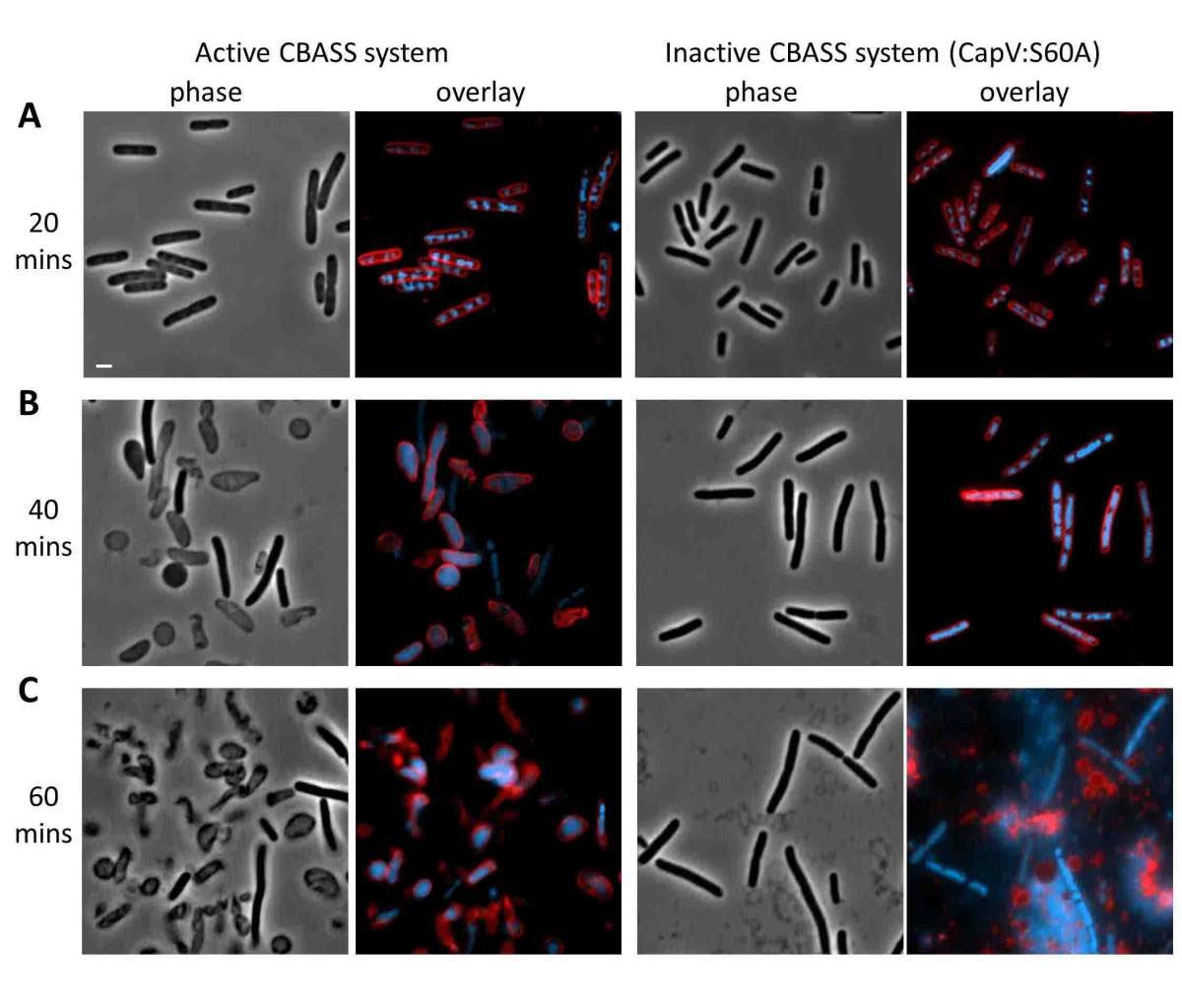
    Cyclic oligonucleotide-based anti-phage signaling systems shown to be widespread, using the same logic as human cGAS-STING.

  8. Sorek lab publishes nine new defense systems

    Discovery

    Science paper establishes the computational-plus-experimental pipeline that will drive the discovery boom.

  9. Doudna and Charpentier turn CRISPR into a tool

    Discovery

    Science paper shows Cas9 can be programmed with a single guide RNA to cut any DNA sequence, launching the gene-editing era.

  10. CRISPR shown to be adaptive immunity

    Discovery

    Barrangou and Horvath demonstrate that CRISPR arrays store memories of past phage infections and protect bacteria from reinfection.

  11. CRISPR repeats first spotted in E. coli

    Discovery

    Japanese researchers notice unusual repeat sequences in a bacterial genome without knowing their function.

Scenarios

Predict which scenario wins. Contrarian picks score more — points lock in when the scenario resolves.

Log in to predict. Track your picks, climb the leaderboard. Log in Sign Up
1

Clover-style nucleotide sensors become the next gene-editing platform

CRISPR was a bacterial defense system before it was a lab tool. Nucleotide-sensing enzymes like CloA, if they can be programmed to trigger on a synthetic signal, could be developed into tightly controlled molecular switches for gene therapy—turning edits on only in the presence of a chosen small molecule. Translation is years away but the mechanism is unusually clean.

Discussed by: Kranzusch and Sorek groups in review articles; biotech investors tracking bacterial immunity
Consensus
2

Defense system catalog doubles again by 2030

The current pipeline—mine bacterial genomes, cluster genes near known defense machinery, screen candidates against phages—has not slowed down. The field expects several hundred systems once metagenomic coverage improves, with more surprising eukaryote-like mechanisms showing up.

Discussed by: Nature Reviews Microbiology 2023 survey; Sorek lab public statements
Consensus
3

Antimicrobials exploit the bacteria's own off-switches

If small molecules like p3diT regulate bacterial defenses, synthetic analogs could either disable those defenses (making bacteria vulnerable to phage therapy) or, in the opposite direction, trigger them inappropriately and force bacterial self-destruction. Both are early-stage ideas; neither has a drug candidate yet.

Discussed by: Antibiotic-resistance researchers; bioengineer.org coverage of the Clover paper
Consensus

Historical Context

CRISPR's path from curiosity to Nobel Prize (1987-2020)

1987-2020

What Happened

Repeat sequences noticed in E. coli in 1987 sat unexplained for 18 years. Mojica proposed in 2005 that they were a bacterial immune system; Barrangou and Horvath proved it in 2007 using yogurt cultures; Doudna and Charpentier turned it into a programmable gene-editing tool in 2012. The 2020 Chemistry Nobel followed.

Outcome

Short Term

Gene editing became routine in research labs within three years of the 2012 paper.

Long Term

CRISPR-based therapies for sickle cell disease received FDA approval in 2023; the technology underpins a multi-billion-dollar biotech sector.

Why It's Relevant Today

Every bacterial defense system discovered since 2018 is being evaluated for the same trajectory. Clover's programmable nucleotide-switch logic is exactly the kind of feature that made CRISPR valuable.

Restriction enzymes and the birth of molecular cloning (1968-1978)

1968-1978

What Happened

Bacterial restriction enzymes—defenses that cut foreign DNA at specific sequences—were characterized by Werner Arber, Hamilton Smith, and Daniel Nathans. The work won the 1978 Medicine Nobel.

Outcome

Short Term

Researchers gained the ability to cut and paste DNA at defined sites, making recombinant DNA technology possible.

Long Term

Restriction enzymes remain standard lab reagents 50 years later and launched the biotechnology industry, from insulin production to modern sequencing.

Why It's Relevant Today

The template is well-established: a bacterial defense mechanism, once understood, becomes a foundational tool. Restriction enzymes for cutting, CRISPR for editing, and potentially Clover-family enzymes for conditional control.

cGAS-STING: a human immune pathway with bacterial roots (2013-2020)

2013-2020

What Happened

The cGAS-STING pathway that detects cancer and viral DNA in human cells was shown by Kranzusch and collaborators to be evolutionarily derived from the bacterial CBASS defense system. The enzymes and signaling logic are largely the same.

Outcome

Short Term

Drug developers began targeting STING for cancer immunotherapy; multiple STING agonists entered clinical trials.

Long Term

The discovery reframed innate immunity as an ancient bacterial invention rather than a vertebrate innovation.

Why It's Relevant Today

Bacterial defense research is not niche microbiology—it repeatedly turns out to describe human biology too. Mechanisms like Clover's dual-signal control could have counterparts in human cells that nobody has looked for yet.

Sources

(8)