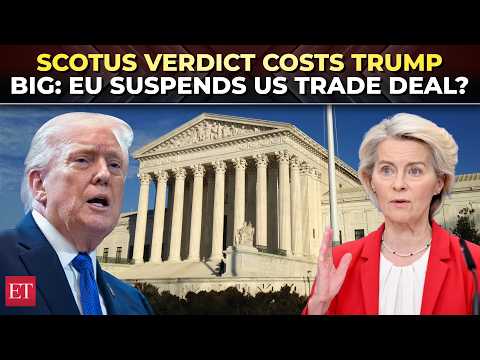
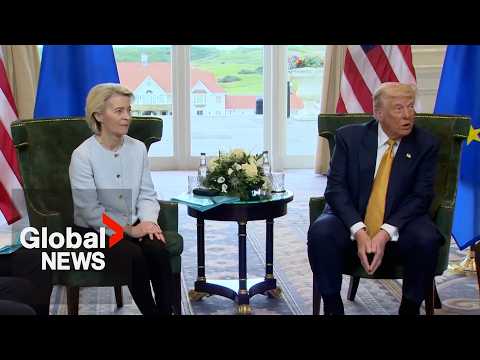
Trump and von der Leyen announced a US-EU trade framework at Turnberry, Scotland, in July 2025. The deal still isn't ratified, nearly ten months on. On May 8, Trump gave Brussels until July 4 to close it, threatening tariffs above the 25% levy already on European cars.
The framework would drop most industrial tariffs to zero on roughly $1 trillion in annual trade and grant US farm goods duty-free European access. In March, the European Parliament backed it 417-154 — but attached a suspension clause and a March 2028 expiry. A second internal EU negotiating session ended without a deal on May 7-8; talks continue May 19 in Strasbourg.
Why it matters
If the deal collapses, European cars get pricier in the US and American farmers lose duty-free access to a market of 450 million consumers.
Questions about this story
Free account needed to ask — your question is kept and asked for you right after sign-up. Answers are public.
No questions yet — be the first to ask.
Key Indicators
$1T
Annual transatlantic trade
Goods and services exchanged between the US and EU each year, the largest bilateral trade flow in the world.
25%
Current US tariff on European cars and trucks
Imposed in spring 2026 on top of existing duties; Trump warned of 'much higher' rates if July 4 passes.
July 4
Ratification deadline
Date by which Trump says the EU must ratify the framework or face escalated tariffs.
0%
Target industrial tariff
What the framework would set for most industrial goods crossing the Atlantic.
13 events
Latest: May 19th, 2026 · 4 months ago
Showing 8 of 13
JK to step
Tap a bar to jump to that date
Jump to
May 2026
Third EU trilogue scheduled in Strasbourg
LatestNegotiation
EU Parliament and Council meet for a third trilogue session. A diplomatic source told Euronews the legislative file is expected to receive approval at this meeting.
Next scheduled negotiating round
Negotiation
EU and US negotiators meet to work through outstanding implementation issues flagged by Bernd Lange.
Trump sets July 4 deadline for ratification
Statement
Trump tells reporters the EU must ratify the framework by July 4 or face 'much higher' tariffs on top of the existing 25% auto levy. European stocks fall on the news.
Trump and von der Leyen speak by phone
Diplomatic
The two leaders discuss ratification timing in a call that preceded Trump's deadline announcement the next day.
Second EU trilogue ends without breakthrough
Negotiation
EU Parliament and Council negotiators concluded a second trilogue in Brussels without finalizing the implementing regulation. Bernd Lange said there was progress on the safeguard mechanism but 'still some way to go.' The next session was set for May 19 in Strasbourg.
April 2026
US imposes 25% tariff on European cars and trucks
Tariff
Trump administration applies a 25% levy on European autos, citing slow ratification of the framework deal.
March 2026
EU Parliament backs Turnberry deal 417-154, with conditions
Legislative
MEPs voted to support the framework but attached three safeguards: a sunrise clause requiring US compliance before tariff cuts take effect, a suspension clause allowing Brussels to halt preferences if Washington breaks the 15% ceiling, and a sunset date of March 31, 2028.
February 2026
Supreme Court strikes down IEEPA tariffs; Trump imposes 10% blanket levy
Legal
The US Supreme Court ruled 6-3 in Learning Resources, Inc. v. Trump that tariffs imposed under the International Emergency Economic Powers Act were unlawful. Within days, Trump used separate statutory authority to impose a 10% blanket tariff on all countries, replacing the earlier IEEPA structure.
EU Parliament lifts trade deal freeze after Trump backs down on Greenland
Legislative
Two weeks after Trump dropped his tariff threats over Greenland, EU lawmakers voted to resume work on enforcing the Turnberry deal, ending a two-week freeze.
January 2026
EU Parliament freezes Turnberry deal over Greenland tariff threats
Legislative
The European Parliament halted work on the trade deal after Trump threatened tariffs of 10-25% on European nations in connection with his push to annex Greenland. Trade Committee chair Bernd Lange called the move 'an attack against the economic and territorial sovereignty of the European Union.'
August 2025
Joint statement details published
Agreement
US and EU release a joint statement laying out the framework's commitments on tariffs, energy purchases, and investment.
July 2025
Trump and von der Leyen announce framework deal
Agreement
Meeting at Trump's Turnberry resort in Scotland, the two leaders announce a framework that would zero out industrial tariffs and grant duty-free quotas for US farm and seafood goods.
April 2025
Trump announces broad import tariffs
Policy
Trump unveils sweeping tariffs on most US trading partners, including the EU, citing trade imbalances.
Scenarios
1
EU ratifies by July 4, industrial tariffs drop to zero
Possible
Discussed by: Bloomberg trade analysts; ING economist Carsten Brzeski in May 8 client note
Member states and Parliament accelerate the timetable, accepting concessions on agriculture and autos to lock in zero industrial tariffs. The 25% auto levy is rolled back as part of the implementation package. Brzeski wrote that Brussels has 'strong incentive to close before July' given the cost of the auto tariff to German manufacturers.
2
Trump extends deadline again as talks drag past Independence Day
Likely
Discussed by: Reuters Brussels bureau; Politico Europe trade reporter Jakob Hanke Vela
Technical issues flagged by Bernd Lange (rules of origin on autos, agricultural quota allocations) prove harder to close than political will to finish. Trump pushes the deadline back, as he has done with similar deadlines on Mexico, Canada, and South Korea. The 25% auto tariff stays in place during the extension.
3
Talks break down, US imposes broader tariffs on EU goods
Unlikely
Discussed by: Peterson Institute economist Chad Bown; CNBC May 8 coverage
Member-state objections (France on agriculture, Italy on luxury goods, Germany on autos) prevent the Council from approving implementing legislation. Trump follows through on the threat, layering additional tariffs on European exports. The EU activates its Anti-Coercion Instrument, triggering retaliation against US services and digital firms.
Historical Context
2 moments from history that rhyme with this story — and how they unfolded.
1 of 2
March 2002 - December 2003
Bush steel tariffs (2002-2003)
President George W. Bush imposed tariffs of up to 30% on imported steel under Section 201 to protect US producers. The EU, Japan, and other partners challenged the move at the World Trade Organization and threatened $2.2 billion in retaliatory tariffs targeting goods from electoral swing states.
Then
US steel prices rose; downstream manufacturers warned of job losses larger than the steel jobs saved.
Now
The WTO ruled the tariffs illegal in November 2003. Bush rescinded them the following month, 21 months after they took effect.
Why this matters now
Shows how tariff threats can be unwound when retaliation is targeted at politically sensitive exports. The EU's 2026 leverage on bourbon, motorcycles, and farm goods follows the same playbook.
2 of 2
June 2018 - October 2021
Trump 1.0 EU steel and aluminum tariffs (2018-2021)
Trump imposed 25% steel and 10% aluminum tariffs on EU imports under Section 232 of the Trade Expansion Act, citing national security. The EU retaliated with tariffs on US whiskey, motorcycles, and jeans worth roughly $3 billion.
Then
EU producers lost market share in the US; American distillers and motorcycle makers saw exports to Europe drop sharply.
Now
The Biden administration replaced the tariffs with a tariff-rate quota system in October 2021 after three years of disputes at the WTO and direct talks.
Why this matters now
Same actors, similar dynamic. Shows that EU-US tariff disputes can drag on for years before settling into a managed-trade compromise rather than a clean resolution.