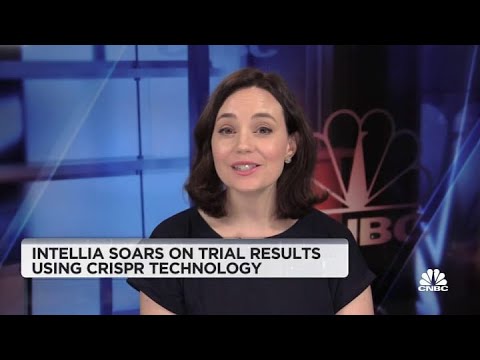
On April 27, 2026, Intellia Therapeutics reported results from Phase 3 testing of lonvoguran ziclumeran (lonvo-z), a one-time in-body CRISPR gene-editing therapy for hereditary angioedema. The 80-patient randomized double-blind trial found a single IV infusion cut debilitating swelling attack rates by 87% versus placebo (weeks 5-28); 62% of patients became attack-free and stopped all preventive medications. The safety profile was clean: no serious adverse events, and infusion-related reactions, headache, and fatigue—the most common complaints—were mild or moderate.
Intellia did not wait: the same day it released Phase 3 results, the company initiated a rolling Biologics License Application (BLA) submission to the FDA. Lonvo-z's RMAT designation allows the FDA to review completed sections as they arrive, rather than waiting for a full package. Intellia expects to complete the full submission in the second half of 2026 and launch lonvo-z commercially in the first half of 2027 if approved. This would make it the first approved in-body CRISPR medicine and offer the roughly 50,000 Americans with HAE a one-time treatment instead of weekly preventive drugs.
Why it matters
In-body CRISPR therapy offers a new model for genetic diseases: one-time treatment instead of lifelong medication.
Questions about this story
Free account needed to ask — your question is kept and asked for you right after sign-up. Answers are public.
No questions yet — be the first to ask.
Key Indicators
1st
Phase 3 readout for in-body CRISPR
No other in vivo gene-editing candidate has reached late-stage pivotal data.
87%
Attack rate reduction vs. placebo
Reduction in HAE attack rate between weeks 5 and 28 in the Phase 3 HAELO trial; mean 0.26 attacks/month (lonvo-z) vs. 2.10 (placebo).
62%
Patients completely attack-free
Proportion of lonvo-z patients with zero attacks and off all preventive medications during the primary observation period.
1 dose
Single infusion
A single 50 mg intravenous dose, contrasted with weekly or bi-weekly chronic prophylaxis.
Rolling
BLA submission started
Intellia initiated a rolling FDA submission on April 27, 2026 under lonvo-z's RMAT designation, enabling expedited review as sections are completed.
H1 2027
Planned U.S. launch (if approved)
Intellia targets a first-half 2027 commercial launch, contingent on completing its BLA filing in H2 2026 and FDA approval.
~1 in 50,000
U.S. HAE prevalence
A small but well-defined patient population, sized for a rare-disease launch.
14 events
Latest: May 11th, 2026 · 4 months ago
Showing 8 of 14
JK to step
Tap a bar to jump to that date
Jump to
May 2026
Q1 2026 earnings: cash runway to 2028, BLA on track
LatestFinancial
Intellia reported a Q1 net loss of $96.2 million on $15.0 million in collaboration revenue. Combined with the April offering, the company now has cash to fund operations into at least 2028 — past the targeted H1 2027 lonvo-z launch. Management confirmed the rolling BLA is progressing and that patient screening in both nex-z Phase 3 ATTR trials has resumed after FDA lifted clinical holds earlier in 2026.
April 2026
Intellia raises ~$194.6M in equity offering two days after HAELO win
Financial
Intellia priced 16.7 million shares at $10.75 each. Underwriters fully exercised their overallotment option the same day, lifting estimated net proceeds to roughly $194.6 million. Jefferies, Goldman Sachs, and Citigroup ran the book. The offering closed April 30.
First Phase 3 readout for an in-body CRISPR therapy
Clinical milestone
Intellia releases topline efficacy and safety data from HAELO. The readout is the pivotal evidence base for the planned U.S. Biologics License Application later in 2026.
Rolling BLA submission to FDA initiated
Regulatory
Intellia initiated a rolling Biologics License Application to the FDA for lonvo-z on the same day as the HAELO readout, leveraging lonvo-z's RMAT designation and its participation in the FDA's CMC Development and Readiness Pilot. The company expects to complete the full BLA filing in H2 2026 and targets a U.S. launch in H1 2027 if approved.
NTLA stock closes down 4.4% on 'sell the news' reaction
Market
Intellia shares fell approximately 4.4%, closing around $13.03, as investors sold into the positive data after the stock had already surged roughly 25% in the days preceding the readout. Analysts at Chardan raised their price target to $30 (Buy); Baird raised their target to $13 (Neutral). ARK Invest bought the pullback.
Intellia confirms readout date
Statement
Company announces topline HAELO data will be released April 27, 2026 with an 8:00 a.m. ET investor webcast.
November 2025
Pooled Phase 1/2 data: 97% attack-free
Clinical
Of 32 patients dosed at 50 mg in earlier studies, 31 were attack-free and off long-term prophylaxis at data cutoff, with follow-up extending up to three years.
September 2025
HAELO enrollment completed
Clinical
All 80 patients enrolled, exceeding the 60-patient minimum specified in the protocol.
January 2025
First patient dosed in HAELO
Clinical milestone
Pivotal dosing begins. The trial randomizes patients 2-to-1 to a single 50 mg infusion of lonvo-z or placebo.
November 2024
HAELO Phase 3 trial initiated
Clinical
Intellia launches the global Phase 3 HAELO study, the first late-stage trial of an in-body CRISPR therapy.
October 2024
Phase 2 data: deep, durable attack reduction
Clinical
Intellia reports a 98% reduction in monthly HAE attacks in the highest-dose Phase 2 cohort, supporting advancement to Phase 3.
December 2023
FDA approves first CRISPR medicine
Regulatory
Casgevy from Vertex and CRISPR Therapeutics becomes the first approved CRISPR therapy, but it is an ex vivo product — patient cells are removed, edited in a lab, and re-infused over months.
November 2021
First HAE patient dosed with NTLA-2002
Clinical milestone
Intellia begins the Phase 1 trial of NTLA-2002 (later renamed lonvo-z), targeting the KLKB1 gene that drives swelling attacks in hereditary angioedema.
June 2021
First human evidence that in-body CRISPR works
Clinical milestone
Intellia and Regeneron report Phase 1 data showing NTLA-2001 reduced a disease-causing protein in ATTR amyloidosis patients — the first time CRISPR editing inside the body had been shown to work in humans.
Scenarios
1
FDA approves first in-body CRISPR therapy in 2027
Likely
Discussed by: Endpoints News, STAT, sell-side analysts at Leerink and Stifel
Topline HAELO data show a clear, statistically significant reduction in HAE attacks with a clean safety profile. Intellia files its BLA in the second half of 2026, the FDA grants priority review, and lonvo-z is approved in 2027 as the world's first in-body CRISPR medicine. Approval validates the platform and accelerates programs from Verve, Beam, and others into expanded pivotal trials.
2
Strong efficacy, but safety questions slow the launch
Possible
Discussed by: FDA review precedents in gene therapy; analyst reports flagging liver enzyme signals seen in earlier in vivo studies
The trial hits its primary endpoint, but rare adverse events — transient liver enzyme elevations or off-target editing concerns — prompt the FDA to require additional long-term follow-up or a black-box label. Approval comes, but with usage restrictions that limit early uptake against Takhzyro and other biologics that already have a multi-year safety record.
3
Mixed readout reopens questions about in-body CRISPR
Unlikely
Discussed by: Cautious commentary from biotech investors who note placebo effects in HAE trials and the small 80-patient sample
The reduction in attacks is meaningful but smaller than Phase 1/2 suggested, or the placebo arm performs unexpectedly well, narrowing the treatment effect. Intellia still files, but the data complicate pricing, payer negotiations, and the broader investment case for in vivo gene editing across the sector.
4
Approval reshapes the HAE drug market
Discussed by: Patient advocacy groups including the U.S. Hereditary Angioedema Association; market analysts covering Takeda's Takhzyro
A successful one-time therapy directly competes with Takeda's Takhzyro (about $1.7 billion in annual sales) and CSL Behring's prophylactic biologics. Even at a high one-time price, payers prefer it over decades of recurring drug costs. Within five years, in-body CRISPR is the standard of care for severe HAE, and chronic prophylaxis revenues collapse.
Historical Context
3 moments from history that rhyme with this story — and how they unfolded.
1 of 3
October 2012
Glybera (2012, withdrawn 2017)
The European Medicines Agency approved alipogene tiparvovec (Glybera) for lipoprotein lipase deficiency, making it the first gene therapy approved in the Western world. Priced at roughly $1 million per treatment, it was used by approximately 30 patients before being pulled from the market in 2017.
Then
Demand was minimal — the indication was vanishingly rare and payers balked at the price tag for a therapy with limited long-term outcomes data.
Now
Glybera became a cautionary tale about commercializing gene therapies for ultra-rare diseases and pushed developers toward larger patient populations with clear chronic-care economics to displace.
Why this matters now
HAE has the kind of population and pre-existing $6+ billion treatment market Glybera lacked. Whether one-time gene editing can win on price and durability against entrenched chronic biologics is the commercial question lonvo-z will test.
2 of 3
December 2017
Luxturna approval (December 2017)
The FDA approved voretigene neparvovec (Luxturna) from Spark Therapeutics for an inherited form of blindness caused by RPE65 mutations. It was the first directly administered gene therapy approved in the United States, delivered as an injection beneath the retina to roughly 1,000–2,000 eligible patients.
Then
Luxturna launched at $850,000 per patient and uptake was slow, hampered by its narrow indication and the complex retinal surgery required.
Now
The approval validated in vivo gene therapy as a regulatory pathway and informed the framework regulators now use to review durability, immunogenicity, and pricing of one-time genetic medicines.
Why this matters now
Luxturna showed regulators would approve a one-time in-body genetic medicine. Lonvo-z would be the first to do it using CRISPR rather than a viral vector that adds a new gene copy.
3 of 3
December 2023
Casgevy approval (December 2023)
The FDA approved exagamglogene autotemcel (Casgevy) from Vertex and CRISPR Therapeutics for sickle cell disease, then quickly for transfusion-dependent beta thalassemia. It was the first CRISPR-based medicine ever approved, treating a population of about 16,000 eligible U.S. sickle cell patients.
Then
Casgevy proved CRISPR could clear regulators, but its ex vivo manufacturing — extracting stem cells, editing them in a lab over weeks, then giving the patient chemotherapy before re-infusion — limited initial uptake to a handful of certified treatment centers.
Now
The approval established the regulatory template for gene-editing medicines and crystallized the next question: could the same kind of edit be made directly inside a patient's body, without the months-long cell processing?
Why this matters now
Casgevy answered whether CRISPR could be a medicine. HAELO is the first answer to whether in-body CRISPR can be one — a far simpler patient experience if it works.