Anchor

Houthis strike Saudi Aramco's Jazan refinery, reopening a front held quiet since 2022
Force in PlayFive weeks after a drone hit Jazan, Iraq-linked drones shut Saudi Arabia's East-West pipeline, Houthis seized a Red Sea island, and Brent topped $100. Baghdad is investigating and has set a Sept 30 militia disarmament deadline.
Today: Iraq confirms drones came from its territory, sets disarmament deadlineNew here? Follow stories to track developments over time. Create a free account to get updates when stories you care about change.
Overview
Updated 4 hours agoWhat began as a single drone strike on August 9 has grown into the most serious Saudi-Houthi fighting since the 2022 truce. On September 8, Houthi missiles and drones hit four Saudi cities, wounded 73 people, and set fires at oil sites. The 400,000-barrel-per-day Jazan refinery has not fully operated since late July.
On September 10, drones launched from Iraq hit pump stations on Saudi Arabia's East-West pipeline, which had been moving 4 to 5 million barrels a day. Riyadh shut the line the next day, and Brent crude traded near $105 a barrel. The Houthis also reached Perim island in the Bab el-Mandeb strait, the Red Sea's southern gateway. Iraq confirmed the drones came from its territory, dismissed two senior officials, and set a September 30 deadline for armed groups to disarm.
Why it matters
Every drone that hits Saudi oil infrastructure makes Gulf supply riskier and raises prices at the pump worldwide.
Questions about this story
Free account needed to ask — your question is kept and asked for you right after sign-up. Answers are public.
No questions yet — be the first to ask.
Key Indicators
400,000 bpd
Jazan refinery capacity
The Red Sea complex can process 400,000 barrels of crude per day.
73
People wounded on Sept 8
Houthi missiles and drones hit four Saudi cities, wounding 73, including women and children.
$105/barrel
Brent crude, Sept 11
Brent futures traded near $105 a barrel after the pipeline attack, ending the week above $100 for the first time since mid-May.
4-5 million bpd
East-West pipeline throughput
The line had been moving 4 million to 5 million barrels a day, about 4% to 5% of global supply, before the Sept 10 strike shut it down.
Since late July
Jazan refinery below full capacity
Repeated Houthi strikes have kept the plant from running at full capacity.
Sept 11
Perim island reached by Houthis
Houthi forces reached the strategic island in the Bab el-Mandeb strait. Transit through the strait has fallen about 60% since late 2023.
Related Media
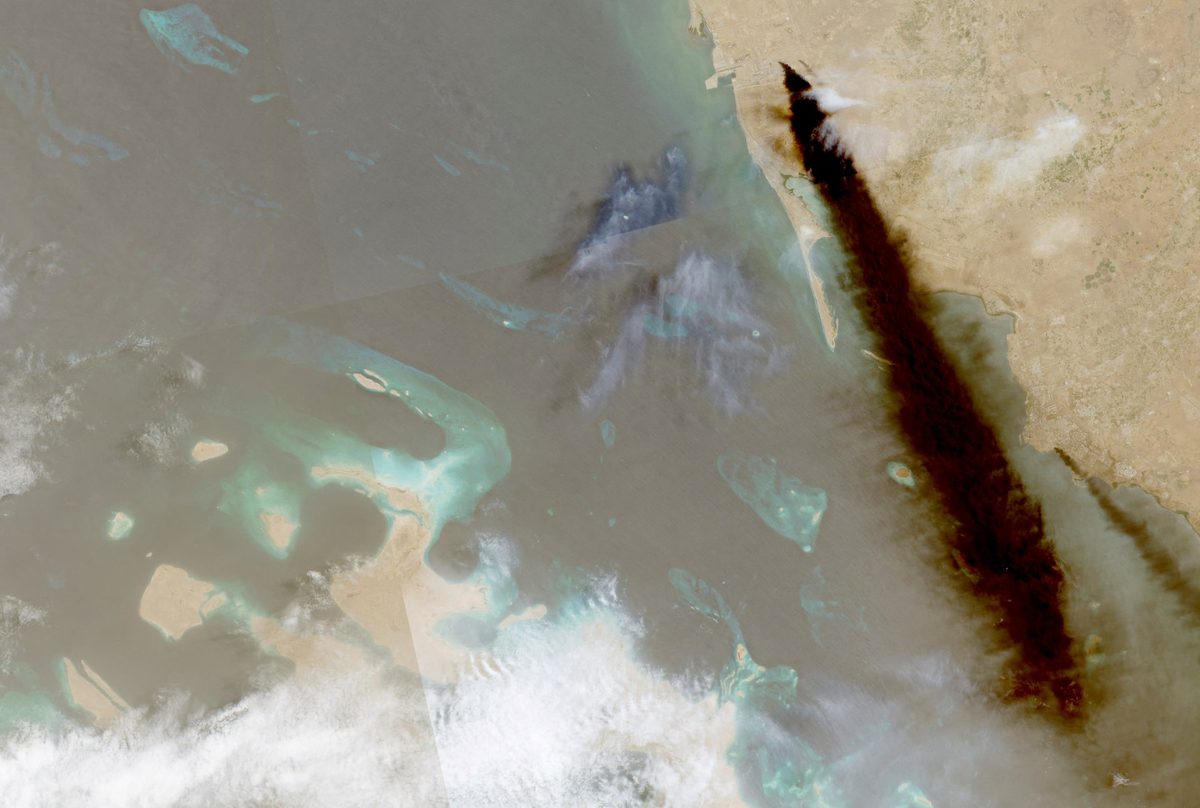
Yemen's Houthis say they attacked Saudi Aramco Jazan refinery, fire extinguished | Reuters
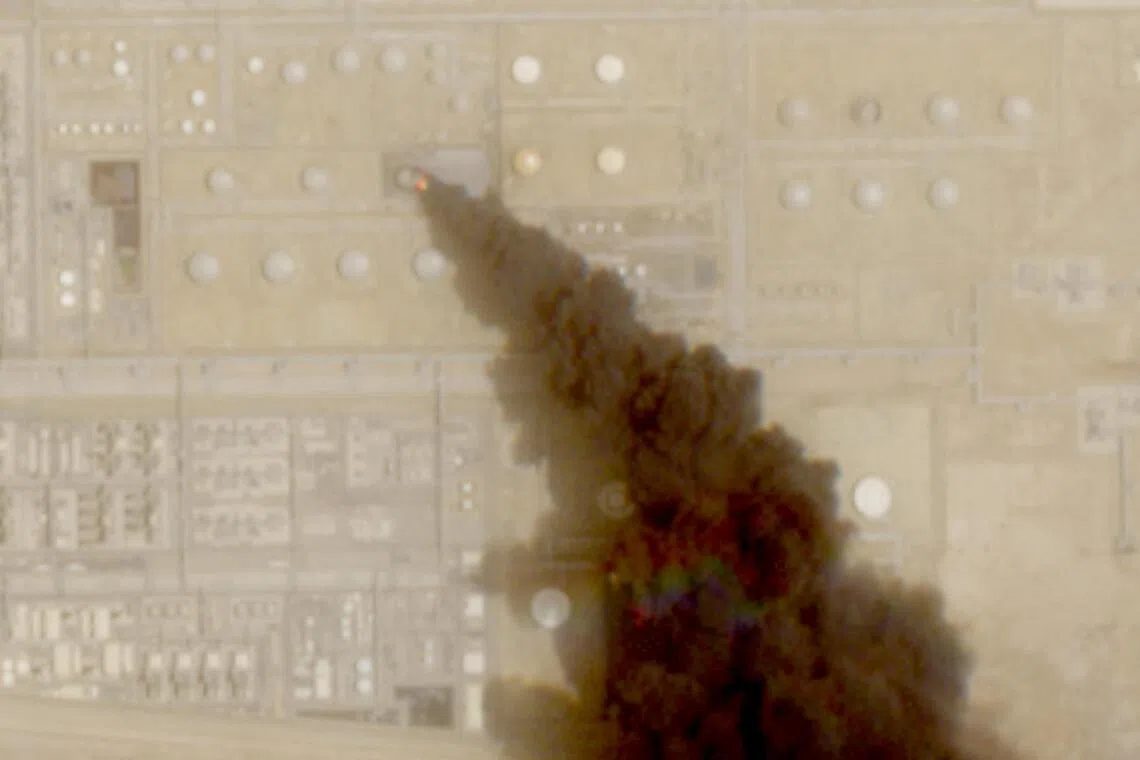
Yemen's Houthis say they attacked Saudi Aramco Jazan refinery, fire extinguished | The Straits Times

108.3K views
1:01:08
Saudi Joins War Against Iran Proxies; Houthis Shut Aramco ...
Firstpost

16.8K views
3:11
Houthis Claim Attacks on Saudi Aramco Facilities in Jizan and ...
DawnNews English
74.4K views
3:34
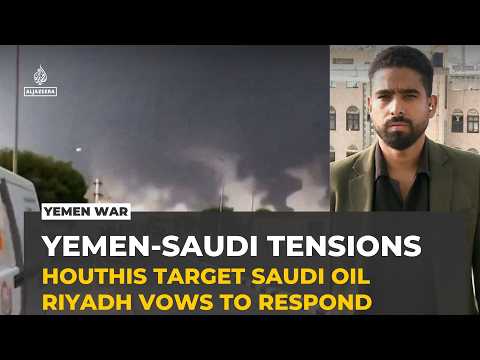
Saudi Arabia intercepts drones from Iraq as Houthis hit oil ...
Al Jazeera English
Images from Openverse under Creative Commons licenses. Videos from YouTube.
Voices
Curated perspectives — historical figures and your fellow readers.
Play
Exploring all sides of a story is often best achieved with Play.
Most of these play right now — no account needed. Sign up to save scores, keep a streak, and unlock Debate and Predict.
Log in
Sign Up
Higher or Lower
A number from this story, against one from elsewhere in the news — guess which is bigger, then keep the chain going. 5 rounds, 3 strikes; a miss costs a strike and resets your streak.
Example
Anchor
EU tariff revenue
$52B
Big for this kind of number
Mystery
Pentagon AI contract
?
Round 1
Streak: 0
Mystery
?
Keyboard: ↓/L lower · ↑/H higher
0 pts
Best streak: 0 · Rounds: 0
0 points — sign up to put that on the leaderboard.
Now try on this story
Timeline
Houthis strike Saudi Aramco's Jazan refinery, reopening a front held quiet since 2022
Order five events from this story, oldest at top. Each in the right slot scores 1 — neighbours within one slot count too. Your previous result — green ✓ for exact slots, yellow ~ for off by one. Cards now in true chronological order.
Loading puzzle…
Tap 💡 Free hint to lock the oldest into slot 1 — that leaves just four to order. Type pills are clues.
0/5
Exact slot
0/5
Within 1
Sign up to save your score and track a streak across stories.
Now try on this story
Connections
Sixteen names from the news. Find the four hidden groups of four. Four mistakes max.
Loading today's puzzle…
0/4 groups
Mistakes
Sign up to keep a daily streak — a new puzzle lands every day.
Now try on this story
Exit debate?
Your progress in this debate will be lost.
How it works
- 1 Two AI personas square off on this story.
- 2 You predict who'll win each round — correct picks earn XP.
- 3 One crossfire question is yours to fire. Pick it carefully.
Couldn't generate a topic
Select Your Champions
Choose one persona for each side of the debate
DEBATE TOPIC
Choose personas with different perspectives for a more dynamic debate.
SIDE A (PRO)
Select debater for this side:
No debate personas available right now.
SIDE B (CON)
Select debater for this side:
No debate personas available right now.
VS
Get ready to make your prediction...
Round of
Claim
Evidence
Stakes
Crossfire Answer
Closing Statement
Claim
Evidence
Stakes
Crossfire Answer
Closing Statement
Your Crossfire Question
Generating arguments...
Who's Got This Round?
Make your prediction before the referee scores
The referee scores both sides on
Correct predictions earn +20 XP
· Press 1 or 2 to pick
Evidence
40%
Logic
30%
Detail
20%
Style
10%
Round Results
Your Pick
Not this time
(%)
Overall Score
/10
Your Pick
Not this time
(%)
Overall Score
/10
Set the Crossfire
Pick the question both personas must answer in the final round
Crafting crossfire questions...
Choosing a question earns +10 XP crossfire bonus
🏆
Total XP Earned
Cred Change
Predictions
Debate Oracle! You called every round!
Sharp Instincts! You know your debaters!
The Coin Flip Strategist! Perfectly balanced!
The Contrarian! Bold predictions!
Inverse Genius! Try betting the opposite next time!
XP Breakdown
Base completion
+20 XP
Rounds played ( rounds x 5 XP)
+ XP
Correct predictions ( correct x 20 XP)
+ XP
Crossfire bonus
+10 XP
Accuracy
%
Prediction History
Round
You picked:
✓
✗
Now try on this story
Keep debating to level up your credibility and unlock achievements
People Involved
Yahya Saree
Military spokesman, Houthi movement
Announcing a widening campaign of strikes on Saudi cities and energy sites; says Red Sea shipping is safe except for Saudi vessels
Abdel-Malik al-Houthi
Leader of the Houthi movement
Directing the group's strategy against Saudi Arabia and shipping
Mohammed bin Salman bin Abdulaziz Al Saud
Crown Prince and prime minister of Saudi Arabia
Weighing Saudi response as strikes resume
Organizations Involved
SA
Saudi Aramco
State oil company
Jazan refinery below full capacity since late July; East-West pipeline shut after Sept 10 strikes
Aramco is Saudi Arabia's state oil company and the backbone of the kingdom's economy.
Houthi movement (Ansar Allah)
Armed political movement
Waging a sustained missile and drone campaign against Saudi energy and civilian sites; has reached Perim island and seized Mokha near the Bab el-Mandeb strait
The Houthis are an Iran-aligned movement that controls northern Yemen and much of its population.
Saudi Ministry of Energy
Government ministry
Confirmed Sept 8 fires and the pipeline attack; announced East-West shutdown
The ministry oversees Saudi Arabia's energy sector and confirmed the Jazan fire.
Timeline
April 2022 September 2026
11 events
Latest: Today
Showing 8 of 11
Tap a bar to jump to that date
-
Iraq confirms drones came from its territory, sets disarmament deadline
Today DiplomacyIraq's government confirmed the Sept 10 pipeline attack originated from its territory, dismissed two senior officials, and pledged an investigation. It set a Sept 30 deadline for nonstate armed groups to disarm; several powerful Iran-backed militias said they will not comply.
-
Houthis reach Perim island in the Bab el-Mandeb strait
MilitaryHouthi forces reached the strategic island of Perim (Mayun) in the Bab el-Mandeb strait and seized the Red Sea port of Mokha.
-
IEA reports Saudi crude supply at lowest in more than three decades
MarketThe International Energy Agency said Saudi crude supply fell to the lowest levels in more than three decades. Brent futures traded near $105 a barrel, ending the week above $100 for the first time since mid-May.
-
Drones from Iraq hit East-West pipeline pump stations
MilitaryDrones from Iraq, according to both Baghdad and Riyadh, struck pump stations on Saudi Arabia's East-West pipeline and started fires. Saudi Arabia shut the pipeline the next day.
-
Houthis strike Jazan refinery again; complex still offline
MilitaryAramco's Jazan refinery took another Houthi strike on September 6 and remained offline the next day. The plant has not fully operated since late July.
-
Drone strikes Aramco's Jazan refinery
MilitaryA Houthi drone sets fire to the Jazan refinery. Aramco crews put it out with no injuries. It is the first Houthi hit on Saudi energy in four years.
-
Houthis claim strikes on Jizan and Yanbu
MilitaryThe group says it fired missiles and drones at Aramco-linked sites in Jizan and Yanbu. A fire is reported at the Jazan refinery.
-
Saudi forces strike Houthi-held Hodeidah
MilitarySaudi Arabia hits Houthi positions in the port city of Hodeidah, raising the risk that Yemen slides back into open war.
-
Iran hits Saudi targets, oil prices jump
MilitaryRetaliatory strikes reach Saudi Arabia, including oil facilities. Brent crude climbs above $80 a barrel before easing back over the following months.
-
US and Israel strike Iran, war begins
MilitaryJoint US-Israeli strikes hit Iran's nuclear and military sites. Iran retaliates with missiles and drones across the region and moves to close the Strait of Hormuz.
-
UN-brokered truce calms the Yemen border
DiplomacyA two-month truce between the Houthis and the Saudi-led coalition takes hold. It is extended and largely holds for four years, even as formal terms lapse.
Scenarios
1
Houthis keep hitting Saudi oil, refinery strikes become routine
Possible
Resolves by Nov 9, 2026
Discussed by: Al Jazeera and Washington Post coverage of the widening Red Sea front
The Jazan strike is the start of a sustained campaign rather than a one-off. Tit-for-tat Saudi airstrikes in Yemen keep drawing Houthi drones and missiles toward Aramco facilities. Each side answers the last blow, and Saudi energy sites stay under regular threat.
2
Back-channel talks restore the lull, strikes stop
Possible
Resolves by Nov 9, 2026
Discussed by: Arab Center Washington DC analysis of Saudi-Houthi de-escalation
Riyadh has spent years trying to exit Yemen and protect its economy. Both sides step back through Omani or other mediation, halting cross-border strikes. Saudi oil facilities go untouched again as the informal truce is patched back together.
3
Saudi Arabia launches a major offensive inside Yemen
Unlikely
Resolves by End of 2026
Discussed by: ABC News reporting on Saudi-Houthi airstrike exchanges
Repeated hits on Aramco push Riyadh to abandon restraint. Saudi forces mount a sustained air campaign or ground push against Houthi strongholds, beyond the limited strikes on Hodeidah and Saada. Yemen tips back toward full-scale war.
4
Gulf strikes drive Brent crude back above $85
Uncertain
Resolves by End of 2026
Discussed by: Euronews and market analysts tracking the 2026 oil shock
Escalating attacks on Gulf energy sites and shipping spook oil traders. Damage or fear of damage to Saudi output pushes Brent crude, near $70 in July, back above $85 a barrel. Consumers feel it at the pump worldwide.
5
East-West pipeline stays shut, pushing more crude through the Strait of Hormuz
Possible
Resolves by End of 2026
Discussed by: Reuters and Al-Monitor coverage of the pipeline shutdown
Saudi Arabia shut the East-West pipeline after projectiles hit pump stations on September 10. The line is the kingdom's main export route that bypasses the Strait of Hormuz. A prolonged shutdown pushes more Saudi crude through the strait, where shipping is already under threat in the 2026 Iran war.
6
Brent crude tops $100 as Gulf supply fears build
Possible
Resolves by Oct 31, 2026
Discussed by: NBC News and market analysts tracking the 2026 oil shock
Brent reached $98 after the September 8 attacks on Saudi energy sites. Another strike, or a prolonged pipeline outage, could push it past $100, the level reached at the war's peak. Higher crude prices show up at the pump worldwide.
7
Houthis close Bab el-Mandeb to Saudi shipping
Possible
Resolves by End of 2026
Discussed by: Reuters and Al-Monitor reporting on Houthi gains at Perim island and Mokha
With Perim island and the port of Mokha in their hands, the Houthis can threaten the 28-kilometre-wide Bab el-Mandeb strait, the Red Sea's southern gateway. Transit through the strait has already fallen about 60% since the Houthis began attacking vessels in late 2023. A full closure would force tankers to sail around Africa and push oil prices higher.
8
Iraqi militias launch fresh drone attacks on Saudi oil sites
Possible
Resolves by Oct 31, 2026
Discussed by: CNN, Al-Monitor and Seattle Times reporting that Baghdad and Riyadh traced the pipeline attack to Iraq
Iraq dismissed a military commander and opened an investigation after the September 10 pipeline attack. If Iran-backed Iraqi militias strike Saudi oil targets again, Riyadh may face pressure to respond inside Iraq. That would open a new front in the 2026 Iran war.
9
Iraqi militias ignore the Sept 30 disarmament deadline and strike Saudi oil again
Possible
Resolves by Oct 15, 2026
Discussed by: Associated Press reporting via The Seattle Times on Iraqi militia fallout
Iraq set a Sept 30 deadline for nonstate groups to disarm after the pipeline attack. Several powerful Iran-backed militias have already refused. If they hit Saudi territory again, Riyadh faces pressure to respond inside Iraq, opening a new front in the 2026 Iran war.
Historical Context
3 moments from history that rhyme with this story — and how they unfolded.
1984–1988
Tanker War (1984–1988)
During the Iran-Iraq war, both sides attacked oil tankers and terminals in the Persian Gulf. Hundreds of vessels were hit, and the US Navy began escorting reflagged Kuwaiti tankers.
Then
Shipping insurance costs soared and traffic through the Gulf grew dangerous.
Now
It set a pattern of energy infrastructure and shipping being used as leverage in Gulf conflicts.
Why this matters now
It shows how Gulf oil supply becomes a weapon when regional wars widen, the same dynamic now pulling Saudi refineries in.
September 2019
Abqaiq–Khurais attack (2019)
Drones and missiles struck Saudi Aramco's Abqaiq processing plant and Khurais oil field. The strikes briefly knocked out about 5.7 million barrels per day, roughly half the kingdom's output. The Houthis claimed the attack; the US and Saudi Arabia blamed Iran.
Then
Oil prices spiked by the largest single-day jump in decades before Aramco restored output within weeks.
Now
The strike exposed how vulnerable Saudi oil hubs are to drones and shaped fears about Gulf supply security.
Why this matters now
It is the benchmark for what a serious hit on Aramco can do. The Jazan fire was minor by comparison, but it revives the same fear.
March 2022
Houthi strikes on Aramco depots (2022)
Houthis hit an Aramco fuel depot in Jeddah, sending smoke over a Formula 1 race weekend, and struck other Saudi sites. The attacks came during the war before the UN truce took hold weeks later.
Then
Saudi Arabia warned it would not bear responsibility for oil supply shortfalls caused by the strikes.
Now
The pressure fed into the April 2022 truce that quieted the border for four years.
Why this matters now
This is the last time Houthis openly targeted Saudi oil before now. The August 9 strike ends the calm that followed.
Sources
(21)Related Stories
Houthis seize strategic island at Red Sea shipping chokepoint
Force in Play
Updated Yesterday
Brent crude nears $100 as Strait of Hormuz shipping halves
Force in Play
Updated 3 days ago
Oil tankers halt Strait of Hormuz transit after US-Israel strikes on Iran
Force in Play
Updated Sep 4
Iran strikes on the United Arab Emirates
Force in Play
Updated Aug 20
Former allies turn weapons on each other in Yemen
Force in Play
Updated May 18
Iran strikes US bases in Jordan after American strike on Larak Island
Force in Play
Updated Sep 4