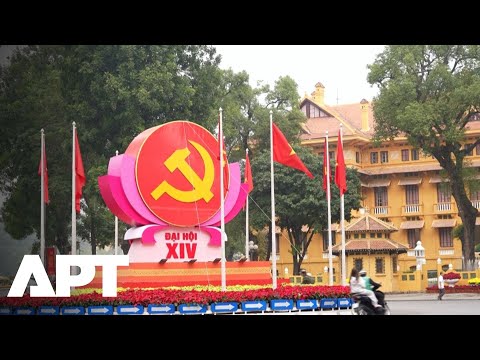
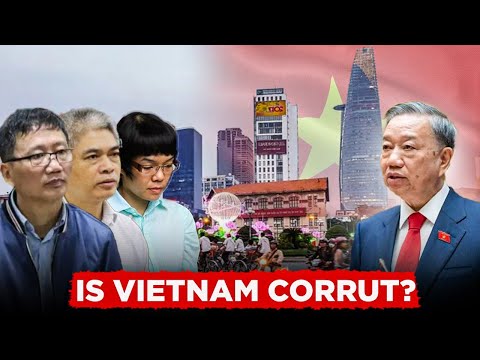
Vietnam's 14th Party Congress concluded January 23, 2026, unanimously re-electing Tô Lâm as General Secretary with all 180 Central Committee votes. A merger of party chief and state presidency (which would make Lâm Vietnam's most powerful leader since Hồ Chí Minh) was not finalized.
That decision awaits the National Assembly's first session in April 2026, after legislative elections on March 15. The 19-member Politburo's composition points toward Lâm assuming the presidency. The delay preserves procedural legitimacy, though whether Vietnam will formally abandon its four-pillar collective leadership model is still open.
Lâm's consolidation accelerated through the Congress. Former central bank governor Lê Minh Hưng, 55, is positioned to succeed retiring Prime Minister Phạm Minh Chính pending National Assembly approval. Chính retired after weathering unprecedented upheaval that removed two general secretaries, four presidents, and four Secretariat members since 2021.
The Congress adopted sweeping economic targets: 10% annual GDP growth through 2030, a digital economy at 30% of GDP, and per-capita income of $8,500 by decade's end. These targets codify the "Đổi Mới 2.0" reforms. The reforms cut 150,000 government jobs, merged 63 provinces into 34, and elevated the private sector as the economy's primary engine.
Questions about this story
Free account needed to ask — your question is kept and asked for you right after sign-up. Answers are public.
No questions yet — be the first to ask.
Key Indicators
30%
Digital Economy Target
Share of GDP by 2030, up from current ~15%
$8,500
Per-Capita GDP Target
By 2030, qualifying Vietnam as upper-middle-income
180/180
Unanimous Re-election
Central Committee votes for Lâm as General Secretary
Images from Openverse under Creative Commons licenses.
Videos from YouTube.
Voices
Curated perspectives — historical figures and your fellow readers.
G. K. Chesterton
(1874-1936) ·Edwardian · satire
Fictional AI pastiche — not real quote.
"The Vietnamese Communists discover what every medieval abbot knew: that you cannot have collective leadership without a leader, and that calling a man General Secretary instead of Emperor does not make him less of one. They delay the coronation to preserve "procedural legitimacy," which is rather like a man who, having decided to jump off a cliff, pauses on the edge to check that his shoelaces are properly tied."
0% found this insightful
Ever wondered what historical figures would say about today's headlines?
Sign up to generate historical perspectives on this story.
33 events
Latest: February 5th, 2026 · 7 months ago
Showing 8 of 33
JK to step
Tap a bar to jump to that date
Jump to
February 2026
General Secretary Lâm Departs for Laos State Visit
LatestDiplomatic
General Secretary Tô Lâm and high-ranking delegation including Prime Minister Phạm Minh Chính, National Assembly Chairman Trần Thanh Mẫn, and five additional Politburo members depart Hanoi for state visit to Laos, marking Lâm's first foreign trip as General Secretary of the 14th term.
Lâm and Thongloun Hold Summit in Vientiane
Diplomatic
General Secretary Lâm and Lao General Secretary and President Thongloun Sisoulith hold summit meeting in Vientiane. Leaders pledge to raise bilateral trade to $10 billion, strengthen economic linkages, and enhance coordination on regional and global issues. Both sides commit to implementing high-level agreements from December 2025 and outcomes of Thongloun's January visit to Vietnam.
Party Leaders Pay Tribute to Hồ Chí Minh on 96th Anniversary
Ceremonial
General Secretary Lâm, State President Lương Cường, Prime Minister Chính, and National Assembly Chairman Trần Thanh Mẫn lay wreath at Hồ Chí Minh Mausoleum to mark the 96th founding anniversary of the Communist Party of Vietnam (February 3, 1930).
Communist Party Museum Groundbreaking Ceremony
Ceremonial
General Secretary Lâm and Prime Minister Chính attend groundbreaking ceremony for Museum of the Communist Party of Vietnam in Hanoi. Museum designed as "steel rampart rising up" with advanced digital technologies, scheduled for completion in Q2 2029 and inauguration on the Party's 100th anniversary February 3, 2030.
Lâm Visits Former General Secretary Nông Đức Mạnh
Diplomatic
General Secretary Lâm pays pre-Tết visit to former Party General Secretary Nông Đức Mạnh, extending Lunar New Year greetings on the occasion of the Party's 96th founding anniversary.
January 2026
State Visit to Laos Announced for February 5-6
Diplomatic
General Secretary Lâm to pay state visit to Laos February 5-6 at invitation of Lao President Thongloun Sisoulith. Will be Lâm's first foreign trip in 2026 and first foreign visit since re-election at 14th Congress. Visit aims to open "new phase of development" for Vietnam-Laos relations focusing on strategic cohesion.
Secretariat Membership Formally Assigned
Administrative
General Secretary Lâm signs Decision No. 05-QDNS/TW assigning five Politburo members to the 14th Secretariat: Lâm himself, standing member Trần Cẩm Tú, Organization Commission Chairman Lê Minh Hưng, Vietnam Fatherland Front President Bùi Thị Minh Hoài, and Nguyễn Trọng Nghĩa. Structure formalizes internal coordination mechanisms for the new term.
Lâm Receives Xi Jinping's Special Envoy
Diplomatic
General Secretary Lâm receives Liu Haixing, Member of CPC Central Committee and head of its International Department, as President Xi's special envoy congratulating the 14th Congress success. Meeting reinforces Vietnam-China party-to-party ties.
Phone Talks with South Korean President Lee Jae Myung
Diplomatic
Lâm and President Lee discuss strengthening Comprehensive Strategic Partnership, including defense industry cooperation and military trade projects. Lee thanks Vietnam for assistance following death of former South Korean PM Lee Hae-chan in Ho Chi Minh City.
Phone Talks with Singapore PM Lawrence Wong
Diplomatic
Lâm proposes establishing Party-to-Party dialogue mechanism with Singapore's People's Action Party. Leaders discuss expanding Vietnam-Singapore Industrial Parks to 30 locations by 2026, marking project's 30th anniversary.
Vietnam-EU Relations Elevated to Comprehensive Strategic Partnership
Diplomatic
State President Lương Cường and European Council President António Costa announce upgrade to comprehensive strategic partnership, Vietnam's first with an EU member. Partnership places EU alongside US, China, and Russia in diplomatic status.
Xi Jinping Calls Lâm to Congratulate Re-election
Diplomatic
Chinese President Xi Jinping calls General Secretary Lâm to congratulate him on 14th Congress success and re-election. Xi expresses support for Vietnam's development goals; Lâm reaffirms one-China policy and support for Belt and Road Initiative.
Congress Concludes; Resolution Adopted Unanimously
Political Event
14th Congress adopts political and economic resolution with 100% delegate approval. Resolution sets 10% annual growth target, $8,500 per-capita GDP by 2030, and digital economy at 30% of GDP.
19-Member Politburo Announced
Appointment
Congress announces 19-member Politburo: 10 re-elected from 13th term (including Lâm, Defense Minister Phan Văn Giang, Public Security Minister Lương Tâm Quang) and 9 new members. Composition signals Lâm's continued dominance.
Lương Cường Retires from Central Committee
Resignation
State President Lương Cường confirmed among 13th Central Committee members not re-elected to 14th term, completing retirement from party leadership bodies. Clears path for Lâm to reclaim presidency.
180-Member Central Committee Elected
Appointment
Congress elects 14th Central Committee comprising 180 full members and 20 alternate members. Prime Minister Chính notably absent, confirming retirement from central leadership.
Lâm Pledges Continued Anti-Corruption Drive
Political Event
In congress address, General Secretary vows "all wrongdoings must be dealt with" while reaffirming 10% annual GDP growth target for 2026-2030.
14th Party Congress Opens
Political Event
1,586 delegates convene in Hanoi for week-long congress to confirm leadership and set 10% GDP growth target for 2026-2030.
July 2025
63 Provinces Merged into 34
Administrative Reform
Vietnam implements most extensive administrative restructuring in decades, eliminating district level entirely.
May 2025
Resolution 68 Elevates Private Sector
Policy Decision
Politburo designates private sector as "most important driving force" of the economy, marking ideological shift from SOE dominance.
February 2025
National Assembly Approves Government Restructuring
Legislation
Parliament formally adopts new cabinet structure cutting ministries from 22 to 17.
November 2024
Central Committee Approves Bureaucratic Restructuring
Policy Decision
Lâm's "revolution" to cut ministries, eliminate districts, and reduce workforce by 20% approved.
October 2024
Lương Cường Becomes President
Appointment
Military general takes presidency as Lâm relinquishes the role to focus on party leadership.
August 2024
Tô Lâm Elected General Secretary
Appointment
Central Committee elects Lâm with 100% approval, making him Vietnam's paramount leader.
July 2024
General Secretary Nguyễn Phú Trọng Dies
Death
Vietnam's longest-serving party chief dies at 80 after 13 years in power, triggering succession.
May 2024
Tô Lâm Elected President
Appointment
National Assembly elects Lâm as Vietnam's 13th president, succeeding the ousted Thưởng.
National Assembly Chair Vương Đình Huệ Removed
Resignation
Fifth Politburo member to fall this term; Lâm's chief rivals largely eliminated.
March 2024
President Võ Văn Thưởng Resigns
Resignation
Second president forced out in 14 months, linked to real estate corruption scandal during his time as provincial party secretary.
March 2023
Võ Văn Thưởng Becomes President
Appointment
At 52, becomes Vietnam's youngest president since reunification.
January 2023
President Nguyễn Xuân Phúc Forced Out
Resignation
First sitting president forced to resign in Vietnam's modern history, held responsible for subordinates' corruption.
January 2022
Anti-Corruption Campaign Intensifies
Investigation
"Blazing furnace" investigations accelerate, targeting COVID-era repatriation flights and test kit procurement scandals.
April 2016
Tô Lâm Becomes Public Security Minister
Appointment
National Assembly confirms Lâm as minister; he subsequently becomes deputy head of the anti-corruption steering committee.
December 1986
Đổi Mới Reforms Launched
Economic Policy
6th Party Congress initiates transition from command economy to socialist-oriented market economy, ending Vietnam's economic isolation.
Discussed by: Bloomberg, South China Morning Post, The Diplomat; most analysts treat this as the base case
Congress confirms Lâm as General Secretary and approves his simultaneous assumption of the presidency after Lương Cường retires. Vietnam's four-pillar system collapses into a China-style model where one person leads both party and state. Military leaders reportedly accept the arrangement in exchange for autonomy over senior officer promotions. Lâm consolidates personal authority unprecedented since the founding era.
2
Congress Blocks Merger; Four Pillars Preserved
Possible
Discussed by: The Vietnamese, Radio Free Asia analysts, some military-linked commentators
Internal resistance—particularly from military factions unwilling to cede the presidency—proves stronger than expected. Congress confirms Lâm as General Secretary but elects a separate president, maintaining the collective leadership tradition. Lâm remains the dominant figure but within constitutional constraints. This outcome would suggest the anti-corruption campaign's decapitation of rivals didn't eliminate institutional counterweights.
Discussed by: CSIS, Fulcrum analysts, some foreign investors
The ambitious 10% growth target runs into structural constraints: bureaucratic paralysis from rapid government restructuring, delayed public investment disbursement, and continued SOE resistance to private-sector competition. Growth stays in the 6-7% range. Foreign investors recalibrate expectations, and political blame games emerge over missed targets.
4
Lâm Era Delivers Sustained High Growth; 'Đổi Mới 2.0' Succeeds
Uncertain
Discussed by: MUFG Research, VinaCapital, government-aligned media
Streamlined government, elevated private sector, and massive infrastructure investment produce sustained 8-10% growth. Vietnam becomes a $500 billion economy by 2030, transitions to upper-middle-income status, and establishes domestic semiconductor manufacturing. Power consolidation is validated by economic results, normalizing the new political model.
Historical Context
3 moments from history that rhyme with this story — and how they unfolded.
1 of 3
December 1986
Vietnam's Đổi Mới Reforms (1986)
Facing 700% inflation, Soviet aid cuts, and economic crisis, the 6th Party Congress launched Đổi Mới ("renovation"). The reforms dismantled collective farming, permitted private enterprise, welcomed foreign investment, and transitioned Vietnam from a command economy to a socialist-oriented market economy.
Then
Vietnam went from perpetual food shortages to exporting 1.4 million tons of rice by 1989.
Now
GDP grew five-fold in the 1990s. Vietnam joined ASEAN (1995), signed a US trade pact (2000), and entered the WTO (2007). Today it hosts $503 billion in cumulative FDI.
Why this matters now
Lâm's reforms are described as "Đổi Mới 2.0"—the most significant structural changes since 1986. Like then, the party is betting that economic liberalization can proceed without political liberalization.
2 of 3
June 1987 – February 1993
South Korea's Democratic Transition (1987-1993)
After decades of military-backed authoritarian rule, mass protests forced constitutional reforms allowing direct presidential elections. General Roh Tae-woo won the 1987 election but continued liberalization. By 1993, the first civilian president took office.
Then
Rapid democratization while maintaining economic growth.
Now
South Korea became a consolidated democracy with robust civil society, though occasional corruption scandals persist.
Why this matters now
Vietnam's one-party system faces no similar pressure—the party maintains tight control over civil society. But South Korea's trajectory shows that economic development and concentrated power can eventually generate demands for political change that even effective authoritarian systems struggle to contain.
3 of 3
March 2018
China's Term Limit Removal (2018)
China's National People's Congress voted 2,958 to 2 to remove presidential term limits, enabling Xi Jinping to rule indefinitely. The amendment reversed Deng Xiaoping-era reforms designed to prevent one-man rule after the chaos of Mao's reign. Xi simultaneously enshrined his political thought in the constitution and created an all-powerful anti-corruption agency.
Then
Xi consolidated power without meaningful opposition; censors blocked criticism online.
Now
China's collective leadership era ended. Xi remains in power, with no clear succession mechanism. The model now influences other single-party states.
Why this matters now
Lâm's proposed merger explicitly follows the Xi model. If approved, Vietnam would join China and Laos in having a single leader atop both party and state, abandoning its distinctive four-pillar system.