

Pull to refresh
Logo
Microsoft offers buyouts to about a quarter of its workforce

Microsoft offers buyouts to about a quarter of its workforce

Money Moves

Voluntary exit offer covers about 60,000 employees as Microsoft's own forecast of AI infrastructure spending outruns its outlook for buyout uptake

Overview

Updated Nov 2

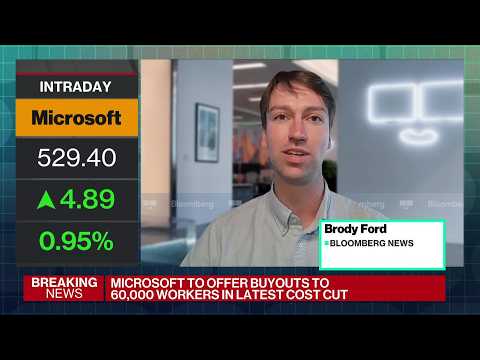
Microsoft is offering buyouts to about 60,000 employees, roughly 27% of its workforce. Eligible staff at level 70 and below in four countries must decide by early December, and those who accept leave December 31.

Chief Financial Officer Amy Hood wrote in an internal memo that she expects "very few people" to accept. A Microsoft spokesperson estimated fewer than 5% will. The company reported $45.2 billion in September-quarter capital spending, below the more than $50 billion it had projected in July. It says the offer does not replace layoffs, which remain possible.

Why it matters

A quarter of Microsoft's workforce is being paid to leave so the company can fund AI data centers — a sign the AI buildout now runs through tech payrolls.

Questions about this story

Free account needed to ask — your question is kept and asked for you right after sign-up. Answers are public.

No questions yet — be the first to ask.

Key Indicators

60,000
Employees eligible for buyouts
About 27% of Microsoft's 223,000-person workforce, across the US, Canada, India, and the UK.
Under 5%
Expected share who accept
A Microsoft spokesperson's estimate, reported October 30. That implies roughly 3,000 or fewer of the 60,000 eligible.
$45.2B
September-quarter capital spending
Reported actual, mostly for AI chips and data centers. Microsoft had projected more than $50 billion in July.
223,000
Total Microsoft workforce
Full-time headcount on June 30 was down from 228,000 a year earlier, before the July layoffs.

Voices

Curated perspectives — historical figures and your fellow readers.

Sign up to generate historical perspectives on this story.

People Involved

Organizations Involved

Timeline

2025 December 2026

11 events Latest: October 30th, 2026 · 1 week ago Showing 8 of 11
Tap a bar to jump to that date
  1. Participating employees depart

    Upcoming Transition

    Employees who accept the offer leave Microsoft at the end of the year.

  2. Employee decision deadline

    Upcoming Deadline

    Eligible employees must decide whether to accept the buyout offer by early December.

  3. Microsoft estimates under 5% uptake

    Latest Estimate

    A Microsoft spokesperson said fewer than 5% of the roughly 60,000 eligible employees are expected to accept. The company has not set a departure target.

  4. CFO expects few employees to accept

    Statement

    In an internal memo reported by Business Insider, Hood wrote that Microsoft expects "very few people" to select the offer because of growth opportunities at the company.

  5. Quarterly profit reported at $36.6 billion

    Earnings

    Microsoft reports quarterly revenue of $92.3 billion, up 19%, and profit above $36.6 billion for the three months to September. Capital spending for the quarter was $45.2 billion.

  6. Voluntary Exit Offer to 60,000 employees

    Program Launch

    Microsoft offers buyouts to about 60,000 employees across the US, Canada, India, and the UK.

  7. 4,800 layoffs and $50B quarterly capex projection

    Restructuring

    Microsoft announces 4,800 layoffs and projects September-quarter capital spending above $50 billion.

  8. First Voluntary Retirement Program launched

    Program Launch

    Microsoft offers retirement packages to eligible U.S. employees. Roughly 30% take the offer, per GeekWire.

  9. Nadella addresses layoff-and-profit gap

    Statement

    CEO Satya Nadella talks to employees about the disconnect between record results and job cuts.

  10. Microsoft begins corporate workforce cuts

    Restructuring

    Microsoft starts reducing its corporate workforce with waves of layoffs aimed at flatter, nimbler teams.

  11. About 15,000 laid off over several months

    Restructuring

    Microsoft cuts around 15,000 employees, including about 3,200 in Washington state, across the year.

Scenarios

1

Microsoft sheds 20,000-plus via buyouts, avoids new layoffs

Possible Resolves by Feb 28, 2027

Discussed by: Based on the roughly 30% uptake of the April retirement program, per GeekWire

If buyout acceptance mirrors the April retirement program, tens of thousands leave voluntarily. Microsoft keeps headcount roughly flat through selective hiring and reskilling, with no further involuntary cuts. Departures of that scale would trim the corporate layers the company says it wants to remove.

2

Buyouts undersubscribed, Microsoft announces new involuntary layoffs

Possible Resolves by Q1 2027

Discussed by: Seattle Times, noting layoffs may follow if too few take the offer

If acceptance is weak, Microsoft follows with performance-based layoffs, as it did in July 2026. The company has said participating divisions will keep meeting workforce needs, and management has shown it will use involuntary cuts to reach targets.

3

Buyouts land in the middle; headcount holds roughly flat

Likely Resolves by Aug 31, 2027

Discussed by: Microsoft leadership, including Brad Smith's comments on reskilling

Acceptance falls between the extremes, and hiring into new roles offsets most departures. Microsoft keeps its total workforce within a few percent of 223,000, consistent with the pattern of the past two years where layoffs and buyouts barely moved net headcount.

4

Fewer than 3,000 employees take the buyout

Likely Resolves by End of 2026

Discussed by: Microsoft spokesperson's under-5% estimate, and CFO Amy Hood's internal memo

If uptake matches Microsoft's own estimate, about 3,000 or fewer of the 60,000 eligible employees would leave. The company says the offer is not a replacement for layoffs, so any further cuts would come separately.

Historical Context

3 moments from history that rhyme with this story — and how they unfolded.

1991-1993

IBM restructuring (1991-1993)

As mainframe revenue collapsed, IBM lost roughly $8 billion in 1993 alone and cut tens of thousands of jobs, about 60,000 that year, using early retirement and voluntary programs.

Then

Workforce fell from about 370,000 to roughly 300,000 by the mid-1990s, and the share price kept falling.

Now

The cuts helped fund IBM's pivot to services under Lou Gerstner, which revived the company over the following decade.

Why this matters now

A dominant tech incumbent paying people to leave to fund a platform shift — the same playbook Microsoft is running to finance its AI buildout.

January 2023

Microsoft layoffs (January 2023)

Microsoft announced plans to cut about 10,000 jobs, roughly 5% of its workforce at the time, as cloud growth slowed and the economy wobbled.

Then

The cuts were spread over months and drew widespread industry attention as a bellwether for tech cost-cutting.

Now

Microsoft kept hiring in AI even as it shed other roles, a pattern that continued into the current restructuring.

Why this matters now

The same company's recent precedent for large reductions — the 2026 buyout program is far larger in scope and voluntary in design.

May 2012

Hewlett-Packard layoffs (2012)

HP announced plans to eliminate about 27,000 jobs, roughly 8% of its staff, offering early retirement and buyouts as it struggled with a declining PC market and turned toward software and services.

Then

HP shrank further in subsequent years as the turnaround under Meg Whitman continued.

Now

The company ultimately split into two firms in 2015, showing how a platform transition can reshape a company's entire structure.

Why this matters now

A bellwether tech employer using voluntary exits during a platform transition — showing both the ambition and the mixed results of such restructurings.

Sources

(12)