

Pull to refresh
Logo
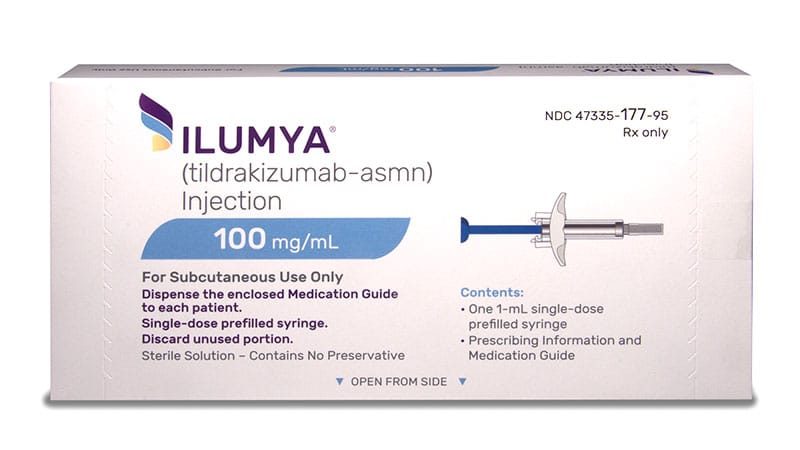
FDA approves ILUMYA for psoriatic arthritis, adding an in-office IL-23 option

FDA approves ILUMYA for psoriatic arthritis, adding an in-office IL-23 option

New Capabilities

Sun Pharma's tildrakizumab, a plaque psoriasis drug since 2018, is the third IL-23 inhibitor cleared for joint disease, and its pooled trial data are now public.

Overview

Updated Nov 2

The Food and Drug Administration approved ILUMYA for adults with active psoriatic arthritis on October 30, 2026. The drug, tildrakizumab, had been cleared since 2018 only for plaque psoriasis. About 2.4 million Americans have psoriatic arthritis, which causes joint pain and stiffness and can permanently damage joints.

Pooled results from the two phase 3 trials, presented at ACR Convergence 2026 in Orlando, showed 38.8% of patients on tildrakizumab reached the ACR20 response threshold at week 24, against 24.4% on placebo. ACR50 and ACR70 responses were also higher, and 41.0% of patients with psoriasis on at least 3% of body surface reached PASI75 versus 10.9% on placebo. ILUMYA is the third IL-23 inhibitor cleared for the joint disease, after Tremfya and Skyrizi, and Sun Pharma says it is the only one given exclusively by a healthcare provider.

Why it matters

Adults with psoriatic arthritis who cannot self-inject now have an IL-23 option a clinician can give in the office.

Questions about this story

Free account needed to ask — your question is kept and asked for you right after sign-up. Answers are public.

No questions yet — be the first to ask.

Key Indicators

2.4 million
Americans living with psoriatic arthritis
Company estimate cited in the approval announcement.
806
Adults enrolled in the two phase 3 trials
Trial PsA2 and Trial PsA3 combined.
38.8%
ACR20 response at week 24, pooled tildrakizumab arms
Pooled INSPIRE-1 and INSPIRE-2 result presented at ACR Convergence 2026.
24.4%
ACR20 response at week 24, pooled placebo arms
Same pooled analysis.
14.4
Percentage-point gap in ACR20 response
Pooled difference between tildrakizumab and placebo.
21.5%
ACR50 response at week 24, pooled tildrakizumab arms
Placebo: 12.5% (P = .001).
41.0%
PASI75 in patients with psoriasis on at least 3% of body surface
Placebo: 10.9% (P < .0001).
100 mg
Recommended PsA dose for patients without coexistent plaque psoriasis
Given every 12 weeks; patients with both conditions also get a week 4 dose.

Voices

Curated perspectives — historical figures and your fellow readers.

Sign up to generate historical perspectives on this story.

People Involved

Organizations Involved

Timeline

2018 November 2026

6 events Latest: Yesterday
Tap a bar to jump to that date
  1. Pooled INSPIRE data presented at ACR Convergence 2026

    Latest Conference

    The pooled analysis of the two phase 3 trials was presented at the Orlando meeting, held November 6-11. At week 24, ACR20 was 38.8% on tildrakizumab versus 24.4% on placebo, with higher ACR50 and ACR70 rates and PASI75 of 41.0% versus 10.9%.

  2. FDA approves ILUMYA for active psoriatic arthritis

    Regulatory

    The supplemental approval covers adults with active psoriatic arthritis, expanding a label limited to plaque psoriasis since 2018.

  3. FDA accepts ILUMYA application for psoriatic arthritis

    Regulatory

    The agency took in Sun Pharma's supplemental biologics license application, with a target action date of October 29, 2026.

  4. Skyrizi follows for psoriatic arthritis

    Regulatory

    AbbVie's risankizumab became the second IL-23 inhibitor approved for the disease.

  5. Tremfya becomes first IL-23 approved for psoriatic arthritis

    Regulatory

    Johnson & Johnson's guselkumab crossed over from plaque psoriasis into joint disease, opening the class beyond skin.

  6. ILUMYA cleared for plaque psoriasis

    Regulatory

    The FDA approved tildrakizumab for adults with moderate-to-severe plaque psoriasis who are candidates for systemic therapy or phototherapy.

Scenarios

1

ILUMYA builds an in-office niche in psoriatic arthritis

Possible Resolves by Q3 2027

Discussed by: Sun Pharma executives and dermatology trade coverage

Sun Pharma's pitch is that some patients need or prefer a clinician to give the injection. If that segment is real, ILUMYA prescriptions should grow without taking much share from self-injected IL-23s. The test is whether the company's own filings attribute revenue growth to the psoriatic arthritis launch.

2

Payers put a TNF-failure step in front of ILUMYA

Possible Resolves by Q2 2027

Discussed by: Payer formulary analysts and rheumatology practice groups

Psoriatic arthritis formularies often require patients to try a TNF inhibitor first. If the largest pharmacy benefit managers apply that rule to ILUMYA, the in-office advantage shrinks to patients who have already failed older biologics.

3

A new safety warning lands on the ILUMYA label

Unlikely Resolves by Oct 30, 2027

Discussed by: FDA labeling and rheumatology safety reviewers

The trials found no new safety signals, and the most common psoriatic arthritis adverse reactions were upper respiratory infections and COVID-19. A boxed warning or new contraindication would change the risk-benefit calculation for a drug given in clinics.

4

Full INSPIRE results reach a peer-reviewed journal

Likely Resolves by Nov 11, 2027

Discussed by: Medical Daily, which noted no peer-reviewed publication of the full results exists

The approval announcement carried no response rates, and the week 24 figures so far come from a conference abstract and the FDA label. A peer-reviewed paper would let clinicians compare tildrakizumab with other IL-23 inhibitors on joint, skin, spine and tendon outcomes, and see how long responses lasted.

Historical Context

3 moments from history that rhyme with this story — and how they unfolded.

2020

Tremfya becomes the first IL-23 approved for psoriatic arthritis (2020)

Johnson & Johnson's guselkumab, sold as Tremfya, was already approved for plaque psoriasis. In 2020 it became the first IL-23 inhibitor cleared for psoriatic arthritis, taking the class beyond skin disease.

Then

Dermatologists and rheumatologists gained an IL-23 option for joint symptoms.

Now

It set the template ILUMYA now follows: a psoriasis drug expanding into psoriatic arthritis.

Why this matters now

ILUMYA is arriving six years later into a category Tremfya created.

2022

Skyrizi follows for psoriatic arthritis (2022)

AbbVie's risankizumab, sold as Skyrizi, became the second IL-23 inhibitor approved for psoriatic arthritis. It joined TNF inhibitors and IL-17 inhibitors in the treatment mix.

Then

The IL-23 class became a standard alternative rather than a single-product curiosity.

Now

Two established competitors now define the category ILUMYA is entering.

Why this matters now

ILUMYA needs a differentiator against two entrenched IL-23 rivals. Sun Pharma's is provider administration.

2018

ILUMYA approved for plaque psoriasis (2018)

The FDA cleared tildrakizumab for adults with moderate-to-severe plaque psoriasis who are candidates for systemic therapy or phototherapy. For eight years, the US label covered only that skin condition.

Then

Sun Pharma got a foothold in psoriasis biologics.

Now

The drug's US label stayed limited to skin disease until the 2026 joint approval.

Why this matters now

The psoriatic arthritis approval is the first expansion of the US label beyond plaque psoriasis.

Sources

(12)