
Pull to refresh
Logo
AI detects heart failure and valve disease from a standard ECG in under two seconds

AI detects heart failure and valve disease from a standard ECG in under two seconds

New Capabilities

Imperial College London algorithm trained on 10.6 million ECGs could fast-track patients who wait months for an ultrasound

Yesterday: Optimist Daily highlights screening potential

Overview

Updated Yesterday

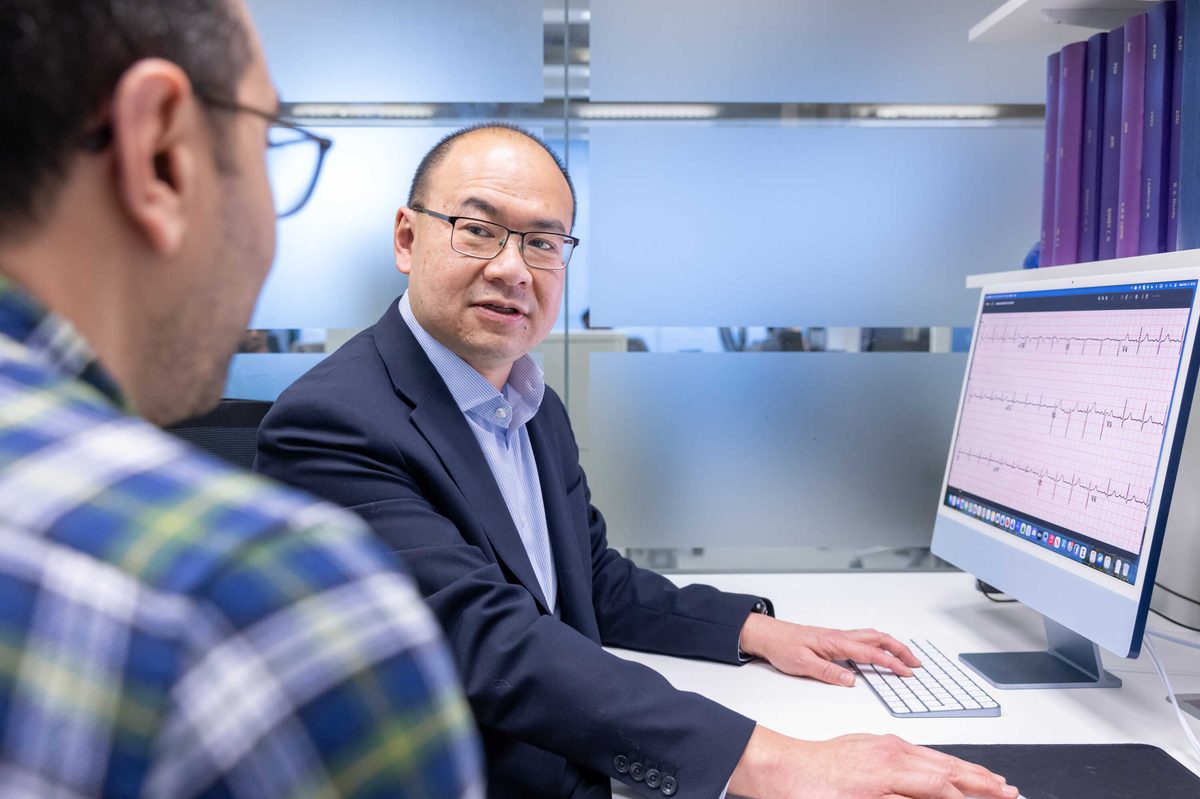
An AI tool developed at Imperial College London can spot heart failure and heart valve disease from a standard electrocardiogram (ECG), a test that has been in clinical use for a century. In a trial of 67,000 US patients, it flagged up to 81 percent of heart failure cases and 90 percent of valve disease cases — in under two seconds.

Today those conditions are diagnosed with an echocardiogram, an ultrasound scan that patients in many health systems wait months to receive. The tool doesn't make the diagnosis; it decides who gets a scan first. The team is now testing it on 590 NHS patients in London and Bristol, and says routine use is possible within two years.

Why it matters

If it clears trials, the test run a billion times a year could fast-track the heart patients who need treatment most.

Questions about this story

Free account needed to ask — your question is kept and asked for you right after sign-up. Answers are public.

No questions yet — be the first to ask.

Key Indicators

81%
Heart failure cases detected (up to)
The AI identified reduced pumping function in up to 81 percent of patients in the large US validation group.
90%
Heart valve disease cases detected (up to)
The AI identified aortic stenosis in up to 90 percent of patients in the smaller US group.
67,000
Patients in US validation trial
Two groups — 5,442 and 61,520 patients — whose echocardiogram results were compared with the AI's ECG analysis.
10.6M
ECGs in the training set
The model learned patterns linking ECG signals to heart conditions from 10.6 million traces with clinical reports.
2 sec
Time to analyze one ECG
The algorithm produces a risk readout in under two seconds, fast enough to run on every ECG a hospital performs.

Voices

Curated perspectives — historical figures and your fellow readers.

Ever wondered what historical figures would say about today's headlines?

Sign up to generate historical perspectives on this story.

People Involved

Organizations Involved

Timeline

August 2026 September 2026

4 events Latest: Yesterday
Tap a bar to jump to that date
  1. Optimist Daily highlights screening potential

    Latest Media coverage

    Coverage emphasizes the tool's role in flagging high-risk patients for faster echocardiograms.

  2. British Heart Foundation publishes trial details

    Statement

    BHF releases technical breakdown, AUC scores, and the 590-patient NHS trial plan.

  3. Guardian reports 'superhuman AI' tool

    Media coverage

    First major coverage describes the AI spotting heart disease in less than two seconds.

  4. ESC Congress opens in Munich

    Conference

    Imperial College team presents AI ECG results to thousands of cardiology delegates.

Scenarios

1

AI ECG clears NHS trial, reaches routine use by 2028

Possible Resolves by End of 2028

Discussed by: The Imperial College research team (El-Medany, Ng) and the British Heart Foundation

The 590-patient NHS trial in London and Bristol confirms the model's accuracy in UK patients. The team secures regulatory clearance and integrates the tool into hospital ECG workflows, running it on every ECG performed. The stated target is routine use within two years of the Munich presentation.

2

NHS trial shows performance dip, adoption slips

Unlikely Resolves by Aug 31, 2028

Discussed by: Caveats in the research: the model was trained on US data, and UK ECG machines and patient populations differ

The algorithm performs worse on UK ECGs than on US data. Different equipment, filtering settings, and patient demographics degrade accuracy. The team must retrain the model and repeat trials, pushing routine use beyond the two-year goal and delaying the promised screening benefit.

3

Handheld AI ECG reader enters clinical trials

Likely Resolves by End of 2027

Discussed by: Dr. Ahmed El-Medany, who named portable devices as the next research question

Strong initial results lead the team to pair the algorithm with a compact, portable ECG device designed for community and primary care settings. If it works, screening for heart failure and valve disease moves out of hospitals entirely, reaching patients who never get a referral for an ultrasound.

Historical Context

3 moments from history that rhyme with this story — and how they unfolded.

November 2017 - March 2019

Apple Heart Study (2017-2019)

Stanford Medicine worked with Apple to enroll 419,000 participants in a study using the Apple Watch's optical heart sensor to detect irregular pulses suggesting atrial fibrillation, a common heart rhythm disorder. The research showed a consumer wearable could flag a condition many people didn't know they had.

Then

The study reported a 0.84 percent rate of irregular pulse notifications, with most flagged participants confirmed to have atrial fibrillation.

Now

Apple's ECG app gained FDA clearance in 2018, demonstrating how AI-driven screening moves from research to regulated devices.

Why this matters now

Shows the typical path an AI screening tool travels: research validation, regulatory clearance, then deployment. The Imperial ECG tool is at the same early stage Apple's watch was in 2017.

March 2019

Mayo Clinic's AI-ECG for weak heart pump (2019)

Cardiologist Paul Friedman's team at Mayo Clinic trained an AI on tens of thousands of 10-second ECGs to detect a weak heart pump (low left ventricular ejection fraction), a hallmark of heart failure. The model read signals invisible to the human eye and flagged patients with impaired pump function, published in Nature Medicine.

Then

The study showed the concept worked, but it was a proof of principle, not a deployed tool.

Now

It established that AI can extract hidden cardiac information from a standard ECG, laying the groundwork for the Imperial College tool.

Why this matters now

This is the direct predecessor: the same condition (reduced pumping function), the same test (standard ECG), and the same approach (deep learning on ECG waveforms). The Imperial tool extends the concept to valve disease and scales it to millions of records.

April 2021 - August 2023

MASAI trial: AI-assisted mammography (2023)

Swedish researchers randomized 80,000 women to AI-supported or standard mammography screening. The AI-assisted arm detected 20 percent more cancers (244 vs 203) with a lower recall rate, published in The Lancet Oncology. It was the first large randomized trial showing AI improves a standard screening test in real clinical practice.

Then

The AI group caught more cancers without increasing false alarms, prompting calls for broader adoption.

Now

It set the evidence bar for AI screening tools: randomized controlled trials, not retrospective validation.

Why this matters now

The Imperial ECG tool has replicated the mammography AI's retrospective results. To reach routine use, it must clear the same hurdle MASAI did: prove real-world benefit in a prospective trial, which the 590-patient NHS study begins to address.

Sources

(6)