

Pull to refresh
Logo
AI-designed IPF drug enters Phase III trial, a first for generative AI

AI-designed IPF drug enters Phase III trial, a first for generative AI

New Capabilities

Rentosertib targets TNIK, a kinase AI linked to fibrosis; 52-week readout to come

2 days ago: Insilico announces Phase III initiation

Overview

Updated Yesterday

Insilico Medicine dosed the first patient this week in a Phase III trial of Rentosertib, a drug for the progressive lung disease idiopathic pulmonary fibrosis. It's the first medicine with both an AI-identified target and an AI-designed molecule to reach this stage of testing.

The 320-patient, 52-week study runs at 47 hospitals across China and compares Rentosertib against placebo on the rate of lung-function decline. The outcome will test the core claim of AI drug discovery: that generative models can find treatments faster and cheaper than traditional chemistry.

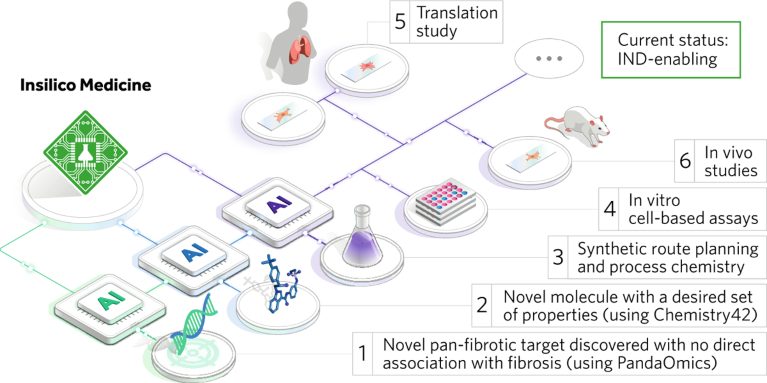
Rentosertib inhibits TNIK, a kinase no one had previously tied to fibrosis. Insilico's PandaOmics platform flagged the target by scoring genes with multi-omics data from fibrotic tissue — a target class not previously associated with the disease.

Why it matters

If Rentosertib succeeds, it validates that generative AI can discover viable medicines — a claim the industry has made for years without proof.

Questions about this story

Free account needed to ask — your question is kept and asked for you right after sign-up. Answers are public.

No questions yet — be the first to ask.

Key Indicators

320
Patients enrolled in Phase III trial
Across 47 centers in China, randomized to Rentosertib or placebo for 52 weeks.
52
Weeks of treatment in study
Primary endpoint measures the annual rate of decline in forced vital capacity.
+98.4 mL
Phase IIa FVC change, 60 mg arm
Mean forced vital capacity change at 12 weeks versus -20.3 mL for placebo.
47
Clinical trial sites
Hospitals across China recruiting for GENESIS-IPF-3.

Voices

Curated perspectives — historical figures and your fellow readers.

Ever wondered what historical figures would say about today's headlines?

Sign up to generate historical perspectives on this story.

People Involved

Organizations Involved

Timeline

February 2023 September 2026

6 events Latest: 2 days ago
Tap a bar to jump to that date
  1. Insilico announces Phase III initiation

    Latest Announcement

    Company confirms Rentosertib is the first generative-AI-driven drug to enter Phase III testing.

  2. First patient dosed in Phase III

    Clinical Trial

    Peking Union Medical College Hospital doses first GENESIS-IPF-3 patient; Shanghai Pulmonary Hospital enrolls its first the same day.

  3. CDE clears IND for inhaled formulation

    Regulatory

    Insilico announces clearance for a Phase I study of inhaled Rentosertib in healthy volunteers and IPF patients.

  4. Phase IIa results published in Nature Medicine

    Publication

    71 patients showed +98.4 mL FVC change at 12 weeks in the 60 mg arm versus -20.3 mL placebo.

  5. China CDE grants Breakthrough Therapy Designation

    Regulatory

    China's Center for Drug Evaluation fast-tracks Rentosertib for IPF.

  6. FDA grants Orphan Drug Designation

    Regulatory

    US Food and Drug Administration designates Rentosertib as an orphan drug for IPF.

Scenarios

1

Rentosertib meets primary endpoint, heads toward approval

Uncertain Resolves by Oct 30, 2029

Discussed by: Insilico Medicine leadership; analysts covering AI drug discovery

Topline data from the 52-week study show a meaningful reduction in annual FVC decline versus placebo with an acceptable safety profile. Insilico files for approval in China first, then in the US and Europe. A successful readout would make Rentosertib the first approved drug discovered and designed by generative AI, a landmark for the field.

2

Phase III trial misses primary endpoint, denting the AI drug thesis

Possible Resolves by Oct 30, 2029

Discussed by: Skeptics of AI drug discovery; analysts citing IPF trial history

The 52-week readout shows no significant difference in FVC decline versus placebo, or an effect too small to matter clinically. IPF has a long history of Phase II-positive drugs failing in larger trials. A miss would hit Insilico's stock and the broader AI drug discovery pitch, though the field would continue with other candidates.

3

Approval lands with conditions attached

Possible Resolves by End of 2030

Discussed by: Regulatory watchers; pulmonologists

The trial meets its endpoint statistically but the effect size is modest or a safety signal emerges. Regulators approve Rentosertib with post-marketing requirements — a larger confirmatory study, a restricted label, or extra monitoring. The precedent still gets set: an AI-designed drug reaches market, but with caveats that temper the victory lap.

4

Rentosertib wins in IPF and expands into other indications

Uncertain Resolves by End of 2031

Discussed by: Insilico Medicine leadership (Alex Zhavoronkov); company proteomics program

A positive Phase III readout would let Insilico move TNIK inhibition beyond IPF. The trial collects proteomic data from participants to see how Rentosertib works and which diseases it might treat. Zhavoronkov has said a win would let the company expand into 'many, many indications,' including other fibrotic and age-related conditions.

Historical Context

3 moments from history that rhyme with this story — and how they unfolded.

2000s–2014

Nintedanib's path to IPF approval (2014)

Boehringer Ingelheim's nintedanib (Ofev) became the second approved IPF drug in 2014, after years of failed candidates in a disease where trials have one of the highest failure rates in drug development.

Then

Nintedanib and pirfenidone became the standard of care, slowing FVC decline without reversing fibrosis.

Now

They set the regulatory precedent: FVC decline rate is the accepted endpoint for IPF trials, which is exactly what GENESIS-IPF-3 measures.

Why this matters now

IPF's brutal trial history is why Rentosertib's Phase III readout carries so much weight — positive Phase II signals have failed here before.

November 2020

AlphaFold 2 (2020)

DeepMind's AlphaFold 2 won the CASP14 protein-folding competition, predicting protein structures with accuracy near experimental methods. The problem had stood unsolved for 50 years.

Then

AlphaFold's predictions were released openly, and the database now covers hundreds of millions of proteins used by researchers worldwide.

Now

It established AI as a legitimate tool for fundamental biology, not just a laboratory curiosity.

Why this matters now

AlphaFold proved AI could predict biology; Rentosertib tests whether AI can deliver a marketable medicine. Both are 'firsts' for AI in their respective domains.

1990s–2010s

Computational drug discovery's unfulfilled promise (1990s–2010s)

Computer-aided drug design methods like molecular docking promised in the 1990s to speed drug discovery. They improved efficiency at the margins but produced few breakthrough drugs.

Then

In silico methods became standard tools, but the industry's core pipeline remained chemistry-driven.

Now

The gap between promise and delivery left the field skeptical of computational claims, a skepticism now aimed at generative AI.

Why this matters now

Rentosertib is the first genuine late-stage test of whether AI delivers where earlier computational waves fell short.

Sources

(15)