


Pull to refresh
Logo
Stored blood samples reveal leukaemia's decades-long evolution

Stored blood samples reveal leukaemia's decades-long evolution

New Capabilities Interactive

A Nature study finds first driver mutations often appear before age 20, then later clones gain up to 100-fold larger growth advantages.

Overview

Updated 2 hours ago

In 47 women who later developed acute myeloid leukaemia (AML), blood samples collected annually for up to a decade before diagnosis show the disease's roots often stretch back more than 50 years. Two-thirds had acquired their first driver mutation before age 20.

The Nature paper quantifies how those early clones grow slowly, then acquire further mutations that make them expand faster. It also finds that complete somatic sweeps, where one clone takes over blood production, are strongly linked to future AML and may be missed by current germline filters.

Why it matters

The findings suggest AML risk could be flagged decades early by detecting somatic sweeps that current genetic filters often discard.

How fast it grows

Three cancer-linked mutations could let one blood cell fill the blood in 2.5 years, not 40

Each row starts as one blood stem cell, the kind that makes all your blood. Drag the years and watch which one fills up first.

1 mutationDoubles about every 2.4 years. Seen in a woman who got it at about 39.
2 of 100,000 cellsFills them all in 40 years
2 mutationsDoubles about every 7 months. Seen in a second woman, after her second mutation at about 67.
20 of 100,000 cellsFills them all in 9.7 years
3 mutationsDoubles about every 8 weeks. The first woman, after two more mutations at about 67. Diagnosed with leukaemia at 70.
81,010 of 100,000 cellsFills them all in 2.5 years

Each square = 2,000 blood stem cells

Three cancer-linked mutations could let one blood cell fill the blood in 2.5 years, not 40 (starting from one, filling 100,000 blood stem cells)
RowDoubles everyTime to fillNoteSource
1 mutation2.4 years40 yearsDoubles about every 2.4 years. Seen in a woman who got it at about 39.Watson et al., bioRxiv 2024 preprint (v1)
2 mutations7 months9.7 yearsDoubles about every 7 months. Seen in a second woman, after her second mutation at about 67.Watson et al., bioRxiv 2024 preprint (v1)
3 mutations2 months2.5 yearsDoubles about every 8 weeks. The first woman, after two more mutations at about 67. Diagnosed with leukaemia at 70.Watson et al., bioRxiv 2024 preprint (v1)
Target: blood stem cells100,000Wellcome Sanger Institute (Lee-Six et al., Nature 2018)

As of 2026-11-11. Doubling times estimated for two women in the team's 2024 preprint; growth varies by gene and person. Our arithmetic: one cell doubling steadily to 100,000, within the 50,000-200,000 estimate. Real clones slow as they fill, so these are minimums. Sources: Watson et al., bioRxiv 2024 preprint (v1), Wellcome Sanger Institute (Lee-Six et al., Nature 2018).

Questions about this story

Free account needed to ask — your question is kept and asked for you right after sign-up. Answers are public.

No questions yet — be the first to ask.

Key Indicators

47
Women with pre-AML samples
The study tracked serial blood samples from 47 women who later developed AML.
249
Pre-AML blood samples
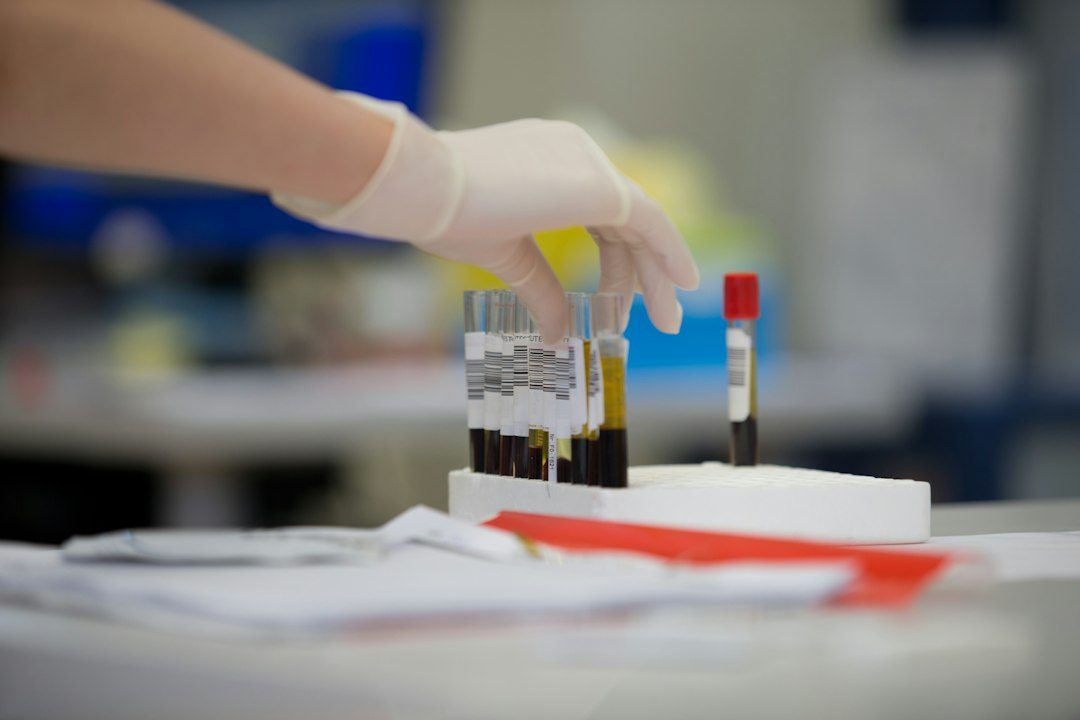
Researchers analyzed 249 serum samples collected before diagnosis.
89%
Pre-AML cases with clonal haematopoiesis
Clonal haematopoiesis was detected in 42 of the 47 women who developed AML.
Two-thirds
First driver mutation before age 20
Most women who developed AML had acquired their first driver mutation by age 20.
107
Odds ratio for future myeloid leukaemia
People with at least one somatic sweep in UK Biobank data had a much higher risk of future myeloid leukaemia.
2–3×
Growth-rate increase per driver mutation
Each additional driver mutation conferred roughly a two- to three-fold increase in growth rate.

Voices

Curated perspectives — historical figures and your fellow readers.

Rachel Carson

Rachel Carson

(1907-1964) · Modernist · science

Fictional AI pastiche — not real quote.

"How like the hidden currents of the sea, this disease moves beneath the surface for decades before breaking upon the shore. That these earliest whispers of leukemia should sound in childhood, then echo through half a lifetime, is a humbling reminder that nature keeps her own calendar—and that our filters, however precise, must learn to see what we do not expect."

Sign up to generate historical perspectives on this story.

Organizations Involved

Timeline

2001 November 2026

3 events Latest: Today
  1. Nature publishes peer-reviewed AML evolution study

    Today Publication

    The paper quantifies driver mutation ages and fitness effects in 47 women.

  2. Preprint describes pre-AML clonal evolution

    Research

    The bioRxiv paper used serial blood samples to reconstruct mutation order.

  3. UKCTOCS begins enrolling women

    Cohort

    The trial eventually stored annual blood samples from 50,640 participants.

Scenarios

1

Somatic-sweep screening enters AML risk models

Possible Resolves by End of 2028

Discussed by: The study authors and University of Cambridge news office

The paper argues that identifying complete somatic sweeps could improve AML risk prediction. If clinical labs validate the signal in independent cohorts, a blood test could flag high-risk people decades before diagnosis.

2

Germline filters revised to keep high-VAF somatic clones

Possible Resolves by End of 2027

Discussed by: Study authors

Current pipelines often discard variants at high variant allele frequency as likely germline. The study shows some of these are somatic sweeps linked to AML. A pipeline update could preserve them.

3

No prospective AML screening trial launches

Uncertain Resolves by End of 2028

Discussed by: Clinical researchers

The study is retrospective and lacks diagnostic material. Without prospective trials, the findings may not change screening. A lack of registered trials would signal that clinical translation has stalled.

Historical Context

3 moments from history that rhyme with this story — and how they unfolded.

July 2018

Somatic mutations precede AML diagnosis (2018)

A Nature Medicine study found AML-associated mutations in blood years before diagnosis. It established that leukaemia has a detectable pre-clinical phase.

Then

Researchers began looking for early mutation patterns.

Now

The work set up longitudinal studies of pre-AML blood.

Why this matters now

The new study extends that finding by measuring mutation ages and fitness.

March 2020

Clonal haematopoiesis fitness landscape (2020)

A Science study showed that clonal haematopoiesis is shaped by positive selection. Some blood clones carry measurable fitness advantages.

Then

It framed aging blood as an evolutionary system.

Now

It gave researchers a way to quantify clone growth.

Why this matters now

The new paper applies that framework to decades of pre-AML samples.

2001-2005

UKCTOCS cohort established (2001-2005)

The UK Collaborative Trial of Ovarian Cancer Screening enrolled 202,638 post-menopausal women. A subset gave annual blood samples for up to 11 years.

Then

The trial created a large stored serum collection.

Now

Those samples later supported cancer precursor research.

Why this matters now

The AML study used 249 pre-AML samples from 47 women in this cohort.

Sources

(5)