



Pull to refresh
Logo
Arm puts neural accelerators inside mobile GPU with CSS for Mobile 2

Arm puts neural accelerators inside mobile GPU with CSS for Mobile 2

New Capabilities

Xiaomi 18 Fold is first phone with Arm's neural-accelerated Mali GPU; C2 CPUs handle agentic AI alongside

3 days ago: Xiaomi 18 Fold ships with Mali G2-Ultra NX

Overview

Updated 3 days ago

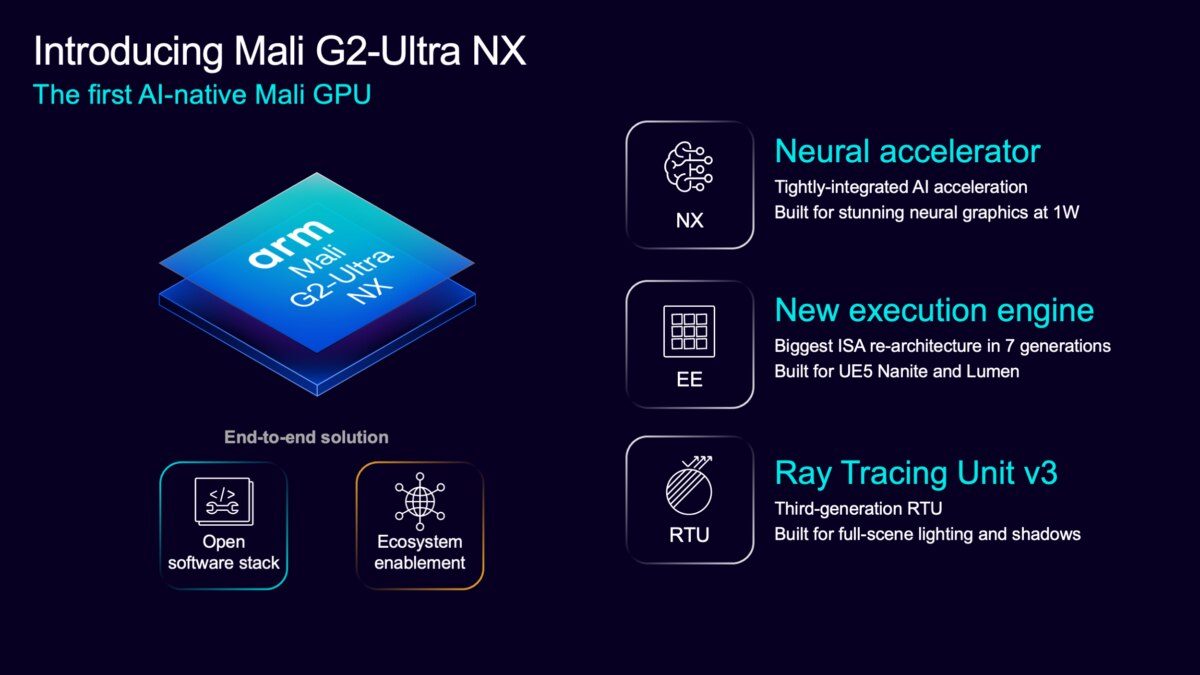
The first phone with Arm's new neural-accelerated GPU went on sale this week. Xiaomi's 18 Fold, launched in mainland China, carries the Mali G2-Ultra NX inside its custom Xring O3 chip.

Arm says neural upscaling and frame generation cut rendering work sharply. A phone can hold 1080p at 60 frames per second for about three hours on a charge. The whole phone draws roughly 2.5 watts, with the GPU taking 1.5.

Why it matters

Arm's neural upscaling is now in a shipping phone; the question is which flagships follow Xiaomi's lead.

Questions about this story

Free account needed to ask — your question is kept and asked for you right after sign-up. Answers are public.

No questions yet — be the first to ask.

Key Indicators

1.7x
AI performance gain over prior C1-Ultra CPU
C2-Ultra with doubled SME2 units delivers the gain.
70%
Small-language-model speedup
Two SME2 units per cluster accelerate on-device language models.
38%
Power reduction at equal performance
Claimed C2-Ultra efficiency versus the previous generation.
4x
Neural graphics efficiency gain
Neural Frame Rate Upscaling versus native rendering.
24%
Faster end-to-end agentic workflow
C2-Ultra completes agentic tasks 24% faster than prior gen.
120 FPS
Sustained mobile gaming frame rate
Neural frame rate upscaling enables longer sessions at high framerates.
2.5 W
Whole-phone power during sustained gaming
Arm targets 2.5W total draw with 1.5W for the GPU, per Chris Bergey.
3 HR
Battery life at 1080p/60fps
Up from roughly 30 minutes before neural rendering, per Arm.

Voices

Curated perspectives — historical figures and your fellow readers.

Ever wondered what historical figures would say about today's headlines?

Sign up to generate historical perspectives on this story.

People Involved

Organizations Involved

Timeline

May 2024 September 2026

3 events Latest: 3 days ago
  1. Xiaomi 18 Fold ships with Mali G2-Ultra NX

    Latest Product Launch

    Xiaomi's foldable launched in mainland China with the Mali G2-Ultra NX inside its custom Xring O3 chip. It is the first shipping device with Arm's neural-accelerated GPU.

  2. Arm launches CSS for Mobile 2

    Product Launch

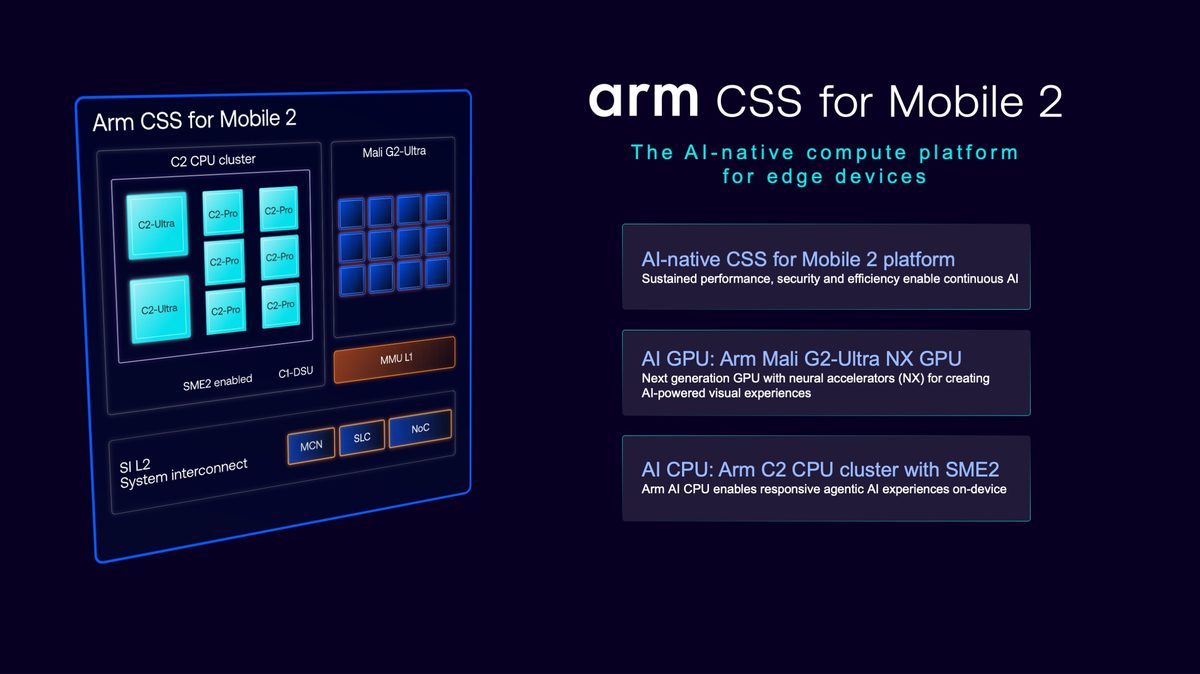
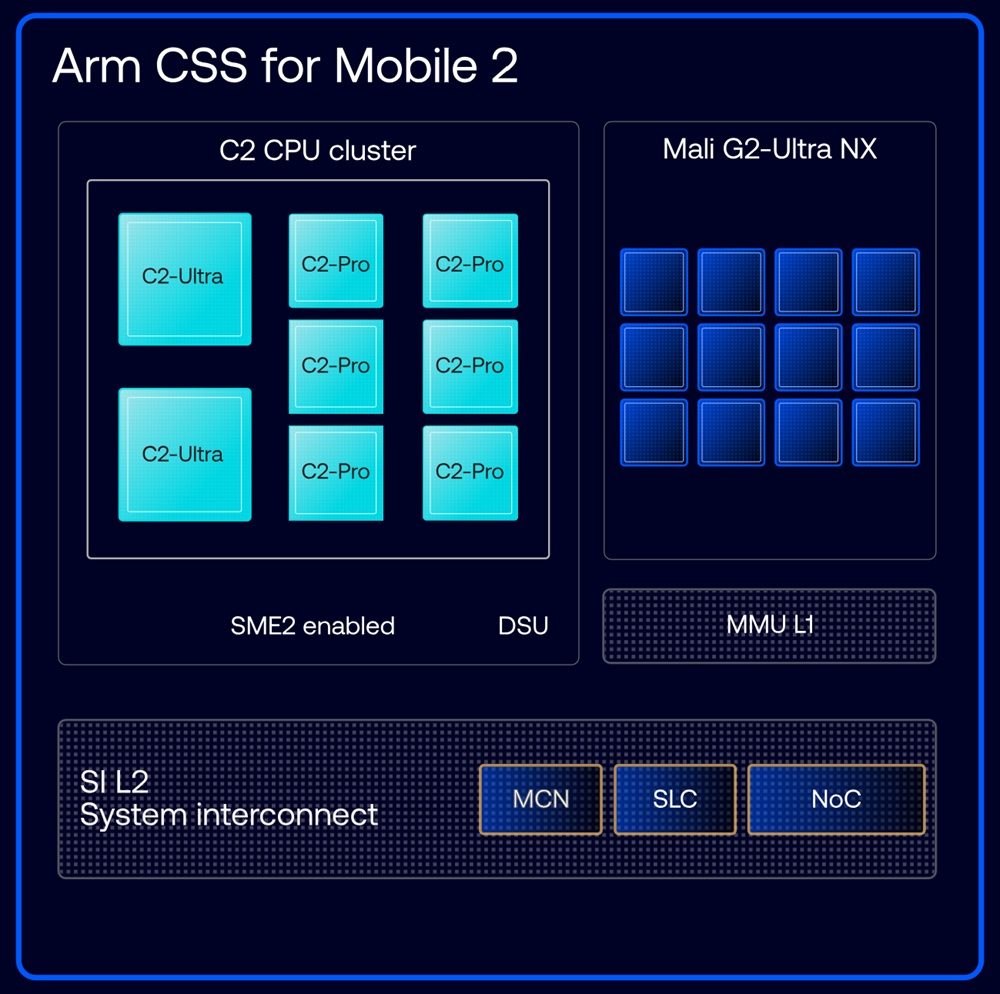
    Arm launches CSS for Mobile 2 with neural-accelerated Mali GPU and C2 CPU cluster.

  3. Arm unveils first Compute Subsystem

    Product Launch

    Arm unveils its first Compute Subsystem, bundling CPU, GPU, and system IP into one platform.

Scenarios

1

CSS for Mobile 2 lands in flagship 2027 SoCs

Possible Resolves by Q2 2027

Discussed by: Semiconductor analysts and Arm, which pitches CSS as a faster path to market for partners.

Arm's platform bundles CPU, GPU, memory, and software to cut partner integration time. MediaTek, Samsung Exynos, and Qualcomm are the candidates. Two design wins by mid-2027 would make the platform the mobile default for flagship Android devices.

2

Neural graphics becomes the mobile gaming baseline

Possible Resolves by End of 2027

Discussed by: Arm and Sumo Digital, whose Neural Dawn demo is the proof of concept.

Neural Frame Rate Upscaling and Neural Super Sampling cut rendering work, claiming up to 4x efficiency and 120 FPS on phones. If Unreal Engine or Unity adds native support, mobile studios adopt neural upscaling the way PC studios adopted NVIDIA's DLSS.

3

Flagship vendors stick with custom cores

Possible Resolves by Q2 2027

Discussed by: Industry observers noting Qualcomm and Samsung rely on their own CPU designs.

Qualcomm's Kryo CPUs and Samsung's custom core strategy mean they may license individual components rather than the whole platform. CSS for Mobile 2 could then serve mid-tier and Chinese brands, leaving the high end untouched.

4

Xiaomi's lead spreads to other Android flagships

Likely Resolves by Q2 2027

Discussed by: Arm's Chris Bergey, who told The Verge the technology will reach other phones and larger screens from 2027

The Xiaomi 18 Fold is the first device with the Mali G2-Ultra NX. Arm says the chip will appear in phones from other makers in 2027, plus tablets and Chromebooks. Neural super sampling hits early titles now, frame generation lands in early 2027, and denoising follows.

Historical Context

2 moments from history that rhyme with this story — and how they unfolded.

September 2018

NVIDIA DLSS launches (2018)

NVIDIA shipped Deep Learning Super Sampling, using tensor cores to upscale lower-resolution frames in real time and cut the rendering load. It debuted as a flagship feature of its GeForce RTX GPUs.

Then

Neural upscaling became a headline PC graphics feature and reshaped player expectations for image quality.

Now

Rivals AMD and Intel shipped their own versions (FSR and XeSS); neural upscaling is now a standard PC graphics feature.

Why this matters now

Arm's Neural Super Sampling and Neural Frame Rate Upscaling are the same play moved to phones, where power and heat budgets are far tighter.

November 2020

Apple Silicon transition (2020)

Apple replaced Intel processors in its Macs with its own integrated chips combining CPU, GPU, and a Neural Engine on one die. The first M1 chip doubled battery life in entry-level laptops.

Then

The transition completed by 2023 and made integration the centerpiece of Apple's computing pitch.

Now

It proved tightly coupled, integrated platforms outperform modular component ecosystems for consumer devices.

Why this matters now

Arm's CSS bundles CPU, GPU, and system IP the same way, betting total integration beats stitching together separately licensed cores.

Sources

(8)