


Pull to refresh
Logo
World's largest solar-storage microgrid reaches full commercial operation in Saudi Arabia

World's largest solar-storage microgrid reaches full commercial operation in Saudi Arabia

Built World

Saudi Arabia's Red Sea destination now runs on 340 megawatts of solar and 1.2 gigawatt-hours of battery storage, independent of the national grid

September 1st, 2026: World's largest solar-storage microgrid fully online

Overview

Updated 5 days ago

Saudi Arabia's Red Sea destination now runs entirely on its own solar-and-battery microgrid, with no connection to the national grid. ACWA Power and its partners signed the project commercial operation date on September 6, 2026, starting a 25-year concession to supply power, water, wastewater treatment, district cooling, and waste management to the tourism site.

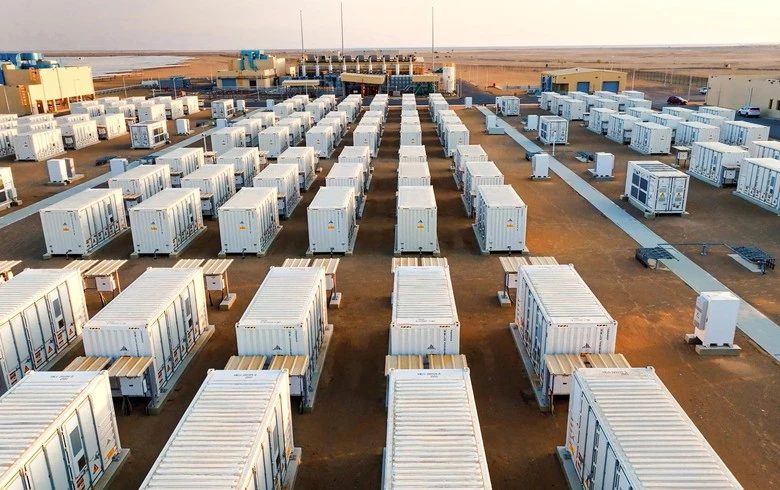
The system pairs 340 megawatts of solar with 1,227 megawatt-hours of battery storage, the largest off-grid battery installation built anywhere. The batteries create the grid's voltage and frequency, a job normally done by spinning generators, and keep the destination powered through the night. The milestone comes as Red Sea Global, the destination's developer, has reportedly paused construction on Phase Two of the resort project, raising questions about how much of the microgrid's capacity will be used in the near term.

Why it matters

This microgrid shows solar-plus-storage can power an entire isolated utility around the clock — a template for islands and remote sites to cut diesel.

Questions about this story

Free account needed to ask — your question is kept and asked for you right after sign-up. Answers are public.

No questions yet — be the first to ask.

Key Indicators

340 MWac
Installed solar capacity
The solar array is the microgrid's primary power source.
1,227 MWh
Battery storage capacity
Grid-forming batteries set the microgrid's voltage and frequency and cover nighttime demand.
112.5 MW
Backup internal-combustion generation
Fossil backup sits behind the renewable system for resilience.
760,000 MWh
Expected annual renewable generation
Up to 760,000 MWh each year supplies the destination and its utilities, per ACWA Power.
25 years
Utility concession term
Red Sea Global buys power, water, and cooling from the ACWA Power consortium under a build-own-operate-transfer deal.

Voices

Curated perspectives — historical figures and your fellow readers.

Ever wondered what historical figures would say about today's headlines?

Sign up to generate historical perspectives on this story.

People Involved

Organizations Involved

Timeline

February 2021 September 2026

8 events Latest: September 1st, 2026 · 1 week ago
Tap a bar to jump to that date
  1. World's largest solar-storage microgrid fully online

    Latest Milestone

    The Red Sea project reaches full commercial operation, powering the destination off-grid.

  2. Full commercial operation announced

    Milestone

    SEPCOIII announces the full utility complex has reached commercial operation.

  3. Red Sea Global reportedly pauses Phase Two construction

    Development

    Multiple outlets reported that Red Sea Global paused construction on Phase Two of the Red Sea destination, citing operating costs exceeding revenue and softer-than-expected demand. Red Sea Global denied any downscaling.

  4. Guinness World Record certified

    Recognition

    Guinness certifies 1,125.18 megawatt-hours of the installation as the world's highest-capacity off-grid battery storage.

  5. Battery storage starts operating

    Milestone

    The 1.2 gigawatt-hour storage unit begins operation, with solar and storage progressively commissioned from 2023.

  6. Financial close reached

    Financing

    The project reaches financial close in February 2022, with c. USD 1.33 billion in senior debt and a total investment of c. US$1.84 billion.

  7. Construction begins on solar and storage

    Construction

    Work starts on the battery storage facility and solar plant on Saudi Arabia's western coast.

  8. Contract signed for Red Sea utility project

    Contract

    SEPCOIII signs the engineering, procurement, and construction contract with ACWA Power.

Scenarios

1

Red Sea microgrid model replicated in new off-grid projects

Possible Resolves by End of 2028

Discussed by: pv-magazine, which wrote that the project 'could offer technical and operational lessons for similar systems on islands, at remote industrial sites and in new developments'

The project's successful commissioning makes it a reference case for off-grid renewable utilities. ACWA Power, which operates in more than a dozen countries, could deploy the same model for other destinations, islands, or industrial sites. A new contract at comparable scale would signal the model is spreading beyond Saudi Arabia.

2

Red Sea destination expansion drives microgrid growth

Likely Resolves by End of 2028

Discussed by: Red Sea Global's public expansion plans, which target 50 hotels by 2030

The destination currently has a handful of operational resorts. Red Sea Global plans to grow toward 50 hotels by 2030, which would push power, water, and cooling demand beyond the current microgrid's capacity. An expansion announcement would confirm the microgrid grows with the destination.

3

ACWA Power publishes first-year data on Red Sea microgrid reliability

Likely Resolves by End of 2027

Discussed by: pv-magazine and ESS News, which noted the project's performance could offer lessons for similar off-grid systems

The project's first full year of commercial operation will produce the first public data on whether a solar-plus-storage microgrid can reliably run water, cooling, and airport loads off-grid. ACWA Power's reporting will show availability, renewable share, and how often the backup generators ran. Strong results would strengthen the case for grid-forming storage worldwide.

4

Microgrid capacity underused if destination expansion stalls

Possible Resolves by End of 2027

Discussed by: Voice of Renewables, which reported that Red Sea Global paused Phase Two construction and that only around ten resorts were open as of early 2026

The microgrid was sized for a destination of up to 50 hotels and roughly 1,000 residential units. If Red Sea Global's expansion stalls, the utility's capacity could sit underused, affecting the economics of the 25-year concession. ACWA Power's revenue depends on the destination's growth.

Historical Context

3 moments from history that rhyme with this story — and how they unfolded.

June 2014

El Hierro wind-hydro project (2014)

The Canary Island of El Hierro commissioned an 11.5 MW wind farm paired with a pumped-hydro storage plant, aiming to run its isolated grid entirely on renewables. Technical problems with the hydro system kept renewable share far below the 100% target in the project's early years.

Then

The island kept relying on its diesel plant more than planned, and renewable penetration stayed well below the target for years.

Now

El Hierro became a cautionary example of how hard it is to decarbonize an isolated grid without reliable, fast-responding storage.

Why this matters now

The Red Sea project takes a different technical path, using grid-forming batteries instead of pumped hydro to create a stable isolated grid.

November 2016

Ta'u Island microgrid (2016)

Tesla and SolarCity completed a 1.4 MW solar array with 6 MWh of battery storage on Ta'u, a small island in American Samoa. The system replaced diesel generators that were refueled by barge, cutting the island's fuel use by roughly 100,000 gallons a year.

Then

The island's roughly 600 residents got near-continuous renewable power, with diesel kept only as backup.

Now

It became the most-cited proof that solar-plus-storage could replace diesel on isolated islands, but at village scale.

Why this matters now

The Red Sea project is about 250 times larger in solar capacity and 200 times larger in storage, showing how far off-grid renewable systems have scaled in a decade.

December 2017

Hornsdale Power Reserve (2017)

Tesla built a 100 MW, 129 MWh battery next to the Hornsdale wind farm in South Australia after a state-wide blackout in 2016. The battery responded to grid frequency disturbances in milliseconds, faster than any conventional generator.

Then

The battery stabilized South Australia's grid and earned significant grid-services revenue in its first year.

Now

It triggered a global wave of grid-scale battery deployments and proved batteries could provide services once reserved for spinning generators.

Why this matters now

Hornsdale proved batteries could support an existing grid. The Red Sea project goes further: its batteries create the grid itself, with no larger system to lean on.

Sources

(11)