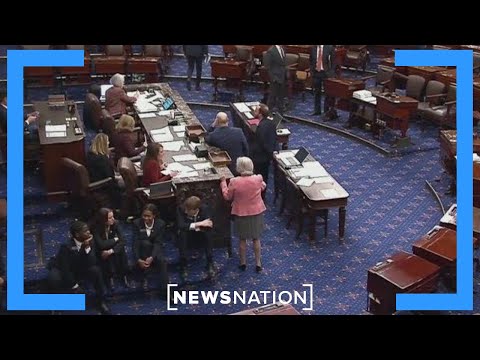
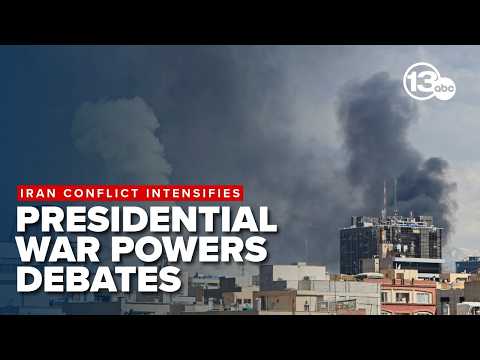
The House voted 215-208 on June 3 to order President Trump to end military operations in Iran, the first time either chamber passed such a measure on a final vote since the conflict began February 28. Four Republicans broke with their leadership: Tom Barrett of Michigan, Warren Davidson of Ohio, Brian Fitzpatrick of Pennsylvania, and Thomas Massie of Kentucky. The Senate advanced a parallel resolution 50-47 in May but has not scheduled a final vote.
A Pakistan-brokered ceasefire took hold in April, but both sides have kept striking. Iran suspended peace talks after Israel escalated operations in Lebanon, and the Trump administration's claim that the ceasefire paused the 60-day War Powers clock drew sustained Democratic pushback. Ten total congressional war powers votes since February have produced one concrete result: a House resolution that faces a near-certain presidential veto if the Senate passes it.
Why it matters
If Congress can't stop a war even when a House majority wants to, the constitutional rule that only Congress declares war becomes fiction.
Questions about this story
Free account needed to ask — your question is kept and asked for you right after sign-up. Answers are public.
0
Did the senate vote yet?
The Senate has not held a final vote — it advanced a parallel resolution 50-47 in May but has yet to schedule a floor vote on passage.
Why it matters: The House just passed its resolution 215-208 on June 3, so both chambers must pass the same measure before it could go anywhere — and Senate leadership has shown no urgency to bring it to a final vote.
—In May, the Senate advanced a parallel war powers resolution 50-47 — a procedural step, not a final passage vote.
—The Senate has rejected war powers resolutions on final votes multiple times since February, most recently 50-49 on May 13 (the closest margin yet), with three Republicans — Murkowski, Collins, and Paul — voting yes.
—Democrat John Fetterman has been the decisive 'no' vote, providing Republicans the margin to defeat every Senate attempt.
—The White House has said the House-passed resolution 'will not reach' Trump's desk, signaling a veto even if the Senate acts.
Some analysts argue the Senate's May 50-47 procedural advance signals enough votes to eventually pass a final resolution; others say Senate Majority Leader Thune will simply never schedule the vote, making the House passage largely symbolic.
AI-generated with web search — may be wrong. Check the linked sources.
Key Indicators
50-47
Senate procedural advance on war powers (May 19)
The first time the Senate moved a war powers resolution forward — a procedural step, not final passage. Four Republicans joined Democrats: Collins, Murkowski, Paul, and Cassidy.
215-208
House passage of war powers resolution (June 3)
The House became the first chamber to pass a final-vote war powers measure against this conflict. Four Republicans voted yes. The measure goes to the Senate next.
4
Republican senators backing war powers advance
Collins, Murkowski, Paul, and Cassidy voted for the May 19 procedural advance — the largest Republican defection in the Senate on this issue.
6+
US service members killed
American military deaths in Operation Epic Fury as of early March, with additional casualties expected.
0
Wars halted by the War Powers Resolution
The House resolution is the first final-vote passage in either chamber in this conflict, but operations continue. Congress has never forced an end to a war over a president's objection.
$200B+
Pentagon supplemental request
The Pentagon sought more than $200 billion for the Iran war. The White House later said it does not plan to submit a formal supplemental request to Congress.
5,500+
Targets struck in Iran
US and allies hit military, nuclear, and security sites since Feb 28.
10
Total congressional war powers votes
Congress voted on war powers ten times since February 28. Nine failed; the House passed one June 3.
19 events
Latest: June 2nd, 2026 · 3 months ago
Showing 8 of 19
JK to step
Tap a bar to jump to that date
Jump to
June 2026
Rubio briefs Congress as Iran suspends peace talks and ceasefire frays
LatestDiplomatic / Legislative
Secretary of State Rubio briefed Congress as Iran suspended negotiations, citing Israeli operations in Lebanon as a ceasefire violation. Both sides resumed strikes while the administration maintained the ceasefire was technically still in effect.
May 2026
Senate defeats war powers resolution 50-49; three Republicans defect for first time
Legislative
The Senate's seventh war powers vote failed 50-49, the closest margin yet. Lisa Murkowski joined Susan Collins and Rand Paul in voting yes — the first time three Republicans backed the measure. John Fetterman's no vote was the margin of defeat.
April 2026
Senate defeats war powers resolution for fifth time, 46-51
Legislative
The Senate voted 46-51 to reject a war powers resolution sponsored by Sen. Tammy Baldwin, one day after Trump extended the ceasefire. Rand Paul remained the only Republican voting yes; John Fetterman again voted no.
Trump extends ceasefire indefinitely
Military / Diplomatic
President Trump extended the two-week Pakistan-brokered ceasefire indefinitely, citing Iran's 'seriously fractured' government and ongoing negotiations toward a more durable deal.
Senate rejects war powers resolution for fourth time, 47-52
Legislative
The Senate voted 47-52 to defeat a war powers resolution, the fourth failed congressional attempt. Rand Paul was the only Republican voting yes; John Fetterman was the only Democrat voting no.
Vance, Witkoff, and Kushner arrive in Islamabad for direct talks with Iranian officials
Diplomatic
Vice President JD Vance, special envoy Steve Witkoff, and Jared Kushner met Iranian officials in Islamabad — the most senior direct US-Iran diplomatic contact since 1979.
US and Iran agree to Pakistan-brokered ceasefire
Diplomatic
The United States and Iran agreed to a two-week ceasefire mediated by Pakistan, pausing the heaviest fighting after five weeks of strikes. Negotiators included Vice President Vance, special envoy Steve Witkoff, and Iranian Foreign Minister Abbas Araghchi.
March 2026
Bipartisan lawmakers challenge $200B war supplemental; GOP cracks emerge
Legislative / Budget
Republican and Democratic lawmakers publicly questioned the Pentagon's $200 billion supplemental request. Rep. Lauren Boebert said she would vote against any war supplemental; Sen. Lisa Murkowski demanded the administration explain its cost and end state before she could support it.
Pentagon seeks over $200 billion supplemental budget for Iran war
Military / Budget
The Pentagon requested more than $200 billion from Congress to fund ongoing operations and replenish expended weaponry after striking thousands of targets.
U.S. strikes Iranian missile sites near Strait of Hormuz
Military
U.S. forces dropped 5,000-pound bombs on coastal missile sites, as reported by U.S. Central Command amid concerns over Strait disruptions.
U.S., Israel strike over 5,500 targets; Hegseth vows force increases
Military
CENTCOM reported strikes on aircraft and ships; Secretary Hegseth stated U.S. would increase forces and 'occupy every line' in response to Iranian attacks.
Senate rejects war powers resolution 47-53
Legislative
The Senate voted 47-53 to reject the Kaine-Paul resolution. Senator Rand Paul was the only Republican to vote yes; Senator John Fetterman was the only Democrat to vote no. The result effectively endorsed the president's authority to continue operations without explicit congressional authorization.
House rejects war powers resolution H. Con. Res. 38
Legislative
The House failed to pass H. Con. Res. 38 directing the President to remove U.S. Armed Forces from unauthorized hostilities in Iran (Roll Call 85). The bipartisan Khanna-Massie measure mirrored the Senate's rejected resolution.
Senate leaders announce floor vote on resolution
Legislative
Senators Kaine, Schumer, and Schiff announced they had secured a floor vote on the war powers resolution, forcing every senator to go on record regarding the president's authority to continue the Iran war.
US death toll rises to six; Rubio briefs Congress again
Military / Briefing
Three additional American service members were confirmed dead, bringing the total to six. Secretary of State Rubio briefed the Gang of Eight again, telling lawmakers the next phase of operations "will be even more punishing."
First US casualties confirmed; Kaine introduces resolution
Military / Legislative
The Pentagon confirmed three American service members killed and five seriously wounded in the initial strikes. Senator Tim Kaine introduced a war powers resolution, co-sponsored by Rand Paul, to require congressional authorization for continued hostilities.
February 2026
US and Israel launch joint strikes on Iran
Military
The United States and Israel began coordinated strikes on Iranian nuclear, military, and leadership targets under Operation Epic Fury (US) and Operation Roaring Lion (Israel). Supreme Leader Ali Khamenei was killed. Iran launched retaliatory strikes across the Middle East, targeting United States bases in multiple Gulf states.
Geneva nuclear talks end without a deal
Diplomacy
A third round of indirect United States-Iran nuclear negotiations in Geneva ended without agreement. The United States demanded Iran dismantle its enrichment facilities at Fordow, Natanz, and Isfahan and surrender all enriched uranium. Iran refused.
Rubio briefs Gang of Eight on Iran
Briefing
Secretary of State Marco Rubio briefed the bipartisan congressional leadership group known as the Gang of Eight on the Iran situation, days before strikes began.
Scenarios
1
House also rejects war powers resolution, operations continue unchecked
Likely
Discussed by: Breaking Defense, NBC News, and congressional analysts noting strong Republican opposition and Speaker Johnson's public criticism of the resolution
The House votes down the Khanna-Massie resolution by a similar or wider margin, establishing that neither chamber will constrain the operation. Military operations in Iran continue and potentially escalate without any formal congressional authorization, setting a precedent for large-scale executive war-making that dwarfs previous disputes over Libya, Yemen, or Syria.
2
House passes resolution, forcing a constitutional confrontation
Unlikely
Discussed by: The Intercept and Responsible Statecraft, noting bipartisan support from libertarian Republicans and antiwar Democrats in the House
The House narrowly passes its version of the war powers resolution, creating a split between the two chambers. Even if the Senate and House eventually pass identical language, the president would veto the resolution, requiring a two-thirds override vote that Congress has never achieved on a war powers measure. The confrontation would nonetheless intensify political pressure and could constrain the scope or duration of operations.
3
Congress pivots to a new Authorization for Use of Military Force
Possible
Discussed by: Time, Brookings Institution, and moderate Republican senators who voted against the resolution but expressed interest in a formal authorization framework
Rather than trying to halt operations, a bipartisan group drafts a specific Authorization for the Use of Military Force (AUMF) against Iran with defined objectives, geographic limits, and a sunset clause. This approach allows hawkish members to support the war while asserting congressional prerogative. The risk is that, like the 2001 AUMF against al-Qaeda, such an authorization could be interpreted broadly by future administrations to justify operations far beyond its original scope.
4
Conflict ends quickly, making the authorization question moot
Possible
Discussed by: Administration officials and defense analysts at the Center for Strategic and International Studies (CSIS), citing rapid degradation of Iranian military capacity
Operation Epic Fury achieves its stated objectives — destroying Iran's offensive missile capability, naval infrastructure, and nuclear program — within weeks. The president declares victory and draws down forces before the 60-day clock under the War Powers Resolution expires, making the congressional authorization debate academic. The constitutional question of whether the president needed authorization in the first place remains unresolved for a future conflict.
5
Senate passes war powers resolution and Trump vetoes; Congress falls short of override
Possible
Resolves by Q3 2026
Discussed by: Congressional analysts and legal scholars cited by NPR, CBS News, and the Congressional Research Service, noting the near-impossibility of a two-thirds veto override given current vote counts
With the House having passed a 215-208 resolution, the Senate is the next barrier. If the four Republicans who backed the May 19 procedural advance vote yes on final passage, the measure clears Congress. Trump would almost certainly veto it. A two-thirds override requires 290 House votes and 67 Senate votes — numbers neither chamber is close to. The constitutional question of whether the president needed authorization in the first place would remain unresolved.
Historical Context
3 moments from history that rhyme with this story — and how they unfolded.
1 of 3
August 1964
Gulf of Tonkin Resolution (1964)
After reported attacks on United States naval vessels in the Gulf of Tonkin off Vietnam, Congress passed a joint resolution authorizing President Lyndon Johnson to take "all necessary measures" to repel attacks and prevent further aggression. The Senate voted 88-2; the House voted 416-0. Only Senators Wayne Morse and Ernest Gruening voted no, warning it was a "blank check" for an undeclared war.
Then
Johnson used the resolution to massively escalate the Vietnam War, deploying over 500,000 troops by 1968 without a formal declaration of war.
Now
Congress repealed the resolution in 1971 and passed the War Powers Resolution in 1973, designed to prevent future presidents from waging open-ended wars without explicit congressional approval. The Tonkin episode remains the foundational cautionary tale for congressional war authority.
Why this matters now
The Iran situation inverts the Tonkin pattern. In 1964, Congress gave sweeping authorization and later regretted it. In 2026, the president acted without asking and Congress declined to object. The constitutional outcome is the same: a major war proceeds on presidential authority alone.
2 of 3
March-October 2011
Libya intervention and the 60-day clock (2011)
President Obama ordered United States military participation in NATO airstrikes against Libya without congressional authorization. When the 60-day War Powers Resolution deadline passed, the administration argued the operation did not constitute "hostilities" because no American ground troops were at risk, a legal interpretation critics in both parties called absurd.
Then
The House voted 268-145 to rebuke Obama for violating the War Powers Resolution but did not cut funding for the operation. The campaign continued until Muammar Gaddafi was killed in October 2011.
Now
The episode established that a president can sustain military operations past the 60-day limit without meaningful congressional consequence, further weakening the War Powers Resolution as an enforcement mechanism.
Why this matters now
The Libya precedent is directly relevant to the Iran conflict's legal trajectory. If Operation Epic Fury continues past the 60-day mark without authorization, the administration may cite the same logic — that the War Powers Resolution cannot constitutionally constrain the commander-in-chief — with even more confidence given the Senate's explicit refusal to act.
3 of 3
March-May 2019
Yemen War Powers Resolution (2019)
Congress passed a resolution invoking the 1973 War Powers Resolution to end United States military support for the Saudi-led war in Yemen — the first time either chamber had successfully passed such a measure. The Senate approved it 54-46, and the House followed 247-175, with 16 Republicans joining all Democrats.
Then
President Trump vetoed the resolution on April 16, 2019. The Senate voted 53-45 to override, falling short of the two-thirds majority required.
Now
The episode demonstrated that even bipartisan supermajorities in Congress cannot force an end to military operations if the president vetoes and one-third of either chamber sustains the veto. No subsequent war powers resolution has reached the president's desk.
Why this matters now
The Iran resolution failed at an earlier stage — it could not even pass the Senate with a simple majority. The Yemen precedent showed that passing both chambers is insufficient; the Iran vote shows that even getting to that point has become harder as party discipline on war powers tightens.