





Pull to refresh
Logo
uniQure files Huntington's gene therapy for FDA and UK approval

uniQure files Huntington's gene therapy for FDA and UK approval

New Capabilities

AMT-130 seeks accelerated US approval after the FDA reversed its position on the trial data

September 2nd, 2026: uniQure files for FDA and UK approval

Overview

Updated Sep 4

uniQure filed its Huntington's disease gene therapy, called AMT-130, for approval in the United States and the United Kingdom on September 2, 2026. If approved, it would be the first disease-modifying treatment for a disease that today has none.

The filing follows a sharp FDA reversal. Early in 2026 the agency said the trial data were insufficient; in June it accepted the same data as the primary evidence for accelerated approval. A decision could come within eight months if priority review is granted.

Why it matters

Approval would give Huntington's patients the first therapy that slows the disease, which today has no disease-modifying treatment.

Questions about this story

Free account needed to ask — your question is kept and asked for you right after sign-up. Answers are public.

No questions yet — be the first to ask.

Key Indicators

75%
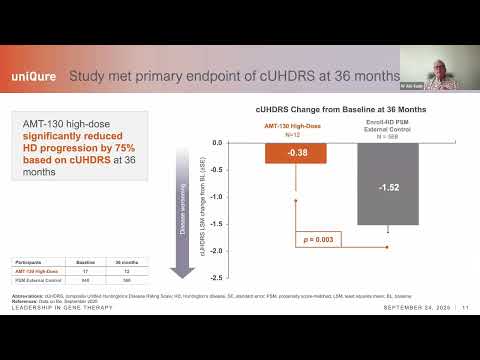
Slowing of Huntington's progression, high-dose group at 3 years
Statistically significant on the composite Unified Huntington's Disease Rating Scale versus matched external control (p=0.003).
29
Patients in the three-year efficacy analysis
17 received the high dose, 12 the low dose; 12 in each group reached 36 months.
75,000
People with Huntington's disease in the US, EU, and UK
The patient population a first disease-modifying therapy would target.
6 months
FDA review cycle if priority review is granted
Down from the standard 10-month review, after the 60-day filing acceptance period.

Voices

Curated perspectives — historical figures and your fellow readers.

Ever wondered what historical figures would say about today's headlines?

Sign up to generate historical perspectives on this story.

People Involved

Organizations Involved

Timeline

June 2026 November 2026

4 events Latest: September 2nd, 2026 · 1 week ago
Tap a bar to jump to that date
  1. FDA filing decision expected

    Upcoming Regulatory

    FDA has 60 days from submission to decide whether to accept the filing for review.

  2. Four-year data presentation expected

    Upcoming Data release

    uniQure to present four-year results from Phase I/II studies before quarter's end.

  3. uniQure files for FDA and UK approval

    Latest Regulatory

    Company filed for accelerated US approval and UK approval, requesting priority review.

  4. FDA reverses course on AMT-130 data

    Regulatory

    FDA accepts three-year Phase I/II data as basis for accelerated-approval filing.

Scenarios

1

FDA approves AMT-130 as first Huntington's gene therapy

Likely Resolves by Jun 1, 2027

Discussed by: uniQure's own guidance; PharmaDeviceNews notes approval would turn the program into a commercial launch

The FDA accepts the BLA after its 60-day review and grants the requested priority review, then issues an approval letter. The decision rests on whether the agency accepts the external-control comparison as sufficient evidence, with a post-approval confirmatory study now expected to compare against standard of care rather than a sham surgical procedure.

2

FDA issues Complete Response Letter, demands more data

Possible Resolves by Jun 1, 2027

Discussed by: PharmaDeviceNews notes the FDA can still conclude the external-control evidence is insufficient

The FDA accepts the filing but, after review, determines the Phase I/II external-control data do not provide robust enough evidence of effectiveness. It issues a Complete Response Letter requiring a randomized confirmatory trial before approval, sending the program back into clinical development for years.

3

FDA grants standard review, delaying the decision

Possible Resolves by Jan 1, 2027

Discussed by: uniQure's filing; priority review is requested but not guaranteed

The FDA accepts the BLA but denies the priority review request, setting a standard 10-month review cycle. The decision date moves to roughly mid-2027 or later, extending the period of regulatory uncertainty even if approval ultimately follows.

Historical Context

3 moments from history that rhyme with this story — and how they unfolded.

October 2012

Glybera, Europe's first gene therapy (2012)

uniQure, then Amsterdam Molecular Therapeutics, won European approval for Glybera, a gene therapy for the rare fat-metabolism disorder lipoprotein lipase deficiency. The one-time treatment carried a list price over $1 million.

Then

Only a small number of patients were ever treated, and the drug was withdrawn from the market in 2017.

Now

Showed that a gene therapy could be approved yet fail commercially if the patient pool is tiny and reimbursement is never secured.

Why this matters now

AMT-130 is another one-time, high-cost gene therapy for a small patient population. Approval would not resolve the access and coverage hurdles that sank Glybera.

May 2019

Zolgensma approval (2019)

The FDA approved Novartis's Zolgensma, a one-time gene therapy for spinal muscular atrophy, with a list price near $2.1 million. It became the first gene therapy for a neurological disease to reach the US market.

Then

Zolgensma saw rapid adoption but also years of reimbursement disputes and installment payment plans.

Now

Set the precedent that regulators would approve ultra-expensive, one-time gene therapies for rare neurological conditions.

Why this matters now

AMT-130 follows the Zolgensma template: a single administration, a high price, and reliance on specialized treatment centers and a long reimbursement tail.

March 2021

Roche's tominersen trial halted (2021)

Roche's tominersen, an antisense drug designed to lower huntingtin protein, was the leading disease-modifying candidate for Huntington's. The Phase 3 trial was halted in March 2021 after the higher-dose arm showed worsening outcomes.

Then

Roche scaled back the program; the setback shifted attention to other modalities, including gene therapy.

Now

Demonstrated how difficult it is to prove a therapy modifies Huntington's in a standard randomized trial.

Why this matters now

AMT-130 aims at the same target, huntingtin, but delivers gene silencing once through neurosurgery instead of repeated spinal injections.

Sources

(7)