

Pull to refresh
Logo
San Francisco voters split on two affordable-housing measures

San Francisco voters split on two affordable-housing measures

Rule Changes San Francisco, CA local

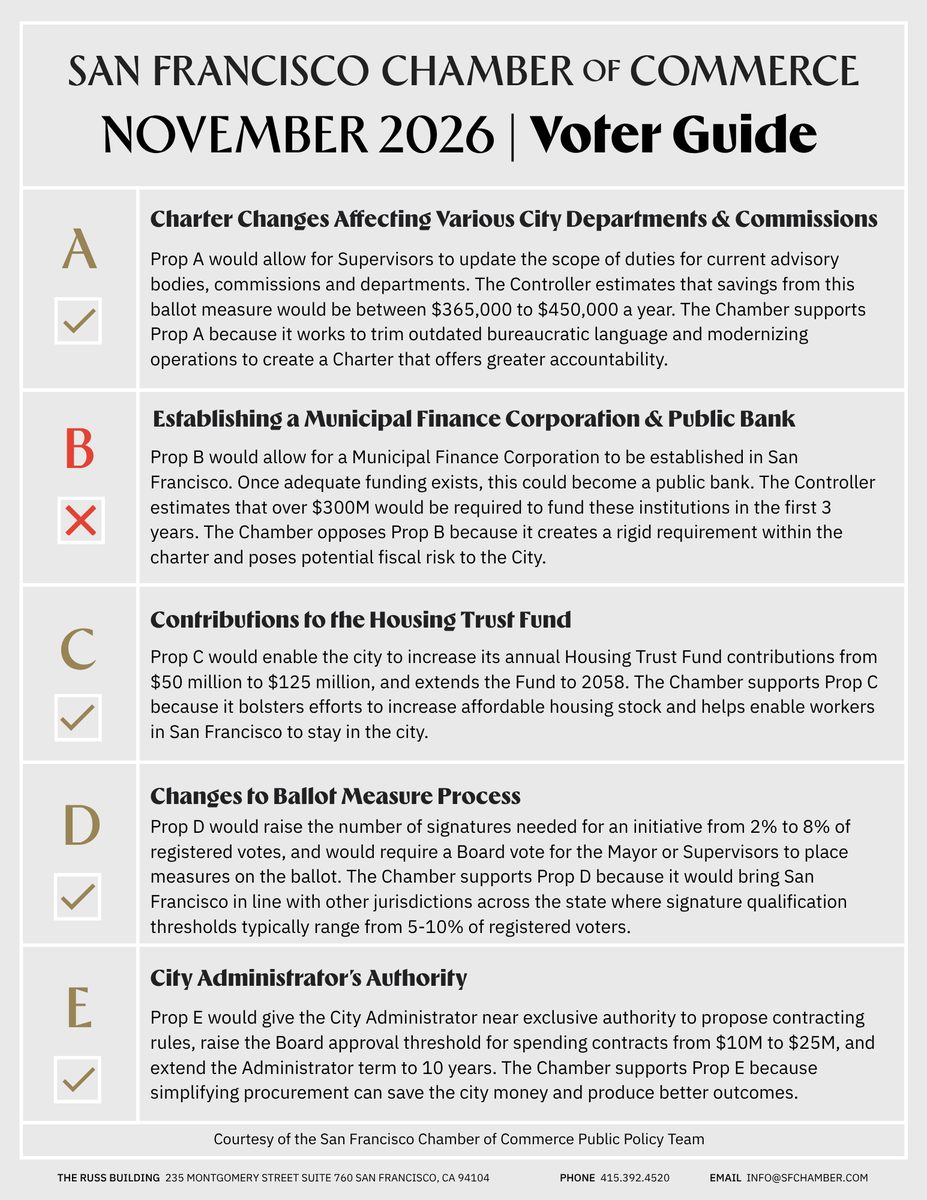
Prop. C, which expands the city's housing trust fund, passed with about 82% support; Prop. I, which would have locked transfer-tax money into housing, lost 52% to 48%.

Overview

Updated Yesterday

San Francisco voters approved Proposition C, which will expand the city's affordable housing trust fund, with about 82% support. They rejected Proposition I, which would have sent half the transfer tax on $10 million-plus property sales to housing, 52% to 48%.

With 99.5% of votes counted, Prop. I trailed by 11,735 votes. It would have locked the transfer tax rate and required voter approval for future changes. The campaign against it spent $2.8 million, and Mayor Daniel Lurie called it a 'slush fund.'

Why it matters

Prop. C gives affordable housing a larger, steadier stream; Prop. I's defeat leaves the transfer tax open to cuts developers have sought.

Last Monday's email for San Francisco, CA

Sent Nov 9. It carried:

Get next Monday's: one short email a week. Free. Unsubscribe in one click.

Questions about this story

Free account needed to ask — your question is kept and asked for you right after sign-up. Answers are public.

No questions yet — be the first to ask.

Key Indicators

82%
Prop. C support
Share of votes for the measure expanding the Affordable Housing Trust Fund, with about 82% as of Saturday.
52%
Votes against Prop. I
The transfer-tax earmark lost 52% to 48%, trailing by 11,735 votes with 99.5% counted.
$125M
Maximum annual Prop. C allocation
Up from roughly $50 million a year the city currently puts toward affordable housing.
$100M+
Annual transfer tax revenue at stake
Prop. I would have earmarked this money for housing instead of the general fund; it fluctuates but exceeds $100 million a year, according to Mission Local.
$2.8M
Opposition spending against Prop. I
Real-estate groups, developers and construction unions spent $2.8 million against the measure, according to Mission Local.
80.8%
Prop. J support
The measure closing a foreclosure exemption in the transfer tax passed with 80.8% support.
52.3%
Prop. B support
The public-bank measure passed 52.3% to 47.7%, according to results updated Thursday.

Voices

Curated perspectives — historical figures and your fellow readers.

Sign up to generate historical perspectives on this story.

People Involved

Organizations Involved

Timeline

2020 November 2026

9 events Latest: 2 days ago
Tap a bar to jump to that date
  1. Prop. I loses after $2.8 million opposition campaign

    Latest Election

    With 99.5% of votes counted, the transfer-tax earmark trailed 52% to 48%, by 11,735 votes. Mission Local reported opposition spending by real-estate groups, developers and construction unions.

  2. Prop. B passes, creating public bank framework

    Election

    The public-bank measure passed 52.3% to 47.7% after trailing on election night, according to results updated Thursday. It creates a municipal finance corporation that can make loans but not take deposits.

  3. Prop. J passes, closing foreclosure tax exemption

    Election

    The measure passed with 80.8% support, or 257,926 yes to 60,947 no, according to KQED. The controller estimated it could raise up to $150 million annually over the first five years.

  4. Prop. C passes with 82% support

    Election

    The measure to expand the Affordable Housing Trust Fund passed handily and had 82% of the vote as of Saturday, according to Mission Local.

  5. Updated count puts Prop. B ahead; Prop. I still short

    Election

    In the city's sixth report, Prop. C had 81.11% support and Prop. I had 46.63% yes. Prop. B led 51.16% to 48.84%, reversing a small deficit from the previous day.

  6. Prop. C leads, Prop. I trails in election-night returns

    Election

    Prop. C sat near 80% support; Prop. I was 55% against. Prop. J, closing a foreclosure loophole, led with 79%.

  7. Transfer tax cut withdrawn over budget deficit

    Policy

    Lurie and Mahmood pulled the proposal, citing the city's ongoing budget deficit.

  8. Mayor and supervisor propose halving the transfer tax

    Policy

    Daniel Lurie and Bilal Mahmood announced a plan to cut transfer tax rates in half.

  9. Voters raise transfer taxes on luxury property sales

    Election

    A Preston-backed measure lifted rates to 5.5% and 6% on sales above $10 million; the revenue was not earmarked for housing.

Scenarios

1

Transfer tax cut returns to the Board of Supervisors

Likely Resolves by Q2 2027

Discussed by: Mission Local, which reports a revived cut is widely expected if Prop. I fails

With the earmark defeated, developers and the real-estate industry press again for lower transfer tax rates. Mayor Lurie and Supervisor Mahmood, who proposed a 50% cut in February before withdrawing it over the deficit, reintroduce legislation or a ballot measure. The fight moves from the ballot to City Hall.

2

Late ballots flip Prop. I into a win

Unlikely Resolves by Dec 1, 2026

Discussed by: No analyst in the reporting predicts this; the scenario tracks the gap between election-night counts and certified results

Election-night returns are not final. If the remaining mail and provisional ballots skew heavily toward yes on Prop. I, the 55% against could narrow. The measure currently trails by ten points, well outside the margins that typically reverse in late counts.

3

Prop. C delivers its full $125 million

Possible Resolves by Aug 15, 2027

Discussed by: Mission Local's description of the measure's funding formula

Prop. C sets aside a small share of growth in general-fund revenue or property taxes, so the payout depends on how fast those revenues rise. A strong budget year could take the affordable-housing allocation from about $50 million toward the $125 million ceiling; a weak one keeps it closer to current levels.

4

San Francisco becomes first city with a public bank

Possible Resolves by End of 2031

Discussed by: Focal News, citing the measure's multi-year approval process

Prop. B creates a municipal finance corporation that can make loans but cannot take deposits. After three to five years of turning a profit, it could apply to become a full public bank if state and federal regulators approve.

Historical Context

3 moments from history that rhyme with this story — and how they unfolded.

2020

San Francisco transfer tax increase (2020)

Voters passed a ballot measure backed by then-supervisor Dean Preston that raised the real property transfer tax on expensive buildings to 5.5% for sales between $10 million and $25 million and 6% above that. The measure was pitched as a way to fund affordable housing, but the revenue was not legally required to go there.

Then

Mayor London Breed directed the money to other city services; Mayor Daniel Lurie's administration has continued the practice.

Now

Developers blamed the tax for stalled projects, and the unrealized housing funding became the argument for Prop. I's earmark.

Why this matters now

Prop. I was written to finish what the 2020 measure started: guaranteeing the money went to housing. Its apparent defeat leaves the revenue in the general fund again.

2018

California Veterans and Affordable Housing Bond Act (2018)

Voters approved a statewide housing bond that funded affordable rental production and homeownership programs. Demand far outstripped the money: the funds were fully committed within five years, by the end of 2023, and the state's main multifamily housing program is routinely oversubscribed about nine to one.

Then

Thousands of affordable homes got built or preserved, but the pipeline of projects needing a final subsidy kept growing.

Now

State leaders put an $11.25 billion bond on the November 2026 ballot to refill the programs.

Why this matters now

It shows why local money like Prop. C matters: affordable projects cannot be built on affordable rents alone, and they need a predictable subsidy source.

March 2024

San Francisco Measure A housing bond (2024)

San Francisco voters approved a $300 million affordable housing bond with about 68.5% support, clearing the two-thirds threshold required for local housing bonds. It was projected to create more than 1,600 homes for low-income residents.

Then

The bond gave the city a one-time infusion for acquisition, construction and rehabilitation of low-income housing.

Now

It established that housing spending can clear the two-thirds bar in San Francisco, though bonds are one-time money rather than an ongoing revenue stream.

Why this matters now

Prop. C is the ongoing-funding counterpart to that bond. It replaces a one-time pot of money with a share of growing city revenue.

Sources

(12)