
Pull to refresh
Logo
Rwanda signs small modular reactor memorandum with Russia's Rosatom

Rwanda signs small modular reactor memorandum with Russia's Rosatom

Built World

The deal covers reactor development, a nuclear science centre and training. Eight years of agreements in, Rwanda still has no site, financing or reactor design.

Overview

Updated Nov 1

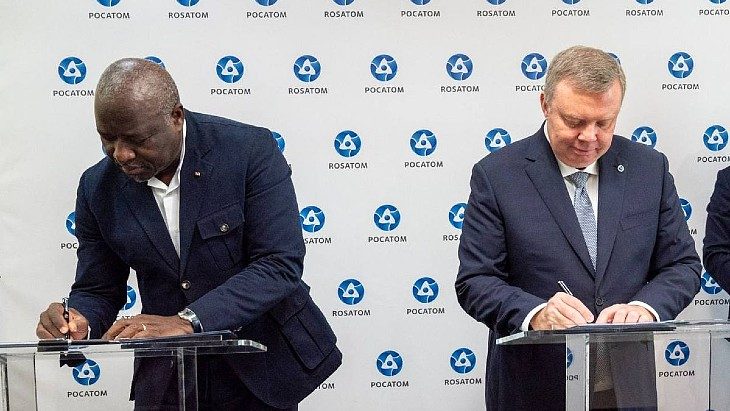
Rwanda's atomic energy board and Russia's state nuclear corporation signed a memorandum in Moscow in late October to develop small modular reactors, build a nuclear science centre and train Rwandan specialists. Rosatom describes it as a memorandum covering the assessment and development of nuclear infrastructure. No reactor model, site, price or construction timetable has been announced.

Rwanda wants 110 megawatts of nuclear power between 2030 and 2033, and nuclear supplying 60 to 70 percent of its electricity in the long term. The International Atomic Energy Agency said in March that Rwanda was making progress on the institutions a nuclear programme needs, and by May it had confirmed the country's move to phase two, which covers preparing to contract and build. Paying for it is unresolved: the Rwanda Atomic Energy Board has said financing is a challenge, and the government has not said whether it will borrow, use a public-private deal or take export credit.

Why it matters

Rwanda is buying nuclear expertise before it buys a reactor, and the vendor it trains with will shape who builds its first plant.

Questions about this story

Free account needed to ask — your question is kept and asked for you right after sign-up. Answers are public.

No questions yet — be the first to ask.

Key Indicators

110 MW
Initial nuclear capacity target
Rwanda aims for 110 megawatts of nuclear generation between 2030 and 2033.
1,500 MWe
Long-term nuclear capacity
The Rwanda Atomic Energy Board's estimate for nuclear supplying 60 to 70 percent of electricity by 2050.
10 MW
Research reactor planned
Capacity specified in the 2019 agreement for the Centre for Nuclear Science and Technology.
3
Areas of cooperation
Small modular reactors, the science centre and workforce training.

Voices

Curated perspectives — historical figures and your fellow readers.

Sign up to generate historical perspectives on this story.

People Involved

Organizations Involved

Timeline

June 2018 October 2026

13 events Latest: October 28th, 2026 · 2 weeks ago Showing 8 of 13
Tap a bar to jump to that date
  1. Rwanda and Rosatom sign SMR memorandum

    Latest Agreement

    The memorandum covers SMR development, a nuclear science centre and specialist training, signed during the Russia-Africa Summit in Moscow. Rosatom called it a document on assessing and developing nuclear infrastructure.

  2. Government names 110 MW target and site approvals

    Statement

    Rwanda said approval of two sites was under way, with generation expected 2030 to 2033.

  3. Rosatom and Rwanda sign SMR roadmap

    Agreement

    The first joint coordination committee meeting produced a roadmap for small modular reactors.

  4. Rwanda signs SMR deal with Holtec and US

    Agreement

    Rwanda added a US vendor and a civil nuclear cooperation agreement to its programme.

  5. Commercial nuclear plant agreement finalised with Rosatom

    Agreement

    The document set measures to the end of 2026 toward a science centre and SMR project.

  6. IAEA confirms Rwanda has reached phase two

    Milestone

    The IAEA confirmed Rwanda had advanced to phase two of its nuclear power programme, the stage covering preparation for contracting and construction of a small modular reactor.

  7. IAEA review finds Rwanda's nuclear infrastructure progressing

    Report

    An IAEA team spent eight days in Kigali reviewing Rwanda's nuclear infrastructure at the government's request and said the country was making progress toward a safe, secure programme.

  8. Broader atomic energy cooperation agreed

    Agreement

    The two sides widened cooperation to more civilian uses of nuclear technology.

  9. Science centre construction agreement signed

    Agreement

    The Sochi summit deal bound both countries to build a centre with a 10 MW research reactor.

  10. Implementation roadmap agreed

    Agreement

    Rosatom and Rwanda's embassy scheduled personnel training and science centre planning.

  11. Inter-governmental agreement signed

    Agreement

    A legally binding framework covering a nuclear science centre and power plants.

  12. Rwanda and Russia sign first nuclear memorandum

    Agreement

    The two governments set basic guidelines for peaceful nuclear cooperation in Moscow.

Scenarios

1

Rosatom signs a binding reactor construction contract with Rwanda

Possible Resolves by End of 2027

Discussed by: World Nuclear Association and Nuclear Africa, which both note the programme has only framework and infrastructure agreements so far

The November memorandum is an infrastructure document. A binding contract would name a reactor model, a site, a price and a financing package. That step would convert eight years of agreements into a construction project. It would need Rwanda's draft nuclear law passed and its regulator able to license a power reactor.

2

Rwanda's first SMR delivers power to the grid by 2033

Unlikely Resolves by End of 2033

Discussed by: The World Nuclear Association, which calls the 2030 to 2033 objective unrealistic

Rwanda's stated target is 110 megawatts between 2030 and 2033. Reaching it requires a contract, a licensed site, a completed reactor and a grid able to absorb the output. The association rates Rwanda's target achievability as low, citing the programme's status and the size of the electricity network.

3

Rwanda awards its first SMR project to Holtec, not Rosatom

Uncertain Resolves by Q2 2028

Discussed by: Nuclear Africa and the World Nuclear Association, which list the Holtec and Rosatom agreements side by side

Rwanda signed a development agreement with Holtec for its SMR-300 in May 2026, three months before the Rosatom roadmap. Two vendors now hold agreements that could lead to the same first project. A site licence or construction contract naming Holtec would settle which one builds it.

4

Rwanda passes a nuclear law and licenses power reactors

Possible Resolves by Q2 2028

Discussed by: The World Nuclear Association, which rates Rwanda's institutional readiness low to moderate

The legal and regulatory pieces are the precondition for any construction contract. Rwanda's nuclear law remained in draft as of October 2026, and its regulator does not yet have full power-reactor capability. Passing the law and issuing reactor regulations would move the programme from memoranda to licensing.

5

Rwanda names how it will pay for its first reactor

Uncertain Resolves by End of 2027

Discussed by: The Rwanda Atomic Energy Board, whose officials told The Exchange that financing for the SMR is a challenge

Rwanda has not said whether it will fund a first reactor through public borrowing, a public-private partnership or export credit. A named financing route, with a lender or partner attached, is the step that would turn the Rosatom and Holtec agreements into a project with a budget.

Historical Context

3 moments from history that rhyme with this story — and how they unfolded.

November 2015 to present

Egypt's El Dabaa nuclear plant (2015)

Egypt and Rosatom signed an agreement in 2015 for four VVER-1200 reactors at El Dabaa, backed by a Russian state loan. Construction of the first unit began in 2022, seven years after the agreement.

Then

The project became the anchor of Russian nuclear influence in North Africa.

Now

El Dabaa's first unit is not expected to generate power before the late 2020s, a gap of more than a decade from signature to electricity.

Why this matters now

It sets the realistic clock for Rwanda: an agreement in one decade, concrete in the next, power later still.

January 2013 to present

Bangladesh's Rooppur plant (2013)

Bangladesh and Russia agreed in 2013 to build two reactors at Rooppur, financed mainly by a Russian loan. Fuel was delivered in 2023, a decade after the agreement.

Then

Rooppur gave Bangladesh its first nuclear project and a long repayment obligation.

Now

Grid connection has slipped repeatedly, and the plant remains a cautionary case for states that sign before financing and regulation are settled.

Why this matters now

Rwanda has published no financing terms. Rooppur shows what unsigned financing does to a construction schedule.

December 2009 to 2024

UAE's Barakah plant (2009)

A Korean consortium won the Barakah contract in 2009 for four reactors. The first unit entered commercial operation in 2021; the fourth followed in 2024.

Then

The UAE built the Arab world's first nuclear plant with a well-funded, single-vendor programme.

Now

Barakah is the benchmark for a smooth newcomer programme: twelve years from contract to first commercial power.

Why this matters now

Even the best-case newcomer timeline runs past Rwanda's 2030 to 2033 target, which starts from an unsigned contract.

Sources

(13)