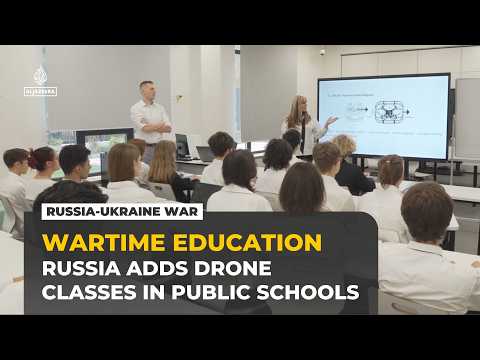
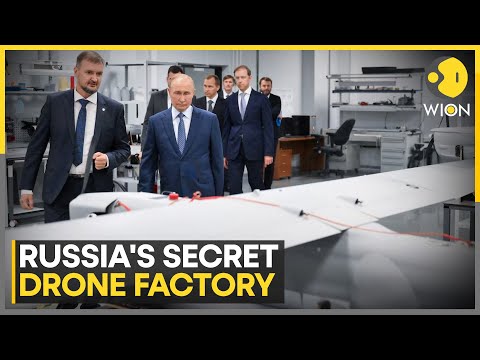
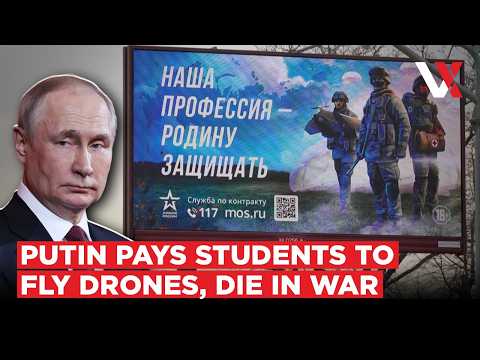
Russian schools teach children to assemble and fly drones as part of the national curriculum, and the training carries into college. A Militarnyi investigation identified at least 40 universities, colleges and technical schools where students build drones or munitions, some of them handed to the army.
The government describes the classes as technical education and wants one million drone specialists by 2030. Training now starts in nurseries in Perm, Tyumen and Sakhalin, and border regions including Kursk and Murmansk run their own programs.
Why it matters
Russia's school system is becoming a military drone pipeline, with children as young as seven being pulled into the program.
Questions about this story
Free account needed to ask — your question is kept and asked for you right after sign-up. Answers are public.
18 events
Latest: October 12th, 2026 · 1 month ago
Showing 8 of 18
JK to step
Tap a bar to jump to that date
Jump to
October 2026
Al Jazeera reports drone classes in schools
LatestReport
Al Jazeera visits a Moscow classroom showing children assembling and flying drones as part of the national curriculum.
Kursk Region starts drone lessons in schools
Policy
Kursk Region begins UAV classes at School No. 23 in Kursk. Students learn drone types, characteristics, and how to detect enemy drones. Classes are slated for all schools in the region, which borders Ukraine.
Murmansk region runs 21 UAV centres
Report
The Kola Peninsula has 21 local UAV centres collaborating with schools and youth organizations, including in border municipalities adjacent to Norway and Finland.
Investigation ties 40+ institutions to drone production
Report
Militarnyi identified 33 universities, five colleges and two technical schools involved in drone or munitions production and dual-use work. Students at a technical school in Krasnoyarsk Krai have assembled FPV drones handed to the army since January 2025, and a student bureau at Pacific National University develops kamikaze drones and passes prototypes to the military.
September 2026
OBZR split into two subjects
Policy
Initial Military Training and Life Safety replace OBZR. Military instruction rises from about one-fifth to half of the course's teaching time, with deeper UAV instruction and mandatory training camps.
June 2026
Transport universities plan mandatory drone course
Policy
Ukraine's Center for Countering Disinformation reported that 19 transport universities and 86 branches were set to introduce a mandatory basic course on unmanned systems from September 1, 2026. Including specialised colleges, more than 250,000 students were expected to take part.
April 2026
Nursery schools teach drone flight
Report
Telegraph reports nurseries in Perm, Tyumen, and Sakhalin operating drone classes and competitions.
January 2026
Drone classes formalized in OBZR
Policy
Government formally adds drone assembly and operation to the Fundamentals of Security and Homeland Defense course.
August 2025
British Defense Ministry counts 500+ schools
Assessment
United Kingdom's defense department reports drone instruction active in over 500 Russian schools.
May 2025
First drone textbook launches
Publication
Russia publishes its first school textbook on drone operation for grades 9-10, with interactive lessons.
January 2025
Forbes details military curriculum
Report
Reporting shows school training covers stripping, loading, and firing a Kalashnikov plus drone warfare essentials.
2025
Putin directs seven-year-olds to race drones
Policy
Putin issues directive calling for children as young as seven to participate in drone races by 2026, lowering the earlier threshold of age ten.
September 2024
OBZR becomes mandatory
Policy
Fundamentals of Security and Homeland Defense starts as a required subject for grades 8-11.
2024
Drone classes added to Labour subject
Policy
Fifteen hours of drone assembly, programming, and operation assigned to grades 7-9 under Labour (Technology).
December 2023
OBZR subject introduced
Policy
Education Ministry creates Fundamentals of Security and Homeland Defense as a compulsory course.
June 2023
Unmanned Aviation Strategy adopted
Policy
Government approves strategy through 2030, identifying children as the starting point of drone workforce training.
2023
Putin endorses drone education
Policy
President backs drone instruction in the national curriculum.
February 2022
Russia invades Ukraine
Conflict
Full-scale invasion begins, accelerating militarization of Russian school education.
Scenarios
1
Russia announces drone education in all secondary schools
Likely
Resolves by Sep 1, 2027
Discussed by: Russian Ministry of Education, state media (TASS, RIA Novosti)
The government has committed to nationwide drone education and is investing heavily. If the war continues and UAVs remain central to combat, Moscow has reason to accelerate the rollout. A formal announcement of full coverage across secondary schools would mark the completion of that expansion.
2
Independent reporting documents shallow drone training
Possible
Resolves by Jun 1, 2028
Discussed by: Pavel Luzin, Novaya Gazeta Europe
Defense policy expert Pavel Luzin argues the program's scale masks its limits: 30-student classes, half the time spent on discipline, minimal practical flight. Independent reporting may document gaps between official coverage claims and what actually happens in classrooms, particularly in regions with limited equipment or instructor training.
3
Drone education expands to primary grades
Possible
Resolves by Jun 1, 2027
Discussed by: The Telegraph, Putin's directives
Putin's directive targeting seven-year-old drone racers signals appetite for earlier training. Nursery programs in Perm, Tyumen, and Sakhalin could become the model for a nationwide expansion below grade 5, extending drone instruction to all primary school students rather than the current selective rollout.
4
Mandatory drone course expands beyond transport universities
Possible
Resolves by Sep 1, 2027
Discussed by: Ukraine's Center for Countering Disinformation
From September 2026, 19 transport universities and 86 branches were set to teach a mandatory basic course on unmanned systems, with more than 250,000 students in scope including colleges. If that rollout holds, the same requirement could reach universities outside the transport sector, which would put drone instruction in front of most Russian students rather than a specialised slice.
Historical Context
2 moments from history that rhyme with this story — and how they unfolded.
1 of 2
1968-1990s
Soviet Initial Military Training (1968)
The Soviet Union introduced compulsory initial military training in secondary schools in 1968, teaching weapons handling, drill, civil defense, and basic tactics. The program ran for decades and reached virtually all Soviet schoolchildren.
Then
Millions of Soviet teenagers received basic military instruction before conscription.
Now
The program normalized military training in civilian education and shaped generations of conscripts, but its practical value was often limited by aging equipment and rote instruction.
Why this matters now
Russia's current curriculum follows the same pattern of embedding military training in the school system, but with a modern focus on drone warfare rather than rifle drill. The Soviet program shows both how such training can persist for decades and how it can degrade into formalism.
2 of 2
1930s
Nazi Germany militarized education (1930s)
The Nazi regime integrated military training and ideology into school curricula across Germany in the 1930s. Youth organizations operated as paramilitary training grounds, and schools emphasized physical fitness, weapons familiarity, and loyalty to the state.
Then
A generation of German youth received military-style training in schools and youth organizations before the outbreak of World War II.
Now
The system dissolved with the regime's defeat in 1945 and became a cautionary example cited in debates about militarizing education.
Why this matters now
Shows how states use education systems to prepare youth for war during conflict. Russia's drone curriculum, combined with patriotic lessons and basic military training, fits that historical pattern, though it operates in a different technological and political context.