
Pull to refresh
Logo
Student reading and math scores hit record lows in PISA 2025

Student reading and math scores hit record lows in PISA 2025

Rule Changes

OECD average reading and math scores fall to lowest levels ever recorded

4 days ago: PISA 2025 results show record lows

Overview

Updated 4 days ago

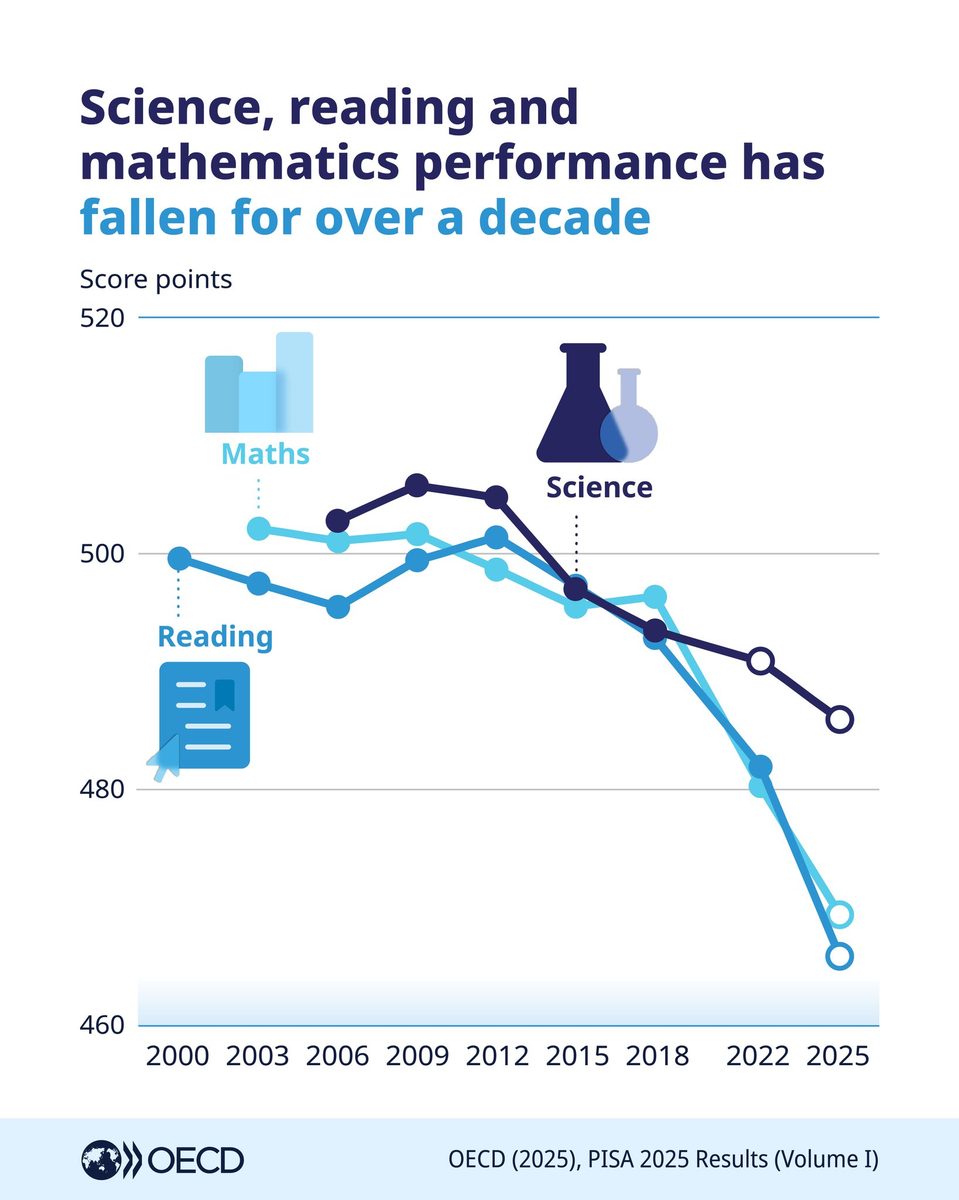
Fifteen-year-olds across the developed world are reading and doing math worse than any cohort the OECD has measured. The 2025 PISA results, released Tuesday, show average reading scores fell 28 points across OECD countries since 2015, about a year and a half of learning. Math fell 22 points, just over a year.

The decline is broad but not universal. Singapore topped reading and placed second in math and science. Across the OECD, one in five students is now a low performer in all three subjects, up from 16% in 2022.

Digital distraction is a growing factor. More than one in four students said classmates were distracted by digital devices in most or every science lesson. The share of 'hasty readers' who rush through texts and answer quickly but incorrectly almost doubled between 2018 and 2025.

Why it matters

A generation of students is entering adulthood with weaker reading and math skills than their parents.

Questions about this story

Free account needed to ask — your question is kept and asked for you right after sign-up. Answers are public.

No questions yet — be the first to ask.

Key Indicators

28 points
Reading score decline (OECD average, 2015-2025)
Equivalent to about 1.5 years of learning.
22 points
Math score decline (OECD average, 2015-2025)
Equivalent to just over one year of learning.
20%
Students who are low performers in all three subjects
Up from 16% in 2022.
760,000
Students assessed
Across 91 countries and economies, the largest PISA cycle ever.
85 points
Science score gap between advantaged and disadvantaged students
Socio-economic background remains a powerful predictor of performance.

Voices

Curated perspectives — historical figures and your fellow readers.

Ever wondered what historical figures would say about today's headlines?

Sign up to generate historical perspectives on this story.

People Involved

Organizations Involved

Timeline

January 2000 September 2026

6 events Latest: 4 days ago
Tap a bar to jump to that date
  1. PISA 2025 results show record lows

    Latest Assessment

    OECD average reading and math scores hit lowest levels ever recorded. Science stabilizes after a decade of decline.

  2. PISA 2022 results show continued declines

    Assessment

    Previous PISA cycle shows further drops, with pandemic disruptions cited as a factor.

  3. Hasty readers begin to rise

    Trend

    Share of students who rush through texts and answer quickly but incorrectly starts climbing.

  4. Reading and math scores begin sharp decline

    Trend

    OECD average reading and math scores start falling, a decline that accelerates over the next decade.

  5. Science scores begin downward trend

    Trend

    OECD science scores start a decline that continues through 2022 before stabilizing.

  6. First PISA assessment launched

    Milestone

    PISA measures reading, math, and science in 43 countries for the first time.

Scenarios

1

OECD countries launch targeted reading interventions

Possible Resolves by End of 2027

Discussed by: OECD Secretary-General Mathias Cormann, education policy analysts

Governments respond to the PISA results with new literacy programs, teacher training, and targeted support for struggling schools. The OECD's own guidance calls for focusing on fewer areas in greater depth and investing in teachers. Countries like Australia and Ireland, which saw sharp declines, face the most pressure to act.

2

School device restrictions expand across OECD

Likely Resolves by Q2 2028

Discussed by: OECD, UNESCO, education researchers

The PISA data showing digital distraction and hasty reading push more countries to restrict smartphone use in schools. Several countries already have such policies. The results may accelerate adoption, especially given the finding that students surrounded by distracted classmates performed worse and felt less connected to school.

3

PISA 2028 shows continued decline

Possible Resolves by End of 2029

Discussed by: OECD, education researchers

The downward trend continues into the next assessment cycle. Reading and math scores fall further, suggesting the decline is structural rather than a temporary post-pandemic effect. This scenario would strengthen the case for fundamental education reform but also raise questions about whether current policy tools are working.

Historical Context

3 moments from history that rhyme with this story — and how they unfolded.

December 2001

Germany's PISA shock (2000)

Germany's first PISA results placed it below the OECD average in reading, math, and science. The mediocre showing triggered a national debate about education quality and led to major reforms.

Then

Germany introduced national education standards, expanded all-day schooling, and increased early childhood education funding.

Now

German PISA scores improved in subsequent cycles, showing that assessment-driven reform can work.

Why this matters now

Shows how PISA results can drive policy change when they shock the public and policymakers.

December 2013

East Asian dominance in PISA 2012

Shanghai, Singapore, Hong Kong, and other East Asian systems dominated the top of PISA rankings, while OECD averages remained relatively stable.

Then

The results sparked debates about education reform in Western countries and highlighted the success of East Asian education systems.

Now

East Asian systems have maintained their lead, though even they show some declines in the 2025 cycle.

Why this matters now

Contrasts with the current cycle, where even top performers show declines and OECD averages have fallen sharply.

2019-2022

US NAEP declines (2019-2022)

The National Assessment of Educational Progress showed the largest-ever drop in 9-year-old reading and math scores between 2019 and 2022, largely attributed to pandemic school closures.

Then

The declines prompted federal and state responses, including tutoring programs and literacy initiatives.

Now

Scores have not fully recovered, suggesting the losses may be persistent.

Why this matters now

Parallels the PISA findings and suggests the decline is not limited to one assessment or country.

Sources

(8)