


Pull to refresh
Logo
PhotonPay raises $40M to link stablecoin and fiat payment rails

PhotonPay raises $40M to link stablecoin and fiat payment rails

New Capabilities

The Hong Kong firm will expand local clearing, card issuing and an execution layer for AI agents, with SBI eyeing a yen-stablecoin link.

Overview

Updated Oct 30

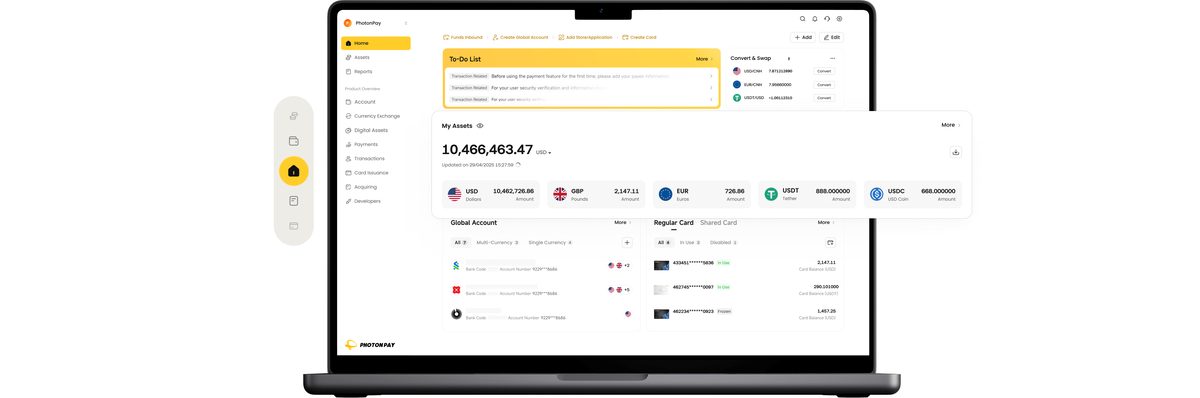
PhotonPay raised $40 million to connect stablecoin balances to the bank accounts, local payment systems and cards companies already use. Blockchain Capital led the round, and SBI Group joined as a new investor.

SBI said the investment could link the yen stablecoin and remittance systems it is building in Japan to PhotonPay's network, which the Hong Kong company says handles $65 billion a year. PhotonPay opened local collection accounts in Nigeria and Ghana in September and is building controls for AI agents that move money.

Why it matters

If stablecoins become routine corporate treasury tools, whoever connects them to local payment rails controls the fees and the access.

Questions about this story

Free account needed to ask — your question is kept and asked for you right after sign-up. Answers are public.

No questions yet — be the first to ask.

Key Indicators

$40M
Series C funding
Round led by Blockchain Capital, with SBI Group joining as a new investor.
$65B
Annualized transaction volume
As of August 2026, across all business lines.
34
Payment and financial licenses
Across the Americas, Europe and Asia, per the company; SBI Group's October 30 notice counted 33.
200,000
Business customers
Spread across more than 200 countries and territories.
4.4M
Cards issued in 12 months
In the year to September 2026, up 275% from a year earlier.
97%
Payouts within hours or same day
Share of payout transactions reaching recipients quickly, per the company.
68%
Payouts in real time
Share of payout transactions arriving instantly, per the company.

Voices

Curated perspectives — historical figures and your fellow readers.

Sign up to generate historical perspectives on this story.

People Involved

Organizations Involved

Timeline

January 2026 October 2026

6 events Latest: October 30th, 2026 · 1 week ago
Tap a bar to jump to that date
  1. PhotonPay closes $40 million Series C

    Latest Funding

    Blockchain Capital led the round, with SBI Group joining and IDG Capital, GL Ventures and Lightspeed Faction returning.

  2. PhotonPay partners with DFNS on stablecoin wallets

    Partnership

    The deal covers wallet creation, transaction signing, permission policies and audit records.

  3. Opens local collection accounts in Nigeria and Ghana

    Product

    Businesses can collect Nigerian naira and Ghanaian cedi through local accounts, the company said.

  4. Mastercard and PhotonPay test AI-initiated card payment

    Partnership

    A tokenized PhotonPay card completed a live agentic payment demonstration on existing card networks.

  5. Launches combined fiat-and-stablecoin collection wallet

    Product

    The multi-currency wallet lets businesses receive, hold and settle funds across traditional and on-chain channels.

  6. PhotonPay closes Series B led by IDG Capital

    Funding

    The company said annualized payment volume had passed $30 billion at the time.

Scenarios

1

PhotonPay ships a production interface for AI-agent payments

Possible Resolves by Q1 2027

Discussed by: PhotonPay's own announcements and Finovate coverage

PhotonPay says it plans Model Context Protocol support and a policy-based execution framework. Shipping it means developers can connect an agent to balances, cards and payments without building custom integrations for each one.

2

PhotonPay discloses how much of its volume is stablecoin

Possible Resolves by Q2 2027

Discussed by: Goodman Macro and payment-industry analysts

The $65 billion figure covers the whole business; the stablecoin share is unknown. If stablecoin volume becomes material to the business, the company would likely break it out for investors.

3

PhotonPay raises a Series D or files to go public

Possible Resolves by End of 2027

Discussed by: Finovate and venture-industry coverage

The Series C gives the company runway. A next round or a public listing would test whether investors put a durable value on the dual-rail model after the build-out costs.

4

SBI connects a yen stablecoin to PhotonPay's network

Possible Resolves by Oct 30, 2027

Discussed by: SBI Holdings' October 30 investment notice

SBI said the investment opens the possibility of linking the yen-denominated stablecoin and remittance infrastructure it has been building from Japan with PhotonPay's global payment and clearing network. A live service would be the first public test of whether the dual-rail model works across two currency blocs.

Historical Context

3 moments from history that rhyme with this story — and how they unfolded.

2011

Stripe's developer-first payments API (2011)

Stripe launched with a pitch that a business could accept payments with a few lines of code, replacing a merchant-acquiring process that had required paperwork and a sales call.

Then

Developers adopted it quickly, and the company grew into one of the most valuable private fintechs.

Now

API-first design became the standard for payments infrastructure, and banks and card networks built around it.

Why this matters now

PhotonPay is making the same bet on API-first architecture, with stablecoins and AI agents as the new inputs.

2012-present

Ripple and blockchain settlement with banks (2012-present)

Ripple built a blockchain-based alternative to correspondent banking, pitching banks on faster and cheaper cross-border settlement.

Then

Some bank pilots followed, but adoption was slow because of regulatory uncertainty and integration costs.

Now

The company later added a stablecoin and custody products, showing that the bridge to fiat banking is the hard part.

Why this matters now

PhotonPay's dual-rail strategy assumes that same bridge can be built, but it is starting with licenses and local clearing rather than trying to replace banks.

2018-present

Circle and USDC in corporate treasury (2018-present)

Circle launched USD Coin in 2018 as a dollar-backed stablecoin aimed partly at businesses moving money across borders.

Then

USDC grew into one of the largest stablecoins, used mostly for trading and payments.

Now

Circle went public in 2025, and stablecoins became a recognized settlement asset, though corporate treasury use remains limited by accounting and regulatory rules.

Why this matters now

PhotonPay's thesis, that stablecoins and fiat converge rather than compete, depends on the same corporate adoption Circle has been building.

Sources

(17)