
Pull to refresh
Logo
OpenAI launches self-serve ChatGPT advertising platform

OpenAI launches self-serve ChatGPT advertising platform

Money Moves

ChatGPT moves from a paid product to an ad-supported platform any business can buy into

May 21st, 2026: OpenAI fully launches self-serve ad platform

Overview

Updated May 21

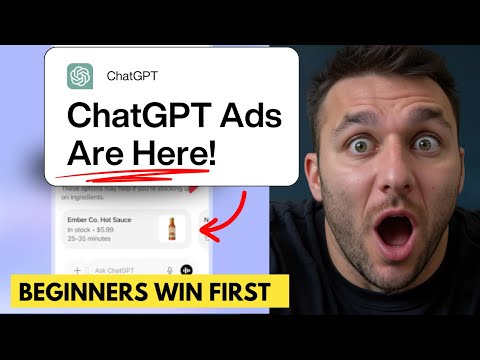
OpenAI ran ChatGPT as a paid and API-only product for three years. On May 21, the company opened a self-serve ad platform that lets any business buy placements inside the chatbot, with no minimum spend.

OpenAI has told investors to expect $2.5 billion in ad revenue this year and $100 billion by 2030. The 2030 target would put ChatGPT within striking distance of Meta's current ad business and a third of Google's.

Why it matters

Free ChatGPT users will see paid placements inside answers, applying Google's ad-supported model.

Questions about this story

Free account needed to ask — your question is kept and asked for you right after sign-up. Answers are public.

No questions yet — be the first to ask.

Key Indicators

$2.5B
2026 ad revenue target
What OpenAI has told investors to expect from ads this year.
$100B
2030 ad revenue target
Long-term goal OpenAI showed investors in April.
$100M
Annualized revenue in first 6 weeks
What the closed pilot generated before the self-serve launch.
2.75B
Projected weekly ChatGPT users by 2030
The user base OpenAI's $100 billion ad target depends on.
$0
Minimum ad spend
Down from $200,000 at pilot start and $50,000 in March.

Voices

Curated perspectives — historical figures and your fellow readers.

Ever wondered what historical figures would say about today's headlines?

Sign up to generate historical perspectives on this story.

People Involved

Organizations Involved

Timeline

February 2026 May 2026

6 events Latest: May 21st, 2026 · 4 months ago
Tap a bar to jump to that date
  1. OpenAI fully launches self-serve ad platform

    Latest Product Launch

    Any business can now register, create, and optimize ChatGPT campaigns through the Ads Manager. The $50,000 minimum spend is removed. Agencies and ad-tech partners get API access.

  2. Self-serve Ads Manager beta begins rolling out

    Product Launch

    Axios reports OpenAI is opening a beta of its self-serve Ads Manager to U.S. advertisers. Cost-per-click bidding is added alongside CPM.

  3. Axios reports OpenAI's $100B 2030 ad target

    Disclosure

    Leaked investor presentation shows OpenAI projecting $11B in 2027, $25B in 2028, $53B in 2029, and $100B in 2030 from ads.

  4. Ads pilot hits $100 million in annualized revenue

    Milestone

    OpenAI confirms the ad business has reached $100M ARR less than two months after launch. Minimum spend drops from $200,000 to $50,000.

  5. CNBC reports advertisers frustrated with slow rollout

    Industry Reaction

    Ad buyers tell CNBC they want faster access, more inventory, and self-serve tooling. OpenAI says expansion is coming.

  6. ChatGPT ads pilot goes live in the U.S.

    Product Launch

    OpenAI opens a closed pilot to logged-in adult users on the Free and Go tiers. Target, Adobe, Williams-Sonoma, and Albertsons buy the first slots. Minimum spend is $200,000 and pricing is CPM-only.

Scenarios

1

OpenAI hits its $2.5 billion 2026 ad revenue target

Possible Resolves by Q1 2027

Discussed by: Axios (April 9, 2026 investor disclosure report); The Information

The pilot generated $100 million ARR in six weeks at $200K minimums. Dropping the minimum to $0 and opening to every advertiser is meant to drive a 25x scale-up by year-end. To hit $2.5B, OpenAI needs CPC pricing to hold in the reported $3 to $5 range and consistent daily inventory across free and Go users in the U.S., Canada, Australia, New Zealand, and additional markets.

2

Google opens a self-serve Gemini ad platform in response

Likely Resolves by End of 2026

Discussed by: AdExchanger; Digiday; Search Engine Land

Google told advertisers in December 2025 it would bring ads to Gemini in 2026. OpenAI's self-serve launch puts public pressure on Google to match. A public Gemini ad platform would protect Google's audience targeting advantage, which ad buyers say is years ahead of what OpenAI can offer.

3

Regulators open a formal probe into ChatGPT ad disclosure

Possible Resolves by May 21, 2027

Discussed by: AdExchanger; The Outcome; Federal Trade Commission consumer-protection division

OpenAI says ads will not influence ChatGPT's actual answers, a principle it calls 'Answer Independence.' Ad buyers and consumer-protection lawyers question how clearly sponsored content can be separated from generated text. A material complaint from the FTC or the European Commission would force OpenAI to overhaul disclosure rules and could slow the international rollout.

4

OpenAI extends ads into the paid Plus or Pro tiers

Unlikely Resolves by End of 2027

Discussed by: The Information; Futurism

OpenAI has committed that ads will only appear on Free and Go. Plus, Pro, Business, Enterprise, and Education stay ad-free. If the $100B target slips behind schedule, the pressure to monetize paid tiers grows. Breaking that promise would mark the second reversal of an Altman ad pledge in two years.

Historical Context

3 moments from history that rhyme with this story — and how they unfolded.

October 2000

Google launches AdWords (2000)

Google had a search engine with 18 million users and no real revenue. In October 2000 it launched AdWords, a self-serve auction platform that let any business buy text ads next to search results. By 2002 ad revenue covered the entire company.

Then

Within two years AdWords generated most of Google's revenue. Yahoo and Microsoft scrambled to match the self-serve auction model.

Now

Search ads became a $300 billion business globally, with Google taking the largest share. The self-serve auction model became the default for digital advertising.

Why this matters now

OpenAI is running the same playbook: a high-traffic consumer product with no native ad revenue, then a self-serve auction that opens inventory to small businesses. The Google parallel is what OpenAI's investor deck is selling.

September 2006 to May 2012

Facebook News Feed ads (2006-2012)

Facebook launched News Feed in September 2006 and began testing ads inside it in 2011. By 2012 the company had built a self-serve ad platform, filed for IPO, and reported $3.7 billion in ad revenue. The product moved from social utility to ad-supported feed in under six years.

Then

Ad revenue became the dominant funding source. Facebook went public in May 2012 at an $81B valuation.

Now

Facebook grew to $196B in 2025 ad revenue. The feed-with-ads model spread to Instagram, TikTok, and every major consumer platform.

Why this matters now

Fidji Simo, who is running OpenAI's consumer business, oversaw the late stage of this conversion at Facebook. Her hire is the strongest signal that OpenAI plans to follow the same arc inside ChatGPT.

November 2022

Netflix adds an ad-supported tier (2022)

After years of insisting it would never run ads, Netflix launched a $6.99 ad-supported plan in November 2022. CEO Reed Hastings had said in 2020 that ads were 'simple to do' but 'not for us.' Slowing subscription growth and a 2022 subscriber loss forced the reversal.

Then

The ad tier added more than 23 million subscribers in its first year and stabilized growth.

Now

Netflix became a hybrid subscription-and-ad business. Other streamers including Disney+ followed within a year.

Why this matters now

Altman's public position on ChatGPT ads tracked Hastings' on Netflix: not now, not for us. The reversal happens once subscription growth alone cannot fund the compute or content bill.

Sources

(9)