

Pull to refresh
Logo
Simulations show kinesin's neck region steers steps counterclockwise

Simulations show kinesin's neck region steers steps counterclockwise

New Capabilities

Atomic-scale models run on Japan's Fugaku supercomputer resolve the long-unseen structure of the motor's guiding neck

Yesterday: Top story on r/science

Overview

Updated Yesterday

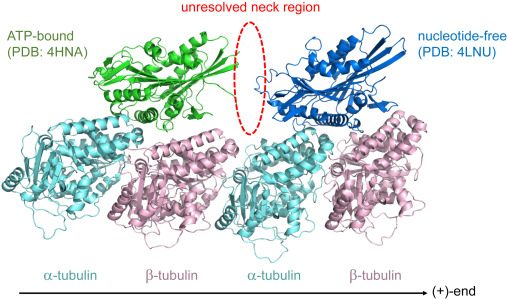
Kinesin is the two-footed motor that hauls cargo through cells by walking along filaments called microtubules. The 'neck' segment that coordinates each step has resisted direct imaging for decades, so researchers simulated it atom-by-atom on Japan's Fugaku supercomputer — the system that was the world's fastest from 2020 to 2022.

The model shows the neck lying perpendicular to the microtubule, pressed against its surface. That contact steers the rear foot in a counterclockwise arc around the front foot, directing each step forward. The result is a structural mechanism for stepping bias that has been missing since kinesin was discovered in 1985.

Why it matters

Every cell depends on kinesin to move cargo; this study resolves how its neck guides those steps, a structural question open since the motor's discovery.

Questions about this story

Free account needed to ask — your question is kept and asked for you right after sign-up. Answers are public.

No questions yet — be the first to ask.

Key Indicators

3,000,000
Atoms in the simulation model
Atomic-level model of kinesin bound to a realistic microtubule lattice.
20
Independent stepping simulations
Each traced the rear foot's center-of-mass path as kinesin took its initial step.
2
Cross-validated force fields
Two independent computational physics models confirmed the neck's stable orientation.

Voices

Curated perspectives — historical figures and your fellow readers.

Ever wondered what historical figures would say about today's headlines?

Sign up to generate historical perspectives on this story.

People Involved

Organizations Involved

Timeline

June 2025 September 2026

3 events Latest: Yesterday
  1. Top story on r/science

    Latest Publicity

    The finding becomes the top post on Reddit's r/science community.

  2. Study appears in Biophysical Journal

    Publication

    IMS announces the study's publication in Biophysical Journal, with coverage on Phys.org and Life Technology the same day.

  3. Preprint posted to bioRxiv

    Preprint

    Researchers post their kinesin neck simulations study to bioRxiv before peer review.

Scenarios

1

Cryo-EM structure confirms perpendicular neck orientation

Possible Resolves by End of 2028

Discussed by: The authors themselves note that imaging limits prompted the computational approach; advances in cryo-EM could test the prediction directly.

Cryo-electron microscopy has been improving resolution on motor protein complexes. If a published structure of kinesin-1 bound to microtubules shows the neck coiled-coil perpendicular to the filament and pressed against the track, the simulation's central claim is confirmed experimentally. This would convert a computational prediction into structural consensus.

2

Follow-up simulations add E-hooks and full-length kinesin

Likely Resolves by End of 2027

Discussed by: The authors list three model simplifications — truncated kinesin, artificial subunit removal, and no E-hooks — as the next targets.

The current model omits the flexible E-hook tails on the microtubule surface and uses a truncated kinesin construct. A follow-up study incorporating these features would test whether the counterclockwise bias holds, shifts, or strengthens. The authors explicitly frame this as the next step.

3

Independent group reproduces the stepping bias

Uncertain Resolves by End of 2028

Discussed by: Computational biology convention expects findings to be reproduced in independent force fields and simulation pipelines.

The finding's robustness depends on independent groups running their own kinesin stepping simulations. If multiple labs reproduce the counterclockwise bias, it becomes a consensus prediction. If results diverge, the neck interaction's role in steering will be debated rather than settled.

Historical Context

3 moments from history that rhyme with this story — and how they unfolded.

1985

Discovery of kinesin (1985)

Ronald Vale and colleagues identified kinesin in squid giant axons using video-enhanced differential interference contrast microscopy. It was the first motor protein found to walk along microtubules.

Then

The discovery opened a new research field focused on how cells transport cargo along filaments.

Now

Kinesin research has since spanned four decades, producing a detailed picture of the motor's chemistry but leaving its neck region's structure unresolved.

Why this matters now

This study closes exactly the structural gap left open since kinesin was named in 1985.

2004

Hand-over-hand debate resolved (2004)

Yildiz and colleagues used single-molecule fluorescence to show kinesin's two heads alternate — the rear head passes the front head with each step. This settled a hand-over-hand versus inchworm debate.

Then

The field accepted that kinesin walks by alternating head positions, each head taking 16-nanometer steps.

Now

The alternation mechanism became textbook knowledge, but the question of what steers the passing motion remained open.

Why this matters now

The current paper addresses precisely what that 2004 work left unresolved: how the neck region biases the direction of the passing step.

Early 2000s

Myosin V lever-arm mechanism (early 2000s)

Single-molecule and structural studies of myosin V — another two-footed processive motor — revealed how a long alpha-helical neck converts ATP hydrolysis into large directional steps along actin filaments.

Then

Researchers gained a template for how processive motors translate chemical energy into directed motion.

Now

The lever-arm model became the reference point for motor protein mechanisms, prompting questions about whether kinesin uses a similar strategy.

Why this matters now

Kinesin's neck plays an analogous role to myosin's lever arm, and this study now specifies how kinesin's version produces directional bias.

Sources

(8)