
Pull to refresh
Logo
GE Aerospace Foundation expands Next Engineers STEM program to Grand Rapids

GE Aerospace Foundation expands Next Engineers STEM program to Grand Rapids

New Capabilities Grand Rapids, MI local

College readiness program aims to reach 4,000 Grand Rapids students over four years as part of $20M expansion

2 days ago: Grand Rapids announced as newest program site

Overview

Updated 2 days ago

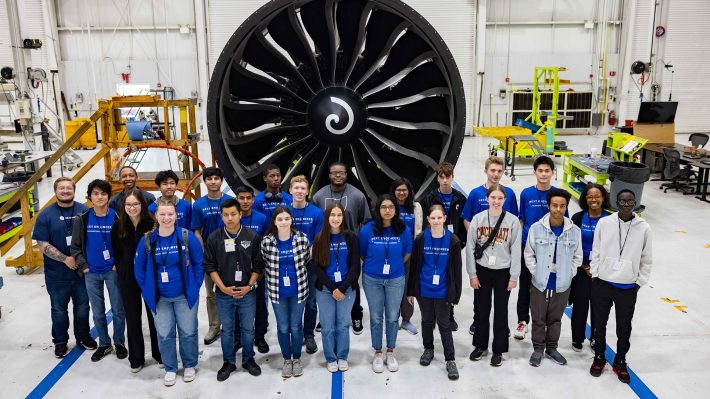
The GE Aerospace Foundation picked Grand Rapids, Michigan as the newest site for its Next Engineers program, a college and career readiness initiative that introduces students ages 13 to 18 to engineering. The program will reach 4,000 students over four years, with programming starting in early 2027.

The announcement is part of a $20 million commitment the Foundation made in 2024 to expand Next Engineers to four new locations. The program already operates in seven cities across the US, UK, South Africa, Poland, and India, and has reached more than 32,000 students since 2021.

Why it matters

With only 32,000 students reached so far toward a 60,000 goal by 2034, GE Aerospace is betting its volunteer-heavy STEM model can address the engineering talent gap in a mid-sized manufacturing city.

Questions about this story

Free account needed to ask — your question is kept and asked for you right after sign-up. Answers are public.

No questions yet — be the first to ask.

Key Indicators

4,000
Students targeted in Grand Rapids over four years
Projected reach of Next Engineers programming in the new site.
32,000+
Students reached globally since 2021
Total Next Engineers participants across all locations worldwide.
$20M
2024 commitment for program expansion
New funding committed to expand Next Engineers to four new locations.
$3M+
Scholarships awarded globally
Cumulative scholarships awarded to Engineering Academy graduates.
7
Current program sites worldwide
Locations serving students: Cincinnati, Greenville, New York, Warsaw, Bengaluru, Staffordshire, Johannesburg.

Voices

Curated perspectives — historical figures and your fellow readers.

Ever wondered what historical figures would say about today's headlines?

Sign up to generate historical perspectives on this story.

People Involved

Organizations Involved

Timeline

January 2021 September 2026

5 events Latest: 2 days ago
Tap a bar to jump to that date
  1. Grand Rapids announced as newest program site

    Latest Expansion

    Foundation announced Grand Rapids addition, targeting 4,000 students over four years; Cincinnati extended through 2035.

  2. Cincinnati celebrates third cohort graduation

    Milestone

    28 students graduated from the Academy program; over 100 total graduates in Cincinnati to date.

  3. Foundation commits $20M to expand program

    Funding

    GE Aerospace Foundation announced new funding to expand Next Engineers to four new locations globally.

  4. Program expands to four international cities

    Expansion

    Johannesburg, Warsaw, Bengaluru, and the New York Capital Region joined the program.

  5. Next Engineers launches in three cities

    Program Launch

    Program began in Cincinnati, Greenville, and Staffordshire with Engineering Discovery and Engineering Academy tracks.

Scenarios

1

Grand Rapids program fully launches and hits enrollment targets

Likely Resolves by Q2 2027

Discussed by: GE Aerospace Foundation leadership; program's track record in other cities

The Foundation identifies an academic partner in late 2026, programming begins early 2027, and the four-year target of 4,000 students is met. Cincinnati's extension through 2035 and the pattern of successful implementation in other cities suggest this trajectory is realistic.

2

Three additional program sites announced, but Grand Rapids underdelivers

Possible Resolves by End of 2030

Discussed by: FHI 360 program monitoring; enrollment data from existing sites

The Foundation announces three more locations as planned, but Grand Rapids enrollment falls short of the 4,000-student target. This could happen if volunteer engagement from GE Aerospace employees is lower than expected or the academic partner struggles to recruit students.

3

Program stalls as GE Aerospace shifts philanthropic priorities

Unlikely Resolves by End of 2028

Discussed by: None publicly predicting this currently; contingency scenario

A downturn in the aerospace industry or a strategic shift in GE Aerospace's philanthropic focus leads to reduced funding or a pause in the expansion. Cincinnati's extension through 2035 would be honored, but new sites like Grand Rapids could see scaled-down programming.

Historical Context

2 moments from history that rhyme with this story — and how they unfolded.

1957-1958

Sputnik and the National Defense Education Act (1958)

The Soviet launch of Sputnik shocked the US and prompted the National Defense Education Act, which poured federal money into science, math, and engineering education. Tens of thousands of students entered STEM fields in the years that followed.

Then

A surge in American STEM graduates throughout the 1960s.

Now

Established the US pattern of attaching STEM education funding to national competitiveness concerns.

Why this matters now

Next Engineers operates in a similar logic—building engineering pipelines—but relies on corporate rather than federal funding, showing how workforce development has shifted toward private-sector initiatives.

1940s-1950s

Bell Labs and the transistor era (1940s-1950s)

Bell Labs, the research arm of AT&T, invested heavily in fundamental science and engineering education. The transistor was invented there in 1947, and the labs trained generations of engineers who went on to define the semiconductor industry.

Then

Bell Labs produced a string of Nobel Prize winners and market-defining technologies.

Now

Set the template for corporate R&D labs as engines of both innovation and scientific workforce development.

Why this matters now

Shows how corporate investment in engineering talent pipelines can pay off for decades, but also that such investments depend on sustained corporate commitment.

Sources

(5)