


Pull to refresh
Logo
Google DeepMind's Genie 4 generates interactive worlds with sound and live steering

Google DeepMind's Genie 4 generates interactive worlds with sound and live steering

New Capabilities

World model adds native audio and natural-language control; trusted testers get it first

Overview

Updated Oct 29

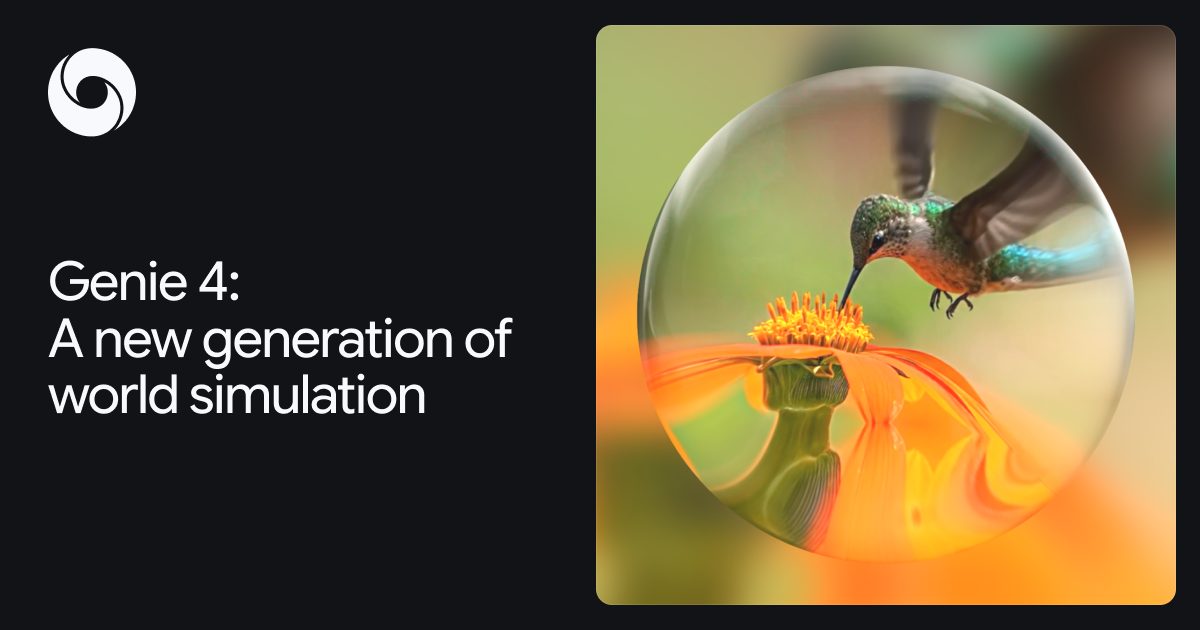
Google DeepMind announced Genie 4 on October 27, calling world simulation a step toward artificial general intelligence. The world model builds interactive scenes in real time and generates ambient sound, music, and dialogue as the scene changes.

Users move through a scene with keyboard controls and type commands to change the weather, move the camera, or add characters. Gemini Omni keeps the visuals realistic, and Gemini 3.8 Flash watches frames and adjusts the scene to stay coherent. DeepMind says it is the first real-time world model to generate audio natively; sessions stay capped near two minutes, up from the 60-second Project Genie limit with Genie 3.

Why it matters

Genie 4 turns text into playable, audible simulations — moving AI from generating video to rehearsing how events unfold.

Questions about this story

Free account needed to ask — your question is kept and asked for you right after sign-up. Answers are public.

No questions yet — be the first to ask.

Key Indicators

2 min
Max continuous simulation length
The new limit is two minutes, up from the 60-second cap in Project Genie with Genie 3.
First
Real-time world model with native audio
DeepMind says it is the company's first real-time world model to generate ambient sound, music, and dialogue alongside the visuals.
Live
Natural-language scene steering
Prompts can change the weather, move the camera, or add characters while the simulation runs.

Voices

Curated perspectives — historical figures and your fellow readers.

Sign up to generate historical perspectives on this story.

People Involved

Organizations Involved

Timeline

February 2024 October 2026

4 events Latest: October 27th, 2026 · 2 weeks ago
Tap a bar to jump to that date
  1. Genie 4 adds real-time audio and steering

    Latest Model release

    Google DeepMind announces Genie 4 with native audio, two-minute sessions, and Gemini 3.8 Flash guiding scenes in a loop, as a research preview for trusted testers.

  2. Project Genie runs on Genie 3

    Product launch

    By January 2026, Project Genie was running on Genie 3; subscribers could explore generated worlds for 60 seconds.

  3. Genie 2 generates interactive 3D worlds

    Model release

    Genie 2 extended the world model to 3D environments that persisted up to a minute from a text or image prompt.

  4. Genie 1 learns to build 2D platformer games

    Model release

    DeepMind's first world model generated playable 2D platformer levels from a single image, trained on 200,000 hours of video.

Scenarios

1

Genie 4 reaches general availability in Project Genie

Likely Resolves by Q2 2027

Discussed by: Google's rollout plan, reported by The Verge and Ars Technica

Genie 4 runs as a research preview with trusted testers now. Google plans to open it to Google AI Ultra subscribers in Project Genie and to Gemini API and Google AI Studio early access partners. If the preview holds up, a broad consumer release follows on those platforms.

2

Genie 4 trains robots inside simulated worlds

Possible Resolves by End of 2027

Discussed by: Google DeepMind's announcement of Gemini 4 Argon experiments

DeepMind is pairing Genie 4 with Gemini 4 Argon so a robot can take a task, have it rendered as a simulation, and practice in the rendered world. The lab frames this as a path to rehearsing scenarios before real-world deployment. Success would make Genie a training ground for embodied AI, not just a media tool.

3

Genie 4 stays a short-session pre-visualization tool

Possible Resolves by Q2 2027

Discussed by: DeepMind's stated limitations; Ars Technica's coverage

DeepMind lists visual drift, lost object permanence, and audio inaccuracy as open problems, with sessions capped near two minutes. If those limits persist, Genie 4 likely settles as a rapid ideation tool for filmmakers, game designers, and engineers rather than a platform for long, persistent worlds.

Historical Context

2 moments from history that rhyme with this story — and how they unfolded.

February 2024

OpenAI Sora (February 2024)

OpenAI showed Sora, a text-to-video model that generated up to a minute of photorealistic footage from a single prompt. It produced no audio and gave users no control over the scene after generation.

Then

Sora reset expectations for generative video and drew attention to a fast race in media generation.

Now

It set the benchmark Genie 4 is measured against, but Sora's outputs are fixed clips, not live worlds.

Why this matters now

Genie 4's leap is precisely what Sora lacked: real-time control and native sound, not pre-rendered clips.

February 2024

Genie 1 (February 2024)

DeepMind released its first world model, Genie 1, trained on 200,000 hours of 2D platformer video. Given a single frame, it could generate a playable game level without any game code.

Then

It proved models could learn interactive environments directly from video, without labels or engines.

Now

It launched the Genie line and showed DeepMind's bet that simulation-from-data, not hand-built physics, is the path forward.

Why this matters now

In 32 months Genie moved from 2D platformer levels to 3D scenes with audio, dialogue, and multi-step event reasoning.

Sources

(10)