Google Cloud pitches itself as the operating system for enterprise AI agents
New Capabilities
Four months after Cloud Next 2026, Google's platform bet has concrete form: a shipped agent runtime and governance layer, with 150 organizations running its A2A interoperability protocol in production.
Four months after Cloud Next 2026, Google's platform bet has concrete form: a shipped agent runtime and governance layer, with 150 organizations running its A2A interoperability protocol in production.
Four months after Cloud Next 2026, Google's agentic pitch has shipped. In April it folded Vertex AI into the Gemini Enterprise Agent Platform, adding a low-code Agent Studio and a runtime that keeps state for days. Agent Gateway routes and inspects agent traffic; Agentic Data Cloud gives agents governed access to BigQuery and other data engines over the Model Context Protocol.
Adoption numbers support the bet. Nearly three-quarters of Google Cloud customers use its AI products, and Gemini Enterprise paid users grew 40% quarter over quarter in Q1 2026. The Agent-to-Agent protocol now runs in production at 150 organizations, including Microsoft, AWS, and Salesforce, though Google still trails both rivals in overall cloud market share.
Why it matters
The company that becomes the default runtime for enterprise AI agents could dominate cloud spending for the next decade.
Questions about this story
Free account needed to ask — your question is kept and asked for you right after sign-up. Answers are public.
No questions yet — be the first to ask.
Key Indicators
500+
Conference sessions
Google Cloud Next 2026 ran April 22–24 with over 500 sessions, the largest Next to date
#3
Google Cloud market position
Google Cloud trails Amazon Web Services and Microsoft Azure in global cloud infrastructure market share
150
Organizations running A2A in production
Google's Agent-to-Agent protocol moved from 50 launch partners to 150 organizations running it in production, including Microsoft, AWS, Salesforce, SAP, and ServiceNow; v1.2 is governed by the Linux Foundation
75%
Google Cloud customers using AI products
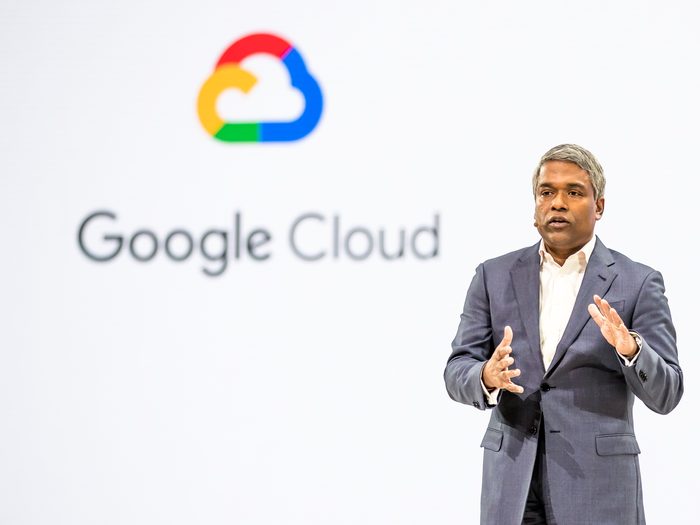
Nearly three-quarters of Google Cloud customers use the company's AI products, per CEO Thomas Kurian at Cloud Next
50%
Q4 2025 revenue growth vs. prior year
Google Cloud grew 50% year over year in Q4 2025, the fastest of the three largest cloud providers
Cloud Next 2026 opens with 'The Agentic Cloud' keynote
LatestProduct Launch
Thomas Kurian opened Google Cloud Next 2026 in Las Vegas by positioning Google Cloud as a full enterprise operating system for autonomous AI agents—not just an AI feature provider. Gemini was presented as an orchestration layer, agent runtime, governance system, and enterprise integration hub.
Gemini Enterprise Agent Platform unveiled
Product Launch
Google folded Vertex AI into the Gemini Enterprise Agent Platform, adding low-code Agent Studio, an upgraded Agent Development Kit, an Agent Runtime that keeps long-running agents in memory for days, and Agent Identity, Registry, and Gateway for governance and security.
Agentic Data Cloud introduced
Product Launch
Google introduced Agentic Data Cloud, an AI-native data layer giving agents permission-aware access to BigQuery, Spanner, AlloyDB, Cloud SQL, and Looker over the Model Context Protocol, with a Knowledge Catalog that infers business meaning across the data estate.
A2A protocol reaches 150 organizations in production
Industry Standard
At Cloud Next, Google's Agent-to-Agent protocol reached version 1.2 under Linux Foundation governance, with signed agent cards. Microsoft, AWS, Salesforce, SAP, and ServiceNow run A2A in production environments.
April 2025
Google launches A2A protocol and Agentspace at Cloud Next 2025
Product Launch
Google unveiled the Agent-to-Agent protocol, an open standard for interoperability between AI agents from different vendors, and Agentspace, an orchestration product for enterprise agent management. About 50 partners signed on at launch.
November 2024
Anthropic releases Model Context Protocol
Industry Standard
Anthropic open-sourced its Model Context Protocol (MCP), a standard for connecting AI models to external data and tools. It was rapidly adopted across the industry and became a building block for agentic AI systems.
Microsoft unveils agentic AI tools at Ignite 2024
Competitive
Microsoft announced Copilot Studio for building custom AI agents and Azure AI Agent Service, signaling its own pivot from passive copilots to autonomous agents integrated into Office and Dynamics.
September 2024
Salesforce launches Agentforce at Dreamforce 2024
Competitive
Salesforce chief executive Marc Benioff declared the copilot era dead and launched Agentforce, a suite of autonomous AI agents for sales, service, and marketing. The enterprise industry's language shifted from 'copilots' to 'agents.'
April 2024
Cloud Next 2024: Gemini replaces Duet AI, Agent Builder debuts
Product Launch
Google rebranded its AI tools under the Gemini name and launched Vertex AI Agent Builder, marking the first explicit shift from AI assistance to AI agents in Google's enterprise messaging.
August 2023
Google Cloud launches Duet AI at Cloud Next 2023
Product Launch
Google introduced Duet AI as its umbrella brand for generative AI assistants across Workspace and Cloud, along with major Vertex AI enhancements. The 'AI copilot' era began in earnest.
Scenarios
1
Google becomes the default agent runtime for multi-vendor enterprises
Google's bet on openness—particularly the A2A protocol—pays off. Enterprises running agents from multiple vendors (Salesforce, SAP, custom-built) choose Google Cloud as the neutral orchestration layer precisely because Google's enterprise application footprint is smaller than Microsoft's, making it a less threatening platform owner. Google Cloud's market share grows significantly, narrowing the gap with Azure.
2
Microsoft's distribution advantage makes Copilot Studio the enterprise default
Likely
Discussed by: Gartner, Goldman Sachs cloud research
Microsoft's installed base of hundreds of millions of Office and Teams users proves decisive. Enterprise buyers prefer agents embedded in the tools their employees already use daily over a separate orchestration platform. Google Cloud remains a strong number-three provider but fails to meaningfully close the gap, and the 'agentic operating system' pitch is absorbed into Azure's broader platform narrative.
3
Agent governance failures slow adoption across all platforms
High-profile incidents—autonomous agents making unauthorized purchases, leaking sensitive data through cross-system integrations, or producing costly hallucination-driven errors—trigger a backlash. Enterprises pull back to supervised 'copilot' modes and regulators impose new requirements on autonomous AI systems. The agentic platform race stalls, and the real winners are governance and observability vendors, not the cloud providers themselves.
4
The agent platform layer fragments along industry lines
Possible
Discussed by: IDC, Deloitte AI practice leaders
Rather than a single horizontal platform winning, industry-specific agent ecosystems emerge: Salesforce dominates sales and marketing agents, ServiceNow owns IT operations agents, Epic and Cerner control healthcare agents, and the cloud providers become commodity infrastructure beneath these vertical platforms. Google's 'operating system' pitch proves too horizontal for how enterprises actually deploy agents.
5
A2A protocol becomes the neutral standard for cross-vendor agent orchestration
Possible
Resolves by End of 2026
Discussed by: Gartner analysts, The Next Web coverage of Cloud Next
Production adoption by Microsoft, AWS, Salesforce, SAP, and ServiceNow turns A2A from a Google project into a neutral industry standard under the Linux Foundation. Google gains influence over how agents interoperate across clouds even where it hosts none of them, while Anthropic's MCP handles the tool-connection layer beneath.
Historical Context
3 moments from history that rhyme with this story — and how they unfolded.
1 of 3
1999–2012
Salesforce and the SaaS platform shift (1999–2012)
Salesforce launched in 1999 arguing that enterprises should rent software as a service rather than install it on their own servers. Incumbents like Oracle, SAP, and Microsoft dismissed the model as insecure and unsuitable for serious enterprise use. Salesforce's 'No Software' campaign was provocative and polarizing.
Then
Enterprise adoption was slow—it took nearly a decade for SaaS to move from early adopters to mainstream acceptance. Security and data-sovereignty concerns were persistent objections.
Now
SaaS became the default enterprise software delivery model. The incumbents who initially dismissed it were forced to rebuild their products for the cloud. The transition from license revenue to subscription revenue took most of them 5–10 years.
Why this matters now
The shift from 'AI copilots' to 'autonomous AI agents' echoes the shift from on-premise to SaaS: incumbents are skeptical, early adopters are enthusiastic, and the governance concerns (security, control, auditability) sound remarkably similar. If the pattern holds, adoption will be slower than boosters predict but more total than skeptics expect.
2 of 3
2006–2020
Cloud platform wars: AWS vs. Azure vs. Google (2006–2020)
Amazon Web Services launched in 2006 and ran effectively unopposed for years. Microsoft Azure launched in 2010 and used its enterprise relationships and Office integration to climb to second place. Google Cloud, despite superior technology in areas like Kubernetes and BigQuery, consistently struggled in enterprise sales and remained a distant third.
Then
AWS established market dominance that persists. Microsoft closed the gap by bundling Azure with enterprise agreements. Google hired Thomas Kurian from Oracle in 2019 specifically to fix its enterprise sales problem.
Now
The pattern established that technical superiority alone does not win platform wars—distribution, enterprise relationships, and ecosystem lock-in matter more. Google learned this lesson painfully.
Why this matters now
Google's 'Agentic Cloud' pitch is an attempt to reset the competitive dynamics of cloud computing around a new paradigm—AI agents—where its Gemini model and A2A protocol could provide a first-mover advantage that raw infrastructure scale did not.
3 of 3
2007–2013
The mobile platform duopoly (2007–2013)
Apple launched the iPhone in 2007 and controlled a tightly integrated hardware-software-services stack. Google responded with Android, an open platform available to any hardware maker. Dozens of competitors—BlackBerry, Windows Phone, Palm—offered technically capable alternatives. Within six years, only two platforms survived.
Then
Apple won the premium segment through integration. Android won market share through openness and manufacturer diversity. Everyone else was eliminated.
Now
The duopoly locked in for over a decade. App developers built for two platforms, creating a self-reinforcing ecosystem barrier that no competitor could overcome.
Why this matters now
Google is running the Android playbook again—championing openness (A2A protocol) against Microsoft's more integrated approach (agents embedded in Office). The question is whether enterprise AI agents will consolidate into a duopoly the way mobile did, and whether Google's openness strategy will capture enough share to survive the consolidation.