



Pull to refresh
Logo
GitHub ships Copilot Fusion, a router that picks AI models per task

GitHub ships Copilot Fusion, a router that picks AI models per task

New Capabilities

Independent tests back the cost savings, but a week in, users report missing tiers and model switches.

Overview

Updated 4 days ago

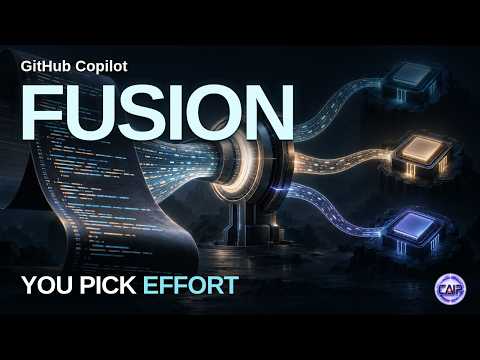
GitHub's Copilot Fusion, an option that picks AI models for each coding task instead of making developers choose one, is now generally available. GitHub says it reaches near-frontier coding scores at about half the cost and 40% less time per task.

Independent testing by Artificial Analysis backs the cost and token savings, though Fusion trails the best single model on repository-editing tasks. A Nov. 4 review of GitHub issues found High and Max limited to paid business plans and a Free/Pro model-picker fix moved to VS Code 1.145. Some users also reported that Fusion switched away from the model they had selected.

Why it matters

If routing holds up, the model you pick matters less than the system that picks it, and coding agents get cheaper per task.

Questions about this story

Free account needed to ask — your question is kept and asked for you right after sign-up. Answers are public.

No questions yet — be the first to ask.

Key Indicators

60
Fusion Max score on the Coding Agent Index
Artificial Analysis scored Fusion Max at 60, about two points behind Claude Code with Opus 5.5 Max.
$5.59
Average cost per task
Artificial Analysis measured $5.59 per task for Fusion Max, against $11.42 for Claude Code with Opus 5.5.
51%
Cost reduction vs Claude Code
Fusion Max cost about 51% less per task than Claude Code with Opus 5.5 Max in the same Artificial Analysis test.
7.2M
Tokens per task
Fusion used about half the tokens of the Opus 5.5 Claude Code configuration in the same test.
40%
GitHub-reported time reduction
GitHub says Fusion finishes tasks about 40% faster; the underlying per-task timing data has not been published independently.
30%
Limited-time Fusion discount
Paid Copilot plans receive 30% off model costs when using Fusion for a limited period.

Voices

Curated perspectives — historical figures and your fellow readers.

Sign up to generate historical perspectives on this story.

People Involved

Organizations Involved

Timeline

September 2026 November 2026

6 events Latest: November 2nd, 2026 · 1 week ago
Tap a bar to jump to that date
  1. Users report Fusion switching away from selected models

    Latest Rollout issue

    GitHub issues filed Nov. 1-2 reported that Fusion switched to a different model after a user picked one; one user said unnoticed switches cost a large amount of credits.

  2. GitHub says Fusion is available across Copilot plans and clients

    Rollout

    GitHub's documentation listed VS Code, the Copilot app, Copilot CLI and JetBrains IDEs, with administrator controls over which models Fusion can use. A later review found availability gaps by plan and client.

  3. GitHub moves Free/Pro Fusion picker fix to VS Code 1.145

    Rollout

    A model-picker fix for Free and Pro accounts slipped from VS Code 1.144 to 1.145, according to a GitHub issue.

  4. GitHub announces Copilot Fusion general availability

    Product launch

    Fusion combines HydraFusion's orchestration with Copilot's automatic model selection and adds three effort levels.

  5. Independent benchmark shows cost gap, quality trade-off

    Benchmark

    Artificial Analysis scores Fusion Max at 60 and $5.59 per task, against about 62 and $11.42 for Claude Code with Opus 5.5 Max.

  6. HydraFusion preview arrives in VS Code

    Product

    GitHub's earlier multi-model orchestration system appears in the model picker for VS Code and the Copilot app.

Scenarios

1

Fusion becomes the default for enterprise Copilot users

Possible Resolves by Apr 30, 2027

Discussed by: GitHub's changelog and enterprise administrator documentation

Administrators can set Fusion as the default at any effort level through enterprise managed settings. If large organizations take that option, most Copilot users stop choosing models at all, and GitHub's router becomes the main gatekeeper for which model providers get enterprise traffic.

2

Independent tests confirm the cost gap holds

Likely Resolves by Q2 2027

Discussed by: Artificial Analysis

The first independent benchmark showed Fusion at roughly half the per-task cost of Claude Code with Opus 5.5 Max. A follow-up index would show whether that gap survives new models and different task mixes, or whether it was specific to the October test set.

3

A rival ships its own model router

Possible Resolves by Q2 2027

Discussed by: Technology trade coverage of the Fusion launch

Fusion's premise is that routing beats picking one model. If that premise holds, Anthropic, OpenAI or another coding-tool vendor has reason to ship a comparable router rather than compete on single-model benchmarks. The trigger would be a rival announcing multi-model orchestration inside its own coding product.

4

Repository-task gap limits Fusion adoption

Uncertain Resolves by Q2 2027

Discussed by: Artificial Analysis benchmark results

Fusion scored 51 on FrontierCode, a repository-change evaluation, against 56 for Claude Code with Opus 5.5 and 54 for Devin Fusion. If that gap persists, teams doing large codebase edits may keep choosing a single strong model, and Fusion's savings may stay concentrated in terminal and question-answering work.

5

Model-switch reports erode trust in Fusion

Possible Resolves by End of 2026

Discussed by: GitHub issue reporters and a Nov. 4 review by Day 7

Users reported that Fusion switched away from a model they had selected, including one who said unnoticed switches cost a large amount of credits. If GitHub does not fix or explain the behavior, developers may avoid the router or pin models, which would undercut the premise that routing can be trusted by default.

Historical Context

3 moments from history that rhyme with this story — and how they unfolded.

1990s-2000s

Ensemble methods in machine learning (1990s-2000s)

Statisticians and computer scientists showed that combining many weaker models often beat a single strong one. AdaBoost arrived in 1995, and Leo Breiman's Random Forests paper followed in 2001. The idea was counterintuitive at the time: more models, not a better model, produced the gain.

Then

Ensembles became standard in competitions and production systems.

Now

The approach established that orchestration can substitute for raw model strength, which is the premise Fusion applies at runtime.

Why this matters now

Fusion is an ensemble method for coding tasks, choosing at request time which models to combine rather than training them together.

1957-1960s

Optimizing compilers replace hand-written assembly (1957-1960s)

IBM's FORTRAN compiler in 1957 generated machine code that programmers had previously written by hand. Early compilers produced worse code than expert assembly writers, but they improved quickly and removed a decision from the programmer's plate.

Then

Programmers kept hand-tuning performance-critical routines while using compilers elsewhere.

Now

Compilers became the default, and hand-written assembly shrank to a niche.

Why this matters now

Fusion asks developers to stop choosing a model the way early programmers stopped choosing instructions. The trade-off is the same: convenience and cost against peak quality on hard cases.

2006-2010s

Cloud auto-scaling abstracts server sizing (2006-2010s)

Amazon Web Services launched Elastic Compute Cloud in 2006, and auto-scaling tools followed. Instead of picking a server size in advance, teams set a policy and let the platform add or remove capacity.

Then

Teams saved money on idle capacity but lost fine control over performance.

Now

Managed scaling became the norm, and cloud providers gained leverage over infrastructure choices.

Why this matters now

Fusion moves model selection from the developer to the platform, the same shift auto-scaling made for servers. It also gives GitHub similar gatekeeping power over which models get used.

Sources

(9)