

Pull to refresh
Logo
OpenAI launches GPT-6.1 Terra, a cheaper model for computer use and agentic work

OpenAI launches GPT-6.1 Terra, a cheaper model for computer use and agentic work

New Capabilities

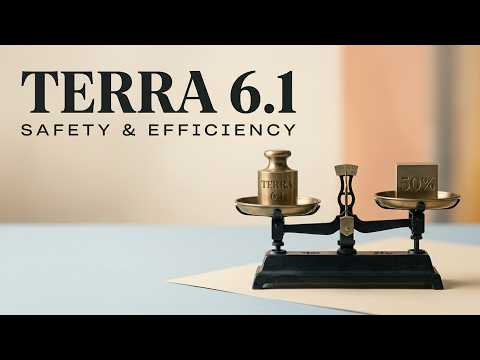
Priced 50% below its predecessor and billed as three times faster, Terra targets high-volume office automation

Overview

Updated Oct 29

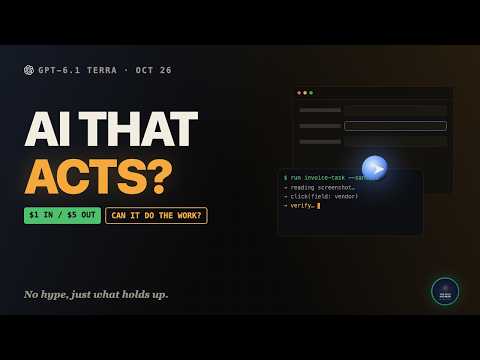
OpenAI released GPT-6.1 Terra on October 26, a model built for the screen-based work that fills office days: reading invoices, filling forms, editing videos and interpreting technical drawings. Standard API pricing is $1 per million input tokens and $5 per million output tokens, which OpenAI says is 50% below GPT-5.6 Terra.

The bet is that cost, more than raw capability, will decide how fast AI agents move into routine back-office work. OpenAI says Terra performs some professional tasks at a level comparable to its flagship GPT-6 Astra, at one-tenth the token price. Its benchmarks also show it completing tasks more than three times faster than the larger models. These figures come from OpenAI's own tests and have not been independently verified.

Why it matters

If Terra's price-performance holds in production, automating high-volume office work becomes cheap enough to change how businesses staff routine tasks.

Questions about this story

Free account needed to ask — your question is kept and asked for you right after sign-up. Answers are public.

No questions yet — be the first to ask.

Key Indicators

$1
API input price, per million tokens
Standard input rate for GPT-6.1 Terra.
$5
API output price, per million tokens
Standard output rate for GPT-6.1 Terra.
50%
List-price cut vs. GPT-5.6 Terra
OpenAI's stated reduction in standard API pricing.
15 pts
Agents' Last Exam gain at medium reasoning
Terra's score over GPT-5.6 Terra at roughly one-third the cost, per OpenAI.
16.7%
Low-effort error rate on OpenAI's internal benchmark
Down from 53.6% for GPT-5.6 Terra on error-inducing prompts.
3x
Claimed speedup over GPT-6 Astra and GPT-6.1 Sol
OpenAI's estimate of how much faster Terra completes computer-use tasks.

Voices

Curated perspectives — historical figures and your fellow readers.

Sign up to generate historical perspectives on this story.

People Involved

Organizations Involved

Timeline

2026 October 2026

4 events Latest: October 26th, 2026 · 2 weeks ago
Tap a bar to jump to that date
  1. OpenAI launches GPT-6.1 Terra

    Latest Product Release

    Lower-cost computer-use model launches at $1 per million input tokens and $5 per million output tokens, which OpenAI says is 50% below GPT-5.6 Terra.

  2. AWS adds Terra to Bedrock

    Availability

    Enterprise customers can call the model through Amazon's managed API platform.

  3. Microsoft and GitHub roll out Terra

    Availability

    Foundry, Azure AI, and GitHub Copilot all gain access to the model the same day.

  4. OpenAI ships GPT-6 Astra and GPT-6.1 Sol

    Product Release

    The flagship frontier model and the coding-focused model anchor the GPT-6 family.

Scenarios

1

GPT-6.1 Terra becomes OpenAI's most-used model

Likely Resolves by Q2 2027

Discussed by: OpenAI, framing Terra as its workhorse for high-volume automation

If Terra's price and speed hold up in production, it could displace GPT-5.6 Terra and take a large share of agentic API traffic. The cost-per-task advantage OpenAI claims is the core driver. Adoption would show up in token volumes that OpenAI occasionally reports in developer updates.

2

Anthropic or Google matches Terra's price-performance

Possible Resolves by Q1 2027

Discussed by: Competitive analysts tracking the agent-pricing race

Terra sets a new price floor for computer-use models. A rival like Anthropic or Google could respond by shipping a comparable model at or below $1 per million input tokens. A matching launch would signal that Terra's pricing, not its capability, is the harder advantage to hold.

3

A documented exploit emerges in Terra's computer-use mode

Possible Resolves by Q3 2027

Discussed by: Security researchers; OpenAI's own prompt-injection testing

Computer-use models that act on screens are exposed to malicious instructions hidden in web pages and documents. OpenAI says Terra showed strong resistance in its own prompt-injection tests, but real-world deployment is a harder proving ground. A demonstrated takeover would prompt safeguards updates or feature restrictions.

Historical Context

2 moments from history that rhyme with this story — and how they unfolded.

March 2023

GPT-3.5 Turbo (2023)

OpenAI released a lightweight, much cheaper version of its GPT-3.5 model as an API. Priced far below the flagship, it became the default engine for thousands of chatbot startups within months.

Then

The cost collapse triggered a wave of consumer and developer AI products built on the API.

Now

It established that price, not raw capability, drove the mass adoption of AI APIs.

Why this matters now

Terra is the same lever being pulled again: a dramatic price cut on a capable model, aimed at making agentic workloads economical at scale.

March 2024

Claude 3 Haiku (2024)

Anthropic shipped the smallest and cheapest model in its Claude 3 family, aimed at high-volume, low-latency tasks where a flagship model was overkill.

Then

Haiku gave Anthropic a competitive entry point for cost-sensitive automation customers.

Now

It popularized the three-tier family structure, fast and cheap, balanced, and flagship, that OpenAI's GPT-6 lineup now mirrors.

Why this matters now

Terra occupies the same tier for OpenAI, competing directly for budget-conscious automation buyers against Anthropic's small models.

Sources

(12)