




Pull to refresh
Logo
GameStop's bid to acquire eBay

GameStop's bid to acquire eBay

Money Moves

Board rejects $56 billion offer as Ryan Cohen weighs going hostile

May 12th, 2026: eBay board rejects bid as not credible

Overview

Updated May 12

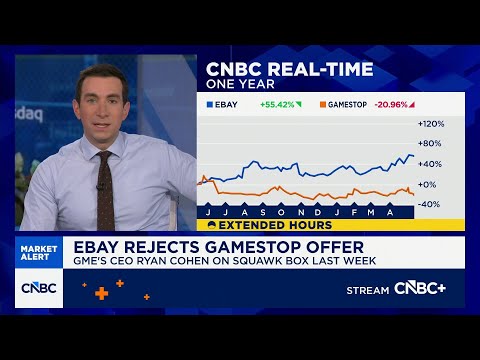
On May 3, Ryan Cohen sent eBay's board a $56 billion offer to buy the company. On May 12, the board sent it back. The directors called the bid 'neither credible nor attractive' and pointed to the debt the combined company would have to carry.

Cohen has signaled he may take the offer over the board's head and put it directly to eBay shareholders. That move, known as going hostile, would set up a major contested takeover fight.

Why it matters

Cohen is trying to buy a company larger than GameStop with borrowed money. The outcome tests whether meme-stock cash can fuel a major e-commerce acquisition.

Questions about this story

Free account needed to ask — your question is kept and asked for you right after sign-up. Answers are public.

No questions yet — be the first to ask.

Key Indicators

$56B
Total offer value
Cash-and-stock bid valuing eBay at about $125 per share.
$20B
Debt commitment
TD Bank financing letter, tied to the combined company keeping an investment-grade rating.
Credit negative
Moody's verdict
The rating agency warned the deal would weaken eBay's balance sheet.
9 days
Bid to rejection
Time between Cohen's May 3 offer and eBay's formal refusal.

Voices

Curated perspectives — historical figures and your fellow readers.

Cornelius Vanderbilt

Cornelius Vanderbilt

(1794-1877) · Gilded Age · industry

Fictional AI pastiche — not real quote.

"A board that calls fifty-six billion dollars neither credible nor attractive has confused their own comfort for their shareholders' interest — a mistake I never made twice. Go hostile, young man; the directors work for the owners, not the other way around, and it's high time someone reminded them of it."

Ever wondered what historical figures would say about today's headlines?

Sign up to generate historical perspectives on this story.

People Involved

Organizations Involved

Timeline

2 events Latest: May 12th, 2026 · 4 months ago
  1. eBay board rejects bid as not credible

    Latest M&A

    eBay's directors formally turn down the offer, citing financing concerns and the leverage burden. Moody's had separately warned the deal would be credit negative.

  2. Cohen submits $56 billion offer for eBay

    M&A

    GameStop sends eBay's board a nonbinding offer at roughly $125 per share, attached to a $20 billion TD Bank commitment letter contingent on an investment-grade rating.

Scenarios

1

Cohen launches tender offer, eBay shareholders approve sale

Unlikely Resolves by End of 2026

Discussed by: Bloomberg and Wall Street Journal M&A reporters; activist M&A specialists

Cohen raises the price modestly, files a tender offer directly with eBay shareholders, and runs a proxy fight to replace the board at the next annual meeting. He needs roughly 50% of shares tendered and enough proxy support to install a board that will sign a merger agreement.

2

GameStop withdraws bid as financing falls through

Possible Resolves by Q3 2026

Discussed by: Credit analysts at Moody's and S&P; CreditSights

Moody's confirms a downgrade to junk for the combined company. TD Bank's commitment lapses because the investment-grade condition cannot be met. Cohen pulls the offer rather than scramble for replacement financing.

3

eBay agrees to a revised, higher offer

Possible Resolves by End of 2026

Discussed by: M&A bankers cited by Reuters and the Financial Times

Cohen sweetens the cash portion or adds protections, and eBay's board returns to the negotiating table. The two sides sign a merger agreement at a higher price than the rejected $125 per share, with the board recommending the deal.

4

A competing bidder enters the contest

Unlikely Resolves by End of 2026

Discussed by: Speculation in the Wall Street Journal and Bloomberg deals desks

A larger strategic buyer, such as a major retailer or private equity consortium, files a superior offer for eBay. That gives eBay's board a stronger position to refuse Cohen and accept the new bidder.

Historical Context

3 moments from history that rhyme with this story — and how they unfolded.

October-November 1988

KKR's leveraged buyout of RJR Nabisco (1988)

RJR Nabisco's chief executive proposed a $17 billion management buyout. KKR launched a competing hostile bid. After a six-week battle, KKR won at $25 billion, the largest leveraged buyout in history at the time. The deal saddled RJR with $19 billion in debt.

Then

RJR cut costs sharply. KKR sold off divisions to service interest payments.

Now

The deal lost KKR money over its life. The book 'Barbarians at the Gate' became the cautionary tale of leveraged-buyout excess, and rating agencies grew warier of debt-heavy megadeals.

Why this matters now

Moody's 'credit negative' warning on the GameStop deal echoes the RJR concerns. When a buyer loads a target with debt, the rating downgrade can wreck the financing before the deal even closes.

February-May 2008

Microsoft's hostile bid for Yahoo (2008)

Microsoft offered $44.6 billion ($31 per share) for Yahoo in February 2008. Chief executive Jerry Yang's board rejected the bid as undervaluing the company. Microsoft raised its offer to $33 per share. Yahoo still refused, and Microsoft walked away in May.

Then

Yahoo's stock cratered after Microsoft withdrew. By December 2008, shares traded below $12, less than half the rejected offer.

Now

Yahoo never recovered as an independent company. Verizon bought its core internet business for $4.5 billion in 2017, roughly one-tenth the rejected Microsoft offer.

Why this matters now

eBay's board has reached the same conclusion Yang's did: the bid undervalues the company. Hostile suitors invoke the Yahoo precedent to argue that boards who refuse to engage punish their own shareholders.

September 2009-January 2010

Kraft's hostile takeover of Cadbury (2009-2010)

Kraft Foods made an unsolicited £10.2 billion bid for British confectioner Cadbury. Chairman Roger Carr called it 'derisory.' Kraft went hostile, took the offer directly to shareholders, and raised its price several times. Cadbury accepted in January 2010 at £11.9 billion.

Then

Kraft took on heavy debt to finance the deal. UK politicians attacked the takeover as a foreign raid on a national institution.

Now

Kraft later spun off Cadbury into Mondelez International. UK takeover rules tightened to require greater commitments from foreign buyers.

Why this matters now

Cadbury shows the playbook Cohen would run if he goes hostile: bypass the board, raise the price, win over shareholders one by one. Cadbury's board capitulated when 71% of shares were tendered to Kraft.

Sources

(3)