
Pull to refresh
Logo
Daily Brief
Following
Why Ranks Sign Up
Europe's quantum computing buildout

Europe's quantum computing buildout

Money Moves

Italy, France, and Germany use state capital to pull commercial quantum capacity inside their borders

5 days ago: Algorithmiq raises €18M and moves HQ to Milan

Overview

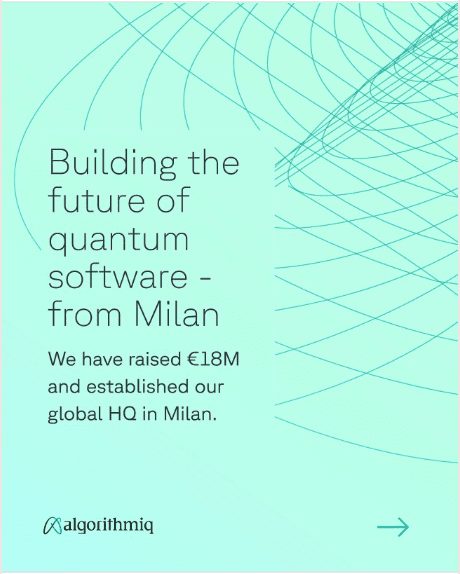
Quantum software startup Algorithmiq moved its global headquarters from Helsinki to Milan on May 11 after raising €18 million from Italian investors. The round is the largest venture capital investment in an Italian quantum company so far.

Europe trails the US and China in quantum hardware spending. National strategies in Italy, France, Germany, and the Netherlands now pull commercialization capacity toward those countries. State-backed funds lead the rounds.

Why it matters

Europe is trying to keep commercial quantum capability inside the bloc before US and Chinese firms control the application layer.

Play on this story Voices Debate Predict

Key Indicators

€18M
Algorithmiq round
Largest venture round for an Italian quantum software company.
€36M
Total funding
Cumulative venture backing for Algorithmiq since its 2020 founding.
€1B
EU Quantum Flagship
Brussels' 10-year commitment to quantum research, launched in 2018.

Interactive

Exploring all sides of a story is often best achieved with Play.

Ever wondered what historical figures would say about today's headlines?

Sign up to generate historical perspectives on this story.

People Involved

Organizations Involved

Timeline

  1. Algorithmiq raises €18M and moves HQ to Milan

    Funding

    United Ventures and Italy's state-backed CDP Venture Capital co-lead the round. Algorithmiq relocates its global headquarters from Helsinki to Milan to plug into Italy's National Quantum Strategy.

  2. Algorithmiq founded in Helsinki

    Company

    Quantum software firm spins out from University of Helsinki research, aiming to run chemistry algorithms on noisy quantum hardware.

  3. EU launches Quantum Flagship initiative

    Policy

    Brussels commits €1 billion over 10 years to quantum research, the first bloc-wide effort to build a European quantum industry.

Scenarios

Predict which scenario wins. Contrarian picks score more — points lock in when the scenario resolves.

Log in to predict. Track your picks, climb the leaderboard. Log in Sign Up
1

Milan becomes Europe's quantum software hub

More European quantum startups follow Algorithmiq's path. CDP Venture Capital continues to anchor rounds, Italian universities tighten links to industry, and Milan develops the talent density needed to retain founders. Italy ends the decade with a defensible position in quantum software while France and Germany hold the hardware side.

Discussed by: Italian government officials, CDP Venture Capital, Tech.eu, and Sifted
Consensus
2

EU quantum effort produces no global champion

US and Chinese spending continues to outpace European budgets. Commercial quantum applications take longer than expected to mature, and European startups either get acquired by US firms or stall before commercialization. National strategies produce research output but no global market leader in the application layer.

Discussed by: European quantum policy researchers at CEPS and Bruegel
Consensus
3

Algorithmiq becomes Europe's first quantum exit

Drug-discovery customers convert from pilots to production use, and Algorithmiq grows to a size where an IPO or strategic sale is possible. A pharma giant or a US tech platform acquires the company, testing whether Italy's industrial-strategy framework can hold onto the asset or whether it leaves the bloc.

Discussed by: European venture analysts and pharma corporate-development teams
Consensus

Historical Context

ASML emerges from a Philips spinoff (1984)

April 1984

What Happened

Philips spun off its lithography arm into ASM Lithography, a Dutch joint venture with ASMI based in Veldhoven. The company struggled for years against Japanese rivals Nikon and Canon. Dutch state support and EU research funding helped it survive the lean period.

Outcome

Short Term

By the early 2000s ASML matched its Japanese competitors on technology and price.

Long Term

ASML is now the sole supplier of extreme ultraviolet lithography machines, the chokepoint of advanced chip manufacturing. The US, China, and Japan all depend on its tools.

Why It's Relevant Today

A coordinated European push at a narrow technology layer can produce global dominance, even when the broader industry is American. Quantum software is the kind of narrow layer European policymakers are now trying to own.

Airbus consortium forms (1970)

December 1970

What Happened

France and West Germany launched Airbus as a state-backed consortium in December 1970, later joined by Spain and the UK. The stated goal was to challenge Boeing's dominance in commercial aviation. Early years required heavy government orders and subsidies.

Outcome

Short Term

Airbus lost money for over a decade and depended on European flag carriers for early orders.

Long Term

By 2003 Airbus delivered more aircraft than Boeing for the first time. The two companies have split the global commercial aviation market roughly evenly since.

Why It's Relevant Today

European industrial policy can challenge entrenched US dominance, but it takes decades and tolerates losses. Quantum buildout uses the same playbook: state capital, multi-country coordination, patience.

Sources

(3)