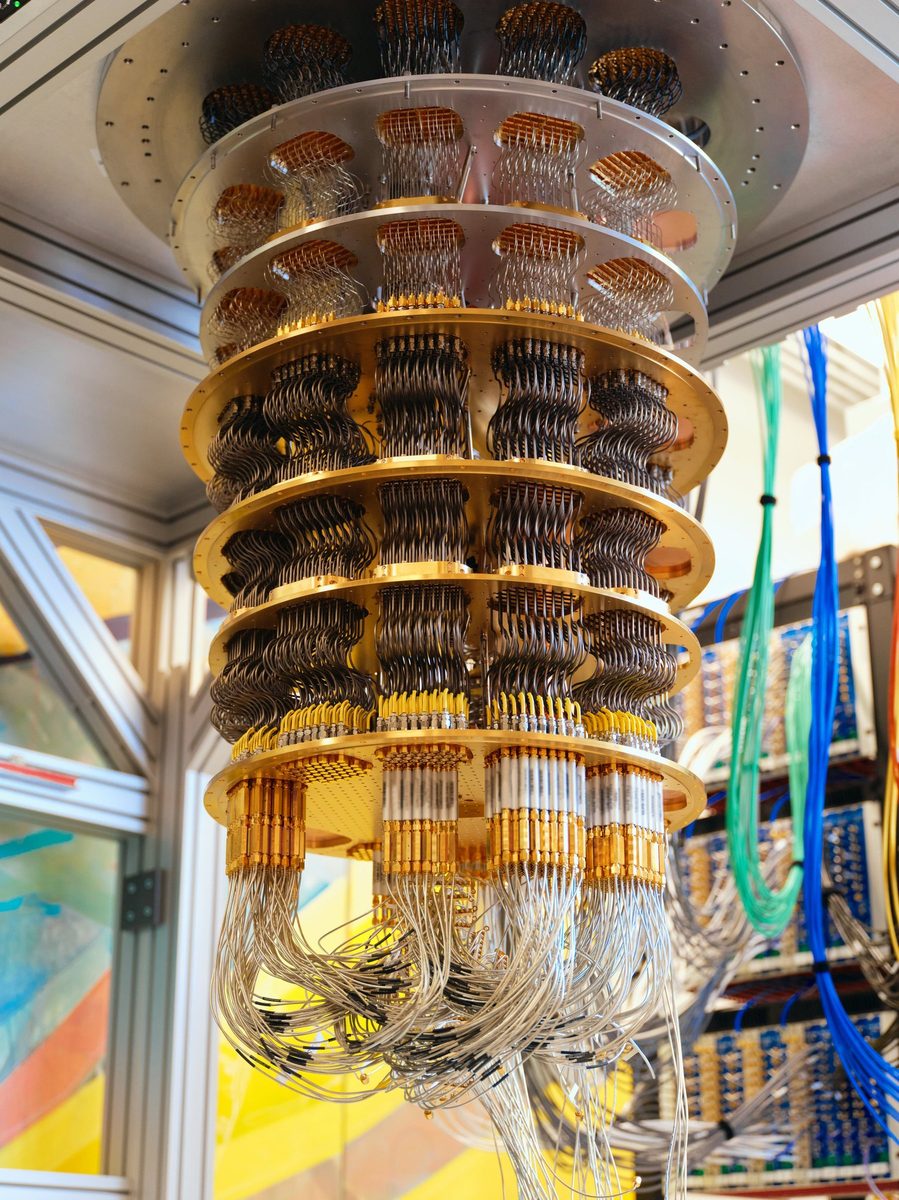
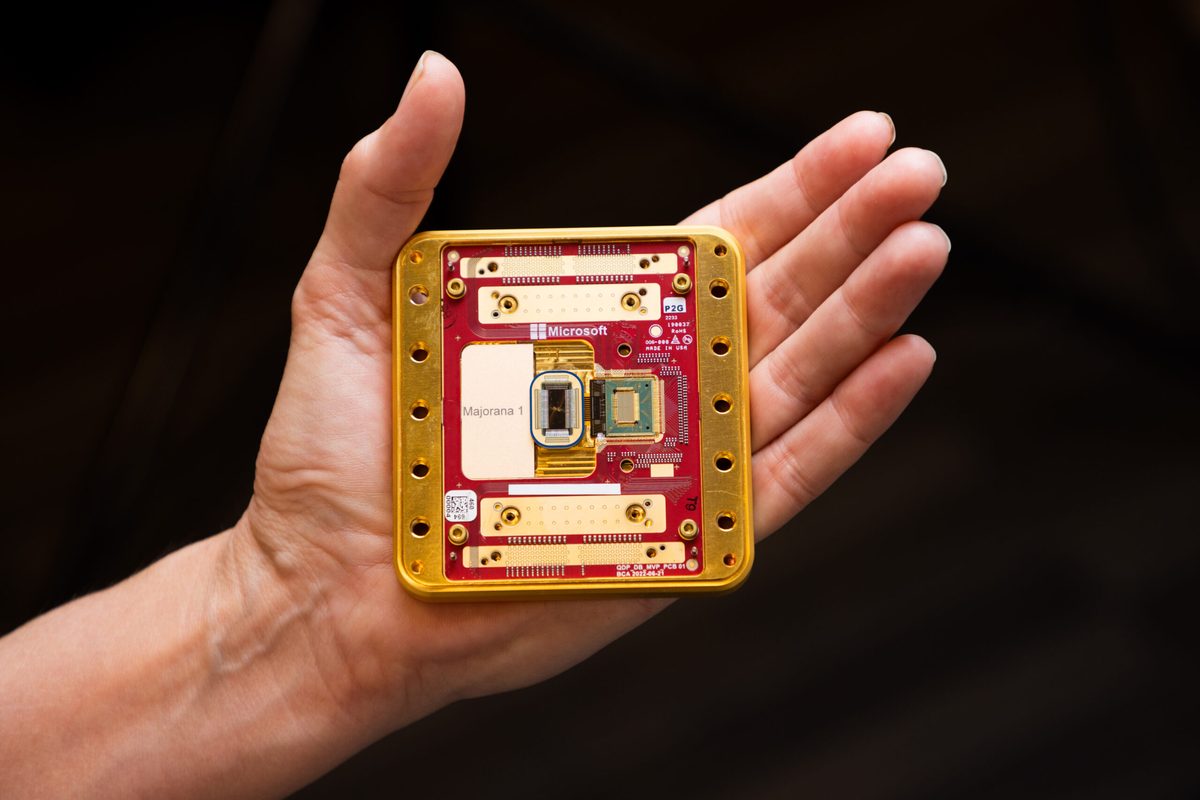
D-Wave Quantum closed its $550 million acquisition of Quantum Circuits in January 2026, adding Yale's dual-rail qubit technology to its quantum annealing platform. The deal is part of a nine-month consolidation spree: IonQ spent $1.08 billion on Oxford Ionics in June 2025 and announced a $1.8 billion SkyWater Technology acquisition in January 2026.
IonQ also completed multiple strategic purchases to build a vertically integrated quantum platform. Quantinuum filed for a $20 billion IPO. At least four quantum startups announced SPAC mergers worth over $3 billion combined.
The industry is consolidating around two interlocking questions: who cracks fault-tolerant quantum computing first, and who controls the supply chain to manufacture it at scale. IonQ's $1.8 billion bet on semiconductor foundry SkyWater is vertical integration from chip fabrication to quantum systems: error correction requires different physics than raw computing power, manufacturing requires owning fabs, and capital markets require scale. So companies are buying what they lack, merging to reach public markets, and racing to assemble complete technology stacks before 2026 milestones that could determine winners and losers for the next decade.
Questions about this story
Free account needed to ask — your question is kept and asked for you right after sign-up. Answers are public.
No questions yet — be the first to ask.
Key Indicators
$1.8B
Largest quantum acquisition (IonQ-SkyWater)
Vertical integration deal announced January 2026, surpassing IonQ-Oxford record
105
Qubits in Google's Willow chip
First system to achieve below-threshold error correction in Dec 2024
$20B
Quantinuum IPO target valuation
Would be largest quantum computing public offering
22 events
Latest: February 17th, 2026 · 7 months ago
Showing 8 of 22
JK to step
Tap a bar to jump to that date
Jump to
February 2026
Infleqtion Begins Trading on NYSE as INFQ
LatestInvestment
Infleqtion completed $1.8B SPAC merger with Churchill Capital Corp X, securing $550M+ gross proceeds including $125M+ PIPE. Became first publicly traded neutral-atom quantum computing company.
Silicon Quantum Computing Launches Quantum Twins Simulator with 15,000-Qubit Register
Technical Breakthrough
Silicon Quantum Computing (SQC) launched Quantum Twins, an analogue quantum simulator using a 15,000-qubit register to replicate complex molecular and material interactions.
Churchill Capital X Announces NYSE Listing Transfer for Infleqtion
Corporate
Churchill Capital Corp X announced transfer of listing from Nasdaq to NYSE following Infleqtion merger close. Combined company will trade under ticker INFQ, with listing expected mid-February 2026 pending shareholder vote approval on February 12.
SkyWater Expansion Plans Announced Following IonQ Acquisition
Corporate
SkyWater Technology announced plans to expand operations at its Kissimmee, Florida facility following IonQ's $1.8B acquisition agreement. Expansion expected to create jobs and advance quantum computing manufacturing capabilities.
Taiwan announced development of a 20-qubit quantum computer, marking a significant technical milestone in the global quantum computing race amid consolidation wave.
Stanford Researchers Develop Scalable Light-Trap Technology for Quantum Computing
Technical Breakthrough
Stanford researchers created miniature optical cavities that efficiently collect light from individual atoms, enabling simultaneous readout of multiple qubits. Breakthrough could support quantum networks with millions of qubits.
January 2026
IonQ Completes Seed Innovations Acquisition
Acquisition
IonQ finalized acquisition of Colorado-based AI software firm Seed Innovations for up to 1,171,868 IonQ shares. Team joins IonQ's Quantum Infrastructure division to integrate machine learning and cloud architecture expertise into quantum operations.
IonQ Completes Skyloom Acquisition for Quantum Networking
Acquisition
IonQ finalized acquisition of Skyloom Global Corp., U.S.-based developer of lightwave-optics technology for secure communications. Adds free-space optical communications expertise and photonic systems engineering to enable distributed quantum entanglement and quantum networking infrastructure.
IonQ to Acquire Seed Innovations for AI-Driven Infrastructure
Acquisition
IonQ announced definitive agreement to acquire Colorado-based AI-software firm Seed Innovations, scheduled to close January 30. Aims to integrate Seed's technical expertise into IonQ's Quantum Infrastructure division to optimize system performance and automate scaling of enterprise quantum solutions.
D-Wave Hosts Qubits 2026 and Announces Boca Raton HQ Move
Corporate
D-Wave held its annual Qubits 2026 conference in Boca Raton, featuring talks on dual-platform quantum roadmap and customer deployments. Company announced relocation of corporate headquarters from Palo Alto to Boca Raton Innovation Campus before year-end 2026, plus $20M Advantage2 system deal with Florida Atlantic University.
IonQ agreed to acquire semiconductor foundry SkyWater Technology for $35/share ($15 cash, $20 stock) in landmark vertical integration deal. Combines trapped-ion quantum computing with domestic foundry capabilities, accelerating 200,000 physical qubit QPU roadmap to 2028. Expected to close Q2-Q3 2026 pending shareholder and regulatory approvals.
Infleqtion S-4 Registration Declared Effective by SEC
Investment
SEC declared Infleqtion and Churchill Capital Corp X joint registration statement on Form S-4 effective (filed Jan 23). Churchill X set February 12 extraordinary general meeting for shareholder vote on $1.8B SPAC merger. Transaction expected to deliver $540M+ gross proceeds under ticker INFQ.
D-Wave Closes Quantum Circuits Acquisition
Acquisition
D-Wave completed $550M acquisition ahead of schedule, receiving $250M cash and issuing 10.4M shares. Dr. Rob Schoelkopf becomes chief scientist; New Haven R&D center established. Roadmap calls for 17-qubit system in 2026, 181-qubit error-corrected machine by 2028.
SEEQC Announces $1 Billion SPAC Merger
Acquisition
New York-based digital quantum-classical chip developer SEEQC agreed to merge with Allegro Merger Corp. at $1B valuation, backed by $65M PIPE. Deal targets Q2 2026 close, would scale SEEQC's Single Flux Quantum technology.
Quantinuum Files for IPO at $20B+ Valuation
Investment
Honeywell announced majority-owned Quantinuum confidentially submitted Form S-1 for IPO potentially valuing company at $20B+, seeking ~$1B. Would be first major traditional IPO after wave of SPAC listings, marking sector maturation.
D-Wave Acquires Quantum Circuits for $550 Million
Acquisition
D-Wave agreed to buy Quantum Circuits for $550M ($300M stock, $250M cash), combining annealing and gate-model quantum computing. Brings Yale professor Rob Schoelkopf and dual-rail qubit technology. First dual-rail system planned for 2026.
Infleqtion Files S-4 for Churchill Capital Merger
Acquisition
Infleqtion filed Form S-4 advancing $1.8B SPAC merger with Churchill Capital Corp X, backed by $125M+ PIPE. Deal targets Q1 2026 close under ticker INFQ. Company recently achieved 12 logical qubits, exceeding 2026 target.
D-Wave Demonstrates Scalable Cryogenic Control
Technical Breakthrough
D-Wave showed first scalable, on-chip cryogenic control of gate-model qubits, signaling readiness for gate-model quantum computing launch. Breakthrough came one day before Quantum Circuits acquisition announcement.
November 2025
Quantum Computing Funding Hits Record High
Investment
Investors poured $1.5B into quantum startups in 2024, nearly double 2023's total. First three quarters of 2025 saw $1.25B more, fueling consolidation wave.
September 2025
IonQ Completes Oxford Ionics Acquisition
Acquisition
IonQ finalized the Oxford Ionics purchase, rapidly accelerating its quantum computing roadmap and integrating world-class scientists into its team.
IonQ agreed to acquire UK quantum startup Oxford Ionics for $1.075B, the largest transaction in quantum computing history. Deal brings record-breaking ion trap technology to IonQ's platform.
Google demonstrated exponential error reduction as qubits scale, solving quantum computing's 30-year challenge. First system to achieve below-threshold quantum error correction with 105-qubit processor.
Discussed by: Analyst predictions cited by Yahoo Finance, Motley Fool coverage of QBTS valuation
D-Wave successfully integrates both quantum computing approaches and delivers commercial fault-tolerant systems before pure-play competitors. The combined annealing and gate-model platform captures enterprise customers who want one vendor for all quantum workloads. Wall Street analysts project the stock could reach $48, validating the $10.7B market cap. Risk: the company is burning $400M annually against $24M in revenue, so execution must be flawless and revenue growth must accelerate dramatically by late 2026 to justify current valuations.
Discussed by: Implied by historical parallels like Intel-Altera, where promised technology fusion never materialized
Annealing and gate-model quantum computing prove too different to integrate effectively. D-Wave ends up running two separate technology stacks with duplicated overhead. Quantum Circuits team operates as isolated unit in New Haven while D-Wave's annealing business continues independently. The company paid $550M for an option on gate-model technology but doesn't achieve the synergies Baratz promised. Like Intel's Altera acquisition, the deal value erodes as management realizes the technologies don't combine as hoped.
3
Google, IBM, or Chinese Labs Achieve Fault Tolerance First—D-Wave Left Behind
While D-Wave focuses on integrating Quantum Circuits, a rival achieves fault-tolerant quantum computing with 1,000+ logical qubits and demonstrates clear quantum advantage in commercially valuable applications. Google builds on Willow's momentum, IBM delivers on its 2026 Kookaburra roadmap, or Chinese researchers leverage recent error correction breakthroughs. First-mover advantage in fault tolerance proves decisive for enterprise adoption. D-Wave's hybrid strategy, designed to hedge all bets, instead left it behind the leaders in both annealing and gate-model computing.
4
Quantum Winter Arrives—Consolidation Accelerates as Funding Dries Up
Uncertain
Discussed by: Industry concerns about sustainability given losses across quantum sector, Riverlane predictions about capital shortage
The quantum computing bubble bursts when companies fail to deliver promised 2026 milestones and investors realize commercialization is still years away. D-Wave's stock crashes alongside rivals IonQ and Rigetti. Private quantum startups can't raise new funding. The industry enters consolidation phase where only a few well-capitalized survivors remain. D-Wave's Quantum Circuits acquisition looks prescient—scooping up capability before the market froze—but the company still faces brutal economics with massive losses and uncertain path to profitability.
5
SPAC Consolidation Wave Crashes—Deals Unwind as Quantum Winter Arrives
Possible
Discussed by: Implicit in SPAC market history (2021 bubble), analyst concerns about quantum timeline delays
Multiple pending SPAC mergers fail to close as investors redeem shares amid growing skepticism about 2026 fault-tolerance timelines. Quantinuum IPO gets postponed indefinitely. Private quantum startups that missed the SPAC window face brutal funding environment. The quantum sector enters a consolidation shakeout where only well-capitalized survivors (IBM, Google, potentially D-Wave post-QCI acquisition) can continue development. The SPAC route to public markets—which looked like a lifeline in early 2026—proves to be a trap as retail investors lose billions on overhyped quantum stocks.
6
Public Markets Validate Quantum Sector—Successful IPOs Fund Next Phase
Possible
Discussed by: Bull case implied by Quantinuum $20B valuation target, SPAC merger announcements
Quantinuum's IPO succeeds spectacularly, raising $1B+ at $20B+ valuation and proving quantum computing can attract traditional public market capital. Pending SPAC mergers close successfully, giving Infleqtion, SEEQC, Horizon Quantum, and Xanadu resources to execute roadmaps. Public market discipline and quarterly reporting force companies to deliver commercial products faster than private competitors. By late 2026, having multiple well-funded public quantum companies accelerates the entire sector as capital flows freely and talent concentrates at leaders. The consolidation wave successfully created viable long-term competitors to IBM and Google.
7
IonQ's Vertical Integration Succeeds—Manufacturing Control Becomes Competitive Moat
Possible
Discussed by: IonQ CEO Niccolo de Masi, industry analysts covering vertical integration strategy
IonQ's $1.8B SkyWater acquisition proves prescient as domestic semiconductor manufacturing becomes critical bottleneck for quantum computing scaling. By owning foundry capabilities at SkyWater's Minnesota, Florida, and Texas facilities, IonQ accelerates its 200,000 physical qubit roadmap to 2028 while competitors face manufacturing delays and supply chain constraints. The vertical integration strategy—spanning quantum computing, networking, security, and sensing with in-house chip fabrication—creates sustainable competitive advantage. Like Tesla's Gigafactories, controlling manufacturing proves as important as the underlying technology. IonQ emerges as the only truly independent, vertically integrated quantum platform.
Discussed by: Historical parallels with failed tech conglomerates, analyst concerns about execution risk
IonQ's aggressive 2025-2026 acquisition spree—Oxford Ionics ($1.08B), Qubitekk, ID Quantique, Capella Space, Skyloom, Seed Innovations, and SkyWater Technology ($1.8B)—proves impossible to integrate effectively. The company spent over $3 billion acquiring disparate capabilities across quantum computing, quantum networking, imaging satellites, semiconductors, and AI software. Management becomes overwhelmed coordinating seven different businesses with incompatible cultures and technologies. Like Hewlett-Packard's failed acquisitions or Yahoo's shopping spree, the deals destroy shareholder value as promised synergies never materialize. IonQ ends up as a bloated conglomerate trading at a discount, having sacrificed focus for empire-building.
Historical Context
3 moments from history that rhyme with this story — and how they unfolded.
1 of 3
2015-2025
Intel's Altera Acquisition (2015-2025)
Intel bought FPGA maker Altera for $16.7 billion in 2015, its largest acquisition ever, betting that combining CPU and programmable logic would create new chip categories. The promise: hybrid chips that outperform traditional processors in data centers and AI workloads. The companies operated separately for years. The promised technology fusion never fully materialized.
Then
Intel gained FPGA capability but struggled to integrate technologies.
Now
Intel sold controlling stake in Altera for $4.46B in 2025, valuing the business at $8.75B—nearly half the original purchase price.
Why this matters now
D-Wave faces similar integration risks combining fundamentally different quantum computing approaches. Like Intel-Altera, the strategic logic sounds compelling but successful technology fusion is harder than dealmakers assume.
2 of 3
2015-2016
Semiconductor Industry Consolidation Wave (2015-2016)
As the chip industry matured pre-AI boom, a massive M&A wave hit: Avago-Broadcom ($37B), NXP-Freescale ($12B), Intel-Altera ($16.7B), and others. Companies consolidated to achieve scale economies and assemble complete technology portfolios as growth slowed and R&D costs soared. The wave reflected industry realization that most players couldn't afford to compete independently across all fronts.
Then
Created a handful of dominant semiconductor conglomerates controlling key technologies.
Now
Consolidation proved prescient as AI explosion rewarded companies with diversified portfolios and manufacturing scale. Stragglers got left behind.
Why this matters now
Quantum computing may be entering its own consolidation phase. Like semiconductors in 2015, the technology is capital-intensive, requires diverse capabilities, and is approaching commercialization. D-Wave and IonQ are moving early, betting consolidation is inevitable and first movers gain advantage.
3 of 3
2019-2021
IBM's Red Hat Acquisition and Kyndryl Spin-off (2019-2021)
IBM bought Red Hat for $34 billion to accelerate its hybrid cloud strategy, then spun off its legacy infrastructure business as Kyndryl to sharpen focus. The moves reflected IBM's bet that it needed to narrow its scope and partner broadly rather than own everything. Kyndryl's separation allowed it to integrate technologies from multiple vendors instead of defaulting to IBM.
Then
IBM refocused on high-value hybrid cloud and AI, acquiring 37 companies in four years.
Now
Strategy succeeded in repositioning IBM around Red Hat's platform, validating focused acquisition approach over conglomerate model.
Why this matters now
Shows two paths for quantum computing: narrow specialization with broad partnerships versus vertically integrated platforms. IonQ and D-Wave are betting on the integrated model, absorbing complementary technologies through M&A.