


Pull to refresh
Logo
Charter closes $34.5 billion Cox merger to form largest US broadband operator

Charter closes $34.5 billion Cox merger to form largest US broadband operator

Money Moves

The combined company serves about 38 million subscribers and sells internet to more US homes than any rival

August 20th, 2026: Charter closes the Cox and Liberty Broadband deals

Overview

Updated Aug 20

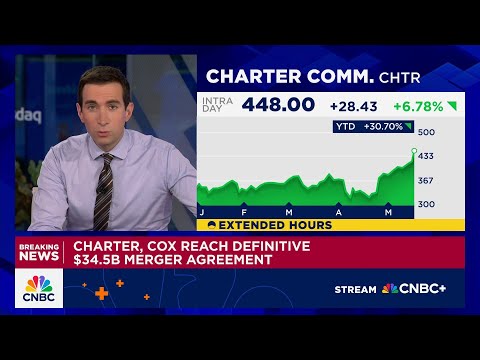
Charter Communications closed its $34.5 billion purchase of Cox Communications on Thursday, folding two of the country's biggest cable providers into one company. It now sells internet to about 35.6 million homes and businesses, more than Comcast.

The combined operator has roughly 38 million video, internet, and mobile subscribers across 45 states. Starting in mid-September, Cox customers move to Charter's Spectrum brand. The parent company will take the Cox Communications name within a year.

Why it matters

The combined company sells home internet to more Americans than any rival, giving it more pricing power just as wireless competitors chase the same customers.

Questions about this story

Free account needed to ask — your question is kept and asked for you right after sign-up. Answers are public.

No questions yet — be the first to ask.

Key Indicators

$34.5B
Deal value
Includes $21.9 billion in equity and $12.6 billion in assumed debt and other obligations.
~38M
Total subscribers
Video, internet, and mobile customers across the combined company.
~35.6M
Broadband customers
Home and business internet, ahead of Comcast's roughly 31 million.
45
US states served
The Spectrum brand will reach Cox markets starting in mid-September.
~26%
Cox Enterprises stake
Family-owned Cox Enterprises' share of the combined company after close.

Voices

Curated perspectives — historical figures and your fellow readers.

Ever wondered what historical figures would say about today's headlines?

Sign up to generate historical perspectives on this story.

People Involved

Organizations Involved

Timeline

May 2025 September 2026

6 events Latest: August 20th, 2026 · 3 weeks ago
Tap a bar to jump to that date
  1. Spectrum brand reaches Cox markets

    Upcoming Operations

    The company begins extending its Spectrum brand into former Cox territory in mid-September.

  2. Charter closes the Cox and Liberty Broadband deals

    Latest Deal

    The merger completes, creating the largest US broadband operator with about 38 million subscribers across 45 states.

  3. California grants the final approval

    Regulatory

    The California Public Utilities Commission approves the deal with conditions, including network upgrades and low-cost internet plans. It was the last state hurdle.

  4. FCC approves the merger

    Regulatory

    The Federal Communications Commission clears the combination, the main federal sign-off for the deal.

  5. Charter shareholders approve the deal

    Corporate

    More than 99% of votes cast at a special meeting back the merger and related steps needed to close.

  6. Charter announces $34.5 billion Cox deal

    Deal

    Charter agrees to buy Cox Communications, combining the two large cable operators. The price includes $21.9 billion in equity and $12.6 billion in assumed debt.

Scenarios

1

Combined company holds broadband lead over Comcast through 2027

Likely Resolves by Q1 2028

Discussed by: Fierce Network, Cartesian broadband research

The merger puts the new company ahead of Comcast in home internet customers on day one. Wireless carriers keep pulling low-end broadband users away, but Charter's larger base and mobile bundles slow the bleeding. If it still reports more broadband customers than Comcast at the end of 2027, the scale bet holds.

2

Wireless rivals win: company posts a full-year broadband customer loss

Possible Resolves by Q1 2028

Discussed by: Yahoo Finance, MoffettNathanson analysts

Charter was already losing broadband customers each quarter before the deal, as T-Mobile and Verizon sell home internet over their wireless networks. Merging with Cox adds customers but not immunity. If the combined company reports a net loss of broadband customers over its first full calendar year, 2027, the wireless threat is outrunning the scale gains.

3

Mobile becomes the growth engine as video keeps shrinking

Possible Resolves by Q1 2028

Discussed by: Broadband Breakfast, Light Reading

Charter sells mobile service over Verizon's network and bundles it cheaply with internet. Pay-TV keeps shrinking from cord-cutting, so mobile is the clearest growth line. If the company adds more than two million net mobile lines during 2027, the bundle strategy is carrying the merger.

4

Parent company completes rename to Cox Communications

Likely Resolves by Aug 20, 2027

Discussed by: Variety, The Hollywood Reporter

At closing, the company said the parent would take the Cox Communications name within a year while operating under the Spectrum brand. Completing the rename by August 2027 would confirm the terms Cox Enterprises negotiated for selling into a stock deal rather than cashing out.

Historical Context

3 moments from history that rhyme with this story — and how they unfolded.

February 2014 - April 2015

Comcast's blocked bid for Time Warner Cable (2014-2015)

Comcast agreed to buy Time Warner Cable for about $45 billion. Regulators at the FCC and Justice Department signaled the combined company would control too much of the broadband market, and Comcast walked away in April 2015.

Then

The collapse freed Time Warner Cable to sell to Charter instead a year later.

Now

It marked a rare instance of regulators stopping cable consolidation over broadband concentration.

Why this matters now

It shows these mergers can die at the regulatory stage. Charter cleared the FCC and all 45 states, a sign the concerns that sank Comcast's bid carried less weight this time.

July 2015

AT&T buys DirecTV (2015)

AT&T paid about $49 billion for DirecTV, betting big on satellite pay-TV just as streaming took off. Subscribers fled, and AT&T later spun off the TV business at a fraction of the price.

Then

AT&T gained tens of millions of TV customers and heavy debt.

Now

Cord-cutting gutted the value, and AT&T offloaded a majority stake in 2021 at a steep markdown.

Why this matters now

It is a warning about buying into shrinking pay-TV. Charter's deal leans on broadband and mobile, not video, which is exactly the business AT&T misjudged.

May 2016

Charter buys Time Warner Cable (2016)

Charter acquired Time Warner Cable and Bright House Networks in a set of deals worth roughly $65 billion. Overnight it jumped from a mid-size operator to the second-largest US cable company and launched the Spectrum brand.

Then

Charter absorbed millions of customers and spent years merging billing systems and rebranding services under Spectrum.

Now

The deal set the template Charter is now repeating: buy a large rival, cut costs, and put everything under the Spectrum name.

Why this matters now

This is the same playbook. The Cox integration will test whether Charter can repeat its earlier rebranding without driving customers away.

Sources

(8)