


Pull to refresh
Logo
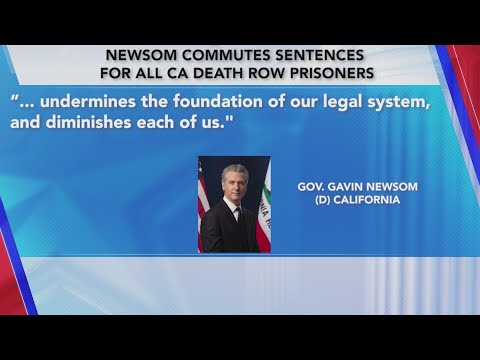
Newsom moves to commute all 548 California death sentences

Newsom moves to commute all 548 California death sentences

Rule Changes

At least a dozen district attorneys oppose the order, and a former Sacramento prosecutor plans to sue over victim notice. The court has no deadline, and the request lapses January 3.

Overview

Updated 2 days ago

Governor Gavin Newsom's order to commute all 548 California death sentences to life without parole now depends on the state Supreme Court, which has no deadline to act. About 382 of the condemned were convicted of more than one felony and need four justices to concur; the rest Newsom can commute on his own.

Prosecutors are pushing back. At least a dozen district attorneys have publicly condemned the order, San Joaquin County's top prosecutor has told his office to file writs in its five remaining cases, and former Sacramento County District Attorney Anne Marie Schubert plans to sue over what she says was inadequate notice to victims. Newsom's request lapses if the court does not act before he leaves office on January 3.

Why it matters

If the commutations hold, California's death row becomes a life-without-parole population and the state stops paying for death penalty appeals.

Questions about this story

Free account needed to ask — your question is kept and asked for you right after sign-up. Answers are public.

No questions yet — be the first to ask.

Key Indicators

12+
District attorneys publicly opposing
Fox News counted at least a dozen as of November 7, including Riverside, Kern, San Diego and Los Angeles counties.
Jan 3
Date the request lapses
If the Supreme Court has not acted before Newsom leaves office, the commutation request does not roll over to the next governor.

Voices

Curated perspectives — historical figures and your fellow readers.

Sign up to generate historical perspectives on this story.

People Involved

Organizations Involved

Timeline

1978 November 2026

9 events Latest: 3 days ago
Tap a bar to jump to that date
  1. A dozen district attorneys condemn the order

    Opposition

    Fox News reports at least a dozen California district attorneys publicly opposing the commutations. San Diego's Summer Stephan says her office is researching lawful remedies; Kern's Cynthia Zimmer says the action will be challenged.

  2. Newsom announces mass commutation

    Clemency

    He says all 548 death sentences will become life without parole, and sends 382 cases to the Supreme Court.

  3. Newsom halts executions

    Executive action

    The new governor orders a moratorium that lasts until he leaves office.

  4. California's last execution

    Execution

    The state carries out its 13th execution since reinstatement. None have followed.

  5. Voters reinstate the death penalty

    Ballot measure

    California voters restore capital punishment, reversing a 1972 state Supreme Court ruling.

Scenarios

1

Court signs off and all 548 sentences become life without parole

Possible Resolves by Q2 2027

Discussed by: Governor's office, Habeas Corpus Resource Center, ACLU

Four or more justices recommend commutation for the 382 people with multiple felonies, and Newsom issues certificates for them plus the roughly 166 he can act on alone. The death row population converts to life without parole, and the state's death penalty statute remains on the books but unused.

2

Court splits, leaving hundreds of death sentences in place

Uncertain Resolves by Q2 2027

Discussed by: Law.com, CalMatters reporting on the court's review

The court has no procedure for a single request covering hundreds of people and is short one justice. It could decline to recommend, recommend only some, or ask the governor to submit individual requests. Any of those outcomes leaves a substantial part of death row under sentence of death.

3

Legislature or voters abolish the death penalty outright

Unlikely Resolves by Nov 30, 2028

Discussed by: Los Angeles County District Attorney Nathan Hochman

Hochman's objection points to the gap the commutations leave open: the statute survives, so future prosecutors can still seek death sentences. Closing that gap requires a ballot measure or legislation, which would make the commutations permanent as a matter of state law rather than case-by-case clemency.

4

Prosecutors' lawsuit blocks or delays the commutations

Uncertain Resolves by Jan 5, 2027

Discussed by: Riverside County District Attorney Mike Hestrin, the California District Attorneys Association, the Criminal Justice Legal Foundation

Hestrin says district attorneys are looking at filing a case and hope it reaches the U.S. Supreme Court. Former Sacramento County District Attorney Anne Marie Schubert plans to sue to block the commutations on behalf of crime victims, arguing they were not given sufficient notice. A court could also find that commuting 382 sentences in one blanket request, without individual review, is an abuse of power.

5

The request lapses on January 3 and the death sentences stand

Possible Resolves by Jan 3, 2027

Discussed by: The Sacramento Bee, reporting on the court's schedule

Newsom leaves office on January 3, and his commutation request does not carry over to the next governor. If the Supreme Court has not recommended commutation by then, the 382 cases it covers stay under sentence of death unless his successor resubmits them.

Historical Context

2 moments from history that rhyme with this story — and how they unfolded.

February 1972

People v. Anderson (1972)

The California Supreme Court ruled 6-1 that the death penalty violated the state constitution's ban on cruel or unusual punishment. The decision emptied a death row of roughly 100 men, and their sentences were reduced.

Then

Every death sentence in the state was voided.

Now

Voters responded that November by approving a constitutional amendment restoring capital punishment, and the legislature reenacted a death penalty statute in 1977.

Why this matters now

California has cleared its death row before, and the reversal was undone at the ballot box within a year. It shows how quickly a clemency-based change can be answered by a statutory one.

March 2011

Illinois abolishes the death penalty (2011)

Governor Pat Quinn signed legislation ending capital punishment and, on the same day, commuted the sentences of all 167 people on the state's death row to life without parole. Illinois had halted executions in 2000 after investigations found defendants had been tortured into confessions and others were wrongly convicted.

Then

Illinois became the 16th state without the death penalty, and its death row emptied in a single act.

Now

The commutations held, and no later Illinois governor restored capital punishment.

Why this matters now

The closest precedent for what Newsom is attempting: a governor using clemency to clear an entire death row, paired with a political case for ending the practice.

Sources

(21)