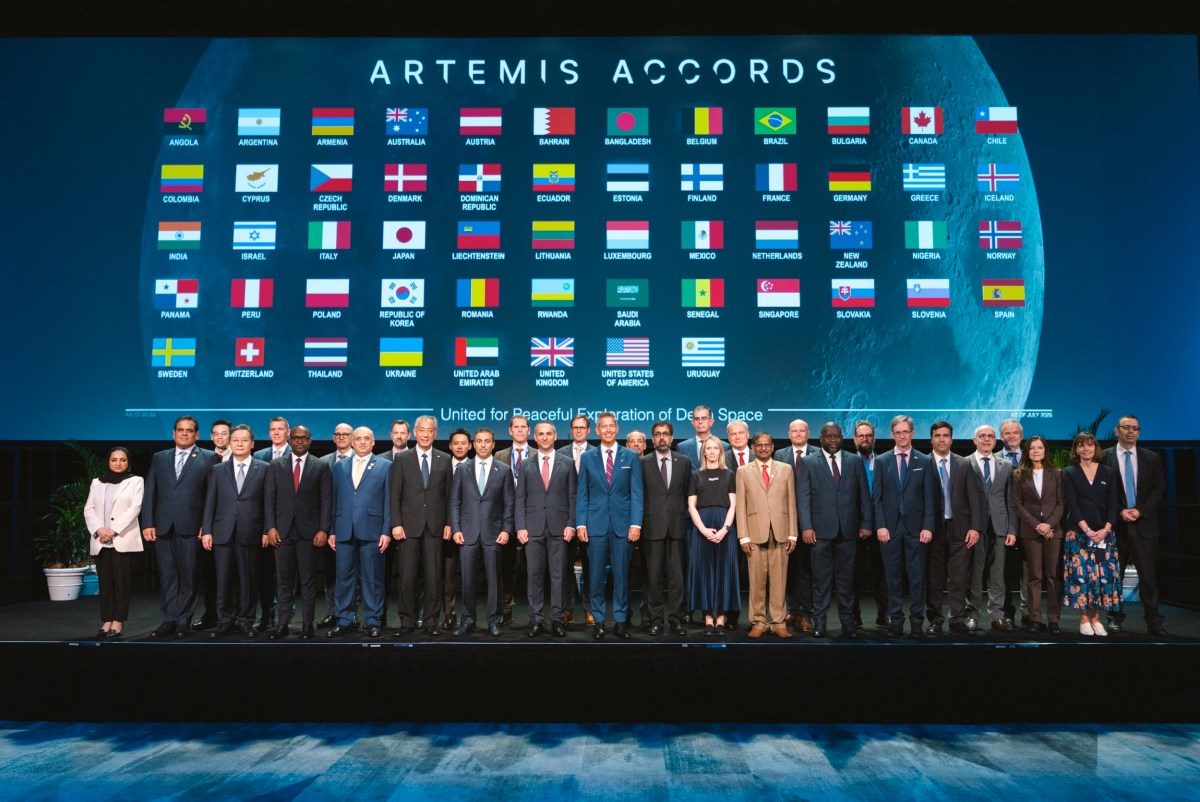
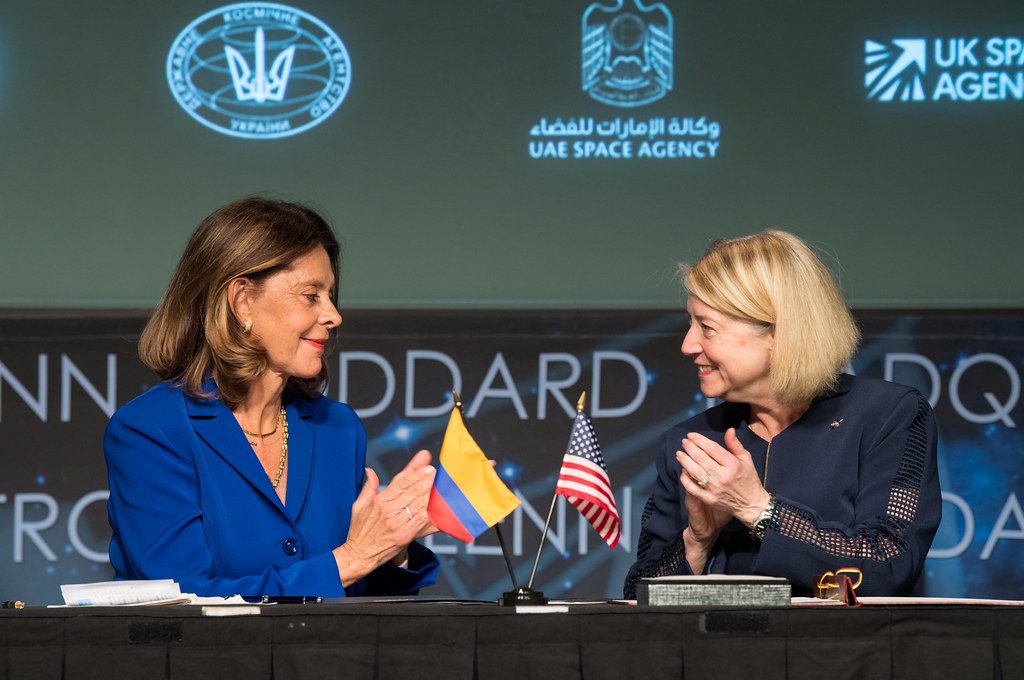
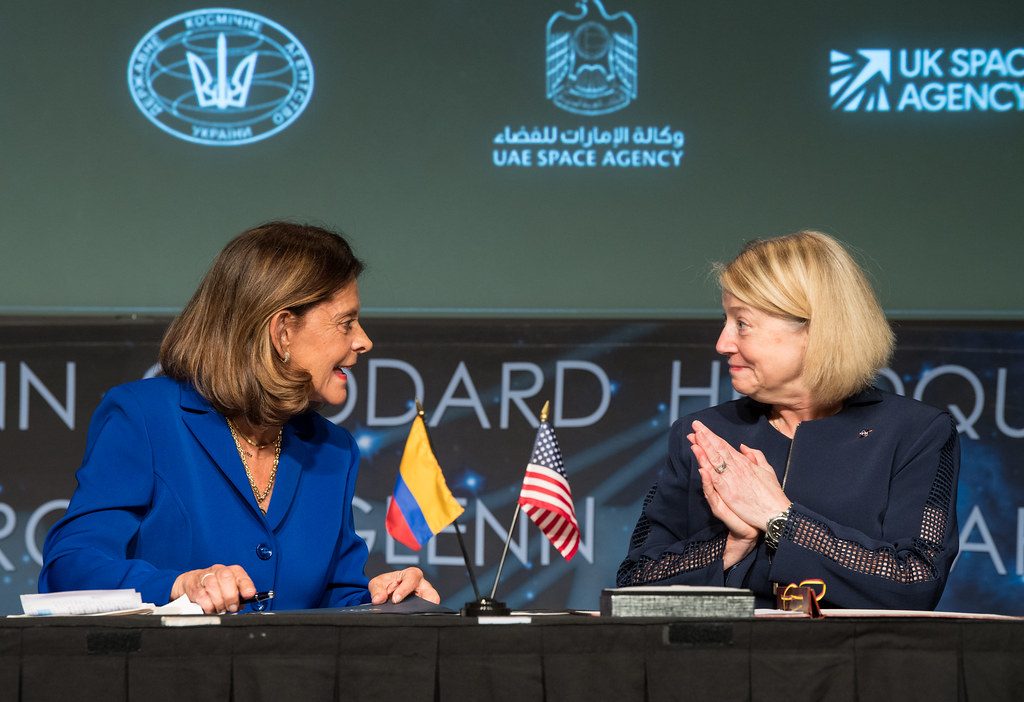
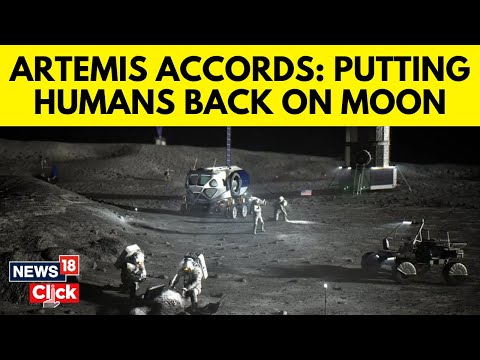
Eight nations signed the Artemis Accords in October 2020, establishing voluntary principles for how countries should behave on the Moon. Six more joined between April 23 and June 25, 2026, pushing the total to 68 — with Botswana becoming the sixth African signatory.
The Accords matter because they set rules for safety zones, resource extraction, and data sharing on the Moon. China and Russia have refused to sign and are building a rival framework, the International Lunar Research Station. Two competing blocs with potentially incompatible legal standards for the Moon are taking shape.
Why it matters
Two rival rule sets for the Moon are forming — which one prevails will determine who mines lunar resources and on what terms.
Questions about this story
Free account needed to ask — your question is kept and asked for you right after sign-up. Answers are public.
No questions yet — be the first to ask.
Key Indicators
68
Signatory nations
Countries that have signed the Artemis Accords as of June 25, 2026
8→68
Growth in nearly 6 years
From eight founding nations in October 2020 to 68 by June 2026
0
Binding legal obligations
The Accords are political commitments, not ratified treaties — no signatory is legally bound
2
Competing lunar blocs
The U.S.-led Artemis coalition and the China-Russia International Lunar Research Station framework
Images from Openverse under Creative Commons licenses.
Videos from YouTube.
Voices
Curated perspectives — historical figures and your fellow readers.
Dorothy Parker
(1893-1967) ·Jazz Age · wit
Fictional AI pastiche — not real quote.
"Sixty-two nations have agreed on how to share the Moon, which is sixty-two more than have ever agreed on anything down here — though I notice the ones who refused to sign are the same ones who've never much cared for sharing anything except blame."
0% found this insightful
George Orwell
(1903-1950) ·Modernist · satire
Fictional AI pastiche — not real quote.
"Sixty-two nations have agreed on how to share the Moon, which is to say that sixty-two nations have agreed, and two have not — and it is the two who have not that will determine everything."
0% found this insightful
Ever wondered what historical figures would say about today's headlines?
Sign up to generate historical perspectives on this story.
18 events
Latest: May 13th, 2026 · 4 months ago
Showing 8 of 18
JK to step
Tap a bar to jump to that date
Jump to
May 2026
Fourth annual Artemis Accords workshop held in Lima
LatestGovernance
Representatives from 30 signatory nations gathered in Lima for two days of technical discussions and tabletop exercises. Topics included non-interference, interoperability, scientific data release, and orbital debris mitigation.
Paraguay signs as 67th nation
Expansion
Paraguay's Minister-President of the Space Agency, Osvaldo Almirón Riveros, signed in Asunción. Paraguay was the sixth country to join since mid-April, bringing the coalition to 67 members.
Malta and Ireland sign on the same day; all ESA members now aboard
Expansion
Malta signed in Kalkara and Ireland signed at NASA Headquarters, becoming the 65th and 66th signatories respectively. Ireland's accession completed all 23 full members of the European Space Agency in the coalition.
April 2026
Morocco signs as 64th nation — first from North Africa
Expansion
Foreign Minister Nasser Bourita signed in Rabat, with U.S. Deputy Secretary of State Christopher Landau attending. Morocco became the first North African country and the fifth African nation overall to join the Accords.
Jordan signs as 63rd nation
Expansion
Jordan's Ambassador to the U.S., Dina Kawar, signed at NASA Headquarters alongside NASA Administrator Jared Isaacman. Jordan was the fourth country to join the Accords in 2026.
Latvia signs as 62nd nation
Expansion
Latvia's Minister for Education and Science Dace Melbārde signed the Artemis Accords at NASA Headquarters, with NASA Administrator Jared Isaacman and Under Secretary of State Jacob Helberg hosting the ceremony.
February 2026
NASA restructures Artemis III — no lunar landing
Program Update
NASA announced that Artemis III, planned for 2027, would test lunar landers in Earth orbit rather than land on the Moon. The first crewed landing was pushed to Artemis IV in late 2028.
January 2026
Oman signs as 61st nation
Expansion
Oman joined the Artemis Accords, bringing the total to 61 signatories.
October 2025
Five-year anniversary; Hungary, Malaysia, Philippines join
Milestone
NASA marked the Accords' fifth anniversary by welcoming three new signatories, with seven countries signing in 2025.
September 2025
Principals' Meeting held in Sydney
Governance
NASA, the Australian Space Agency, and the UAE Space Agency co-chaired a gathering of dozens of signatory nations to deepen dialogue on sustainable space operations.
December 2024
Panama and Austria bring total to 50
Milestone
Panama and Austria became the 49th and 50th signatories. Seventeen countries signed in 2024 alone, the fastest single-year expansion of the Accords.
June 2023
India signs during Prime Minister Modi's state visit
Expansion
India joined the Accords during a high-profile state visit to Washington, a geopolitically significant move given India's independent space capabilities and historically non-aligned posture.
December 2022
First African nations join the Accords
Expansion
Rwanda and Nigeria signed the Artemis Accords, extending the coalition to the African continent for the first time.
June 2022
France signs, breaking European hesitation
Expansion
France became the first major European Space Agency contributor to sign the Accords, signaling that European caution about the U.S.-led framework was easing.
June 2021
China and Russia announce rival lunar framework
Geopolitical
China and Russia jointly unveiled the International Lunar Research Station plan, establishing a competing governance framework for lunar activity with its own set of international partners.
May 2021
South Korea becomes 10th signatory
Expansion
South Korea joined the Accords, moving the coalition into double digits and bringing aboard a major technology economy.
October 2020
Artemis Accords launched with 8 founding nations
Agreement
NASA and the U.S. State Department unveiled the Artemis Accords, signed by Australia, Canada, Italy, Japan, Luxembourg, the United Arab Emirates, the United Kingdom, and the United States.
November 2015
U.S. legalizes space resource extraction
Legislation
President Obama signed the Commercial Space Launch Competitiveness Act, asserting that U.S. citizens have the right to own and sell resources extracted from asteroids and the Moon — a legal foundation the Accords would later extend internationally.
Scenarios
1
Accords reach 100 signatories and become de facto international space law
Possible
Discussed by: Space policy analysts at the Secure World Foundation and the Space Review; parallels drawn to how the Antarctic Treaty's norms became universal despite never being formally universal
If the Accords continue adding roughly a dozen signatories per year, they could pass 100 nations before the first crewed lunar landing. At that scale, their principles — safety zones, resource extraction rights, data sharing — would function as customary international law regardless of formal legal status. This would marginalize COPUOS as the primary rulemaking body for lunar activity and lock in a U.S.-authored governance framework before China's competing program reaches the Moon.
2
Two incompatible legal frameworks split the Moon into rival zones
Possible
Discussed by: The Diplomat, Seradata, and space law scholars at Cambridge; Chinese government-affiliated media has framed the Accords as 'space enclosure'
China's International Lunar Research Station attracts its own coalition — particularly nations in the Global South skeptical of U.S.-led frameworks — while Artemis signatories build out their own operations. If the two blocs establish overlapping safety zones or conflicting resource claims near the lunar south pole, where both programs plan to operate, the result could be a jurisdictional standoff with no agreed mechanism for resolution.
3
Accords stall as non-binding commitments prove toothless
Possible
Discussed by: Critics at the American Society of International Law and European space law scholars; skeptics point to the 1979 Moon Agreement, which was adopted but never ratified by any major spacefaring nation
The Accords are political commitments, not ratified treaties. If a signatory violates their principles — by establishing an exclusionary safety zone, extracting resources without transparency, or interfering with another nation's operations — there is no enforcement mechanism. Signatories could sign for diplomatic goodwill without meaningfully constraining their behavior, hollowing out the framework as actual lunar operations begin.
4
A binding multilateral treaty supersedes the Accords
Unlikely
Discussed by: COPUOS delegates, particularly from nations not aligned with either the U.S. or Chinese bloc; the European Space Agency has expressed interest in multilateral approaches
Pressure from non-aligned nations and legal scholars could push the international community toward a binding treaty negotiated through the United Nations. This would likely incorporate some Accords principles — transparency, deconfliction — while imposing stronger constraints on resource extraction and safety zones. The Accords would then serve as a stepping stone rather than an endpoint, much as the International Geophysical Year preceded the Antarctic Treaty.
Historical Context
3 moments from history that rhyme with this story — and how they unfolded.
1 of 3
December 1959
The Antarctic Treaty (1959)
Twelve nations with competing territorial claims in Antarctica — including Cold War adversaries the United States and the Soviet Union — signed a treaty freezing all claims and dedicating the continent exclusively to peaceful scientific research. The agreement emerged from the cooperative spirit of the 1957-58 International Geophysical Year.
Then
Military activity, nuclear testing, and mineral extraction were banned. Existing territorial claims were frozen but not renounced, a diplomatic compromise that made agreement possible.
Now
The treaty system expanded to 58 parties and spawned additional protocols, including a 1991 mining ban. It became a model for governing shared spaces — though critics note it was negotiated among relatively few stakeholders.
Why this matters now
The Artemis Accords face the same core challenge: setting rules for a shared frontier before commercial exploitation begins. But unlike the Antarctic Treaty, the Accords are non-binding and exclude major rivals China and Russia, raising questions about whether a framework without universal buy-in can hold.
2 of 3
December 1982
The UN Convention on the Law of the Sea (1982)
After nine years of negotiation, 160 nations signed a comprehensive treaty governing ocean resources, navigation rights, and seabed mining. The treaty declared deep seabed minerals the 'common heritage of mankind' — a principle the United States rejected, refusing to ratify.
Then
The treaty entered into force in 1994. The U.S. still has not ratified it, though it observes most provisions as customary international law.
Now
The convention established the International Seabed Authority to regulate deep-sea mining. The U.S. non-ratification created a persistent governance gap for the world's largest naval power.
Why this matters now
The Law of the Sea shows what happens when a major power rejects the 'common heritage' framework — which is precisely the principle China invokes against the Accords' resource extraction provisions. The U.S. is effectively trying to establish space resource norms bilaterally rather than through the multilateral approach it refused to join for oceans.
3 of 3
January 1998
The International Space Station agreements (1998)
The United States, Russia, Japan, Canada, and the European Space Agency signed an intergovernmental agreement to build and operate the International Space Station, creating a multilateral governance framework for the most complex international engineering project in history. The agreement covered jurisdiction, intellectual property, and liability across 15 nations.
Then
The ISS was assembled over a decade of cooperative missions despite deep geopolitical tensions, including the 2014 Russian annexation of Crimea.
Now
The station operated for over 25 years, proving that multilateral space governance could survive political crises. However, cooperation depended on mutual dependence — neither side could operate the station alone.
Why this matters now
The ISS model shows that space cooperation can work even between rivals, but it required genuine interdependence. The Artemis Accords lack that structural glue — signatories gain diplomatic goodwill but face no operational consequences for leaving.