
Pull to refresh
Logo
Google WeatherNext AI model beats standard cyclone forecasts by a day

Google WeatherNext AI model beats standard cyclone forecasts by a day

New Capabilities

Nature study confirms three-day storm forecasts now match old two-day accuracy; model already helped warn Jamaica before Hurricane Melissa.

2 days ago: Nature paper confirms WeatherNext cyclone breakthrough

Overview

Updated 2 days ago

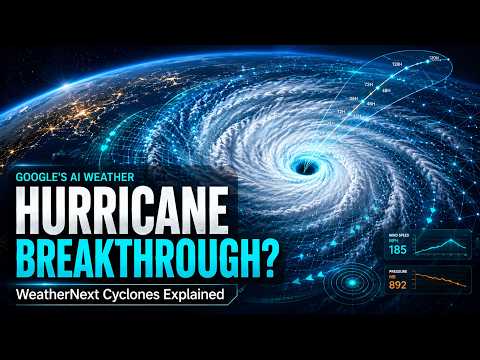
Google's WeatherNext AI model predicts cyclone paths and intensity a full day earlier than conventional physics-based models—a gain equal to a decade of meteorological progress. The results, published in Nature on September 10, show three-day forecasts matching the accuracy of previous two-day predictions.

The model learns from 50 years of weather data instead of simulating fluid dynamics on supercomputers. It runs a 15-day forecast in under a minute on a single chip, generating a thousand scenarios per cyclone. The National Hurricane Center used it in 2025 to warn Jamaica before Hurricane Melissa jumped from Category 1 to Category 5.

Why it matters

An extra day of cyclone warning gives communities more time to evacuate and prepare. That window can save lives when storms rapidly intensify.

Questions about this story

Free account needed to ask — your question is kept and asked for you right after sign-up. Answers are public.

No questions yet — be the first to ask.

Key Indicators

1 day
Extra forecast lead time
Average lead-time advantage over leading operational models for track, intensity, and wind structure.
30%
Edge over NHC at 5-day track forecasts
Second consecutive year WeatherNext outpaced National Hurricane Center human-refined forecasts at most lead times.
1,000
Ensemble scenarios per cyclone
Up from 50 predictions last year; captures rare rapid-intensification events.
28x28 km
Input resolution (100x coarser than traditional models)
The model needs only coarse data yet matches finer physics-based models—a result scientists say remains unexplained.
< 1 minute
Time to generate a 15-day forecast on one TPU
Compare: traditional supercomputers the size of shipping containers take far longer per run.

Voices

Curated perspectives — historical figures and your fellow readers.

Ever wondered what historical figures would say about today's headlines?

Sign up to generate historical perspectives on this story.

People Involved

Organizations Involved

Timeline

October 2024 September 2026

5 events Latest: 2 days ago
Tap a bar to jump to that date
  1. Nature paper confirms WeatherNext cyclone breakthrough

    Latest Publication

    Peer-reviewed study confirms extra day of warning; WeatherNext 2, Cyclones, and 2-mini models open-sourced.

  2. WeatherNext study shows full day of added lead time

    Research

    Evaluation of cyclones from 2023-2025 shows 24-hour lead time advantage over leading operational models.

  3. WeatherNext 2 operationalized

    Deployment

    Updated model entered use in October 2025 with 64-member ensemble generation in one pass.

  4. NHC issues historic Hurricane Melissa warning using WeatherNext

    Operational use

    Model predicted rapid intensification from Category 1 to Category 5 ahead of Jamaica landfall.

  5. WeatherNext Cyclones tracks Hurricane Milton up to 15 days out

    Capability demonstration

    Model iteratively predicted global weather and cyclone tracks during the October 2024 hurricane.

Scenarios

1

Weather agencies extend public forecasts from five to seven days

Likely Resolves by End of 2027

Discussed by: Google DeepMind blog post: agencies 'are looking to extend their public forecast horizons from five days to seven'

The National Hurricane Center and other agencies adopt WeatherNext operationally, using the extra day of accuracy to extend public tropical cyclone forecasts from five to seven days. WeatherNext 3 is already deployed in Google Search, Gemini, and Maps, easing public acceptance.

2

Open-source WeatherNext becomes global operational standard

Possible Resolves by End of 2027

Discussed by: Google DeepMind open-source release; the-decoder coverage of WN-C capabilities

With code and model weights freely available, weather services worldwide adopt WeatherNext or direct derivatives for operational forecasting. Emerging economies without supercomputing infrastructure gain access to state-of-the-art cyclone prediction for the first time.

3

Researchers explain why coarse resolution still works

Uncertain Resolves by Sep 10, 2027

Discussed by: Google DeepMind researchers, who call it 'an open research question'

The scientific community investigates why a 28x28km model outperforms physics-based models running at 100x finer resolution. A peer-reviewed explanation would validate the approach and accelerate adoption; failure to explain it could slow trust among cautious forecasters.

Historical Context

3 moments from history that rhyme with this story — and how they unfolded.

1922

Richardson's hand-calculated forecasts (1922)

Lewis Fry Richardson published Weather Prediction by Numerical Process, laying out equations for forecasting weather by solving physics problems. His calculation for a single day's forecast took more than six weeks by hand.

Then

The method was impractical without computers; Richardson's work was largely ignored for decades.

Now

Numerical weather prediction became operational with computers in the 1950s and dominated forecasting for 75 years.

Why this matters now

Like Richardson's physics equations, WeatherNext needed the right hardware to become practical. The AI approach compressed a decade of meteorological progress into a single generation.

April 1950

First computer weather forecast (1950)

A team including Jule Charney ran the first numerical weather forecast on the ENIAC computer. It took 24 hours of computing to produce a 24-hour forecast.

Then

Established the physics-simulation paradigm for weather forecasting.

Now

Supercomputers scaled this approach over 75 years, gaining roughly one day of forecast accuracy per decade.

Why this matters now

WeatherNext skips physics simulation entirely, generating predictions from data patterns—a shift as fundamental as the move from hand to computer calculation.

Early 1990s

Ensemble forecasting adoption (early 1990s)

The European Centre for Medium-Range Weather Forecasts launched the first operational ensemble prediction system, running multiple forecast scenarios to capture uncertainty instead of a single deterministic run.

Then

Ensemble methods became standard practice across world weather services.

Now

Forecasters now expect probabilistic guidance, not single answers.

Why this matters now

WeatherNext extends the idea to 1,000 ensemble members per cyclone, far beyond the tens used in physics-based systems—capturing rare but catastrophic rapid-intensification events.

Sources

(8)