

Pull to refresh
Logo
An AI agent chose a gene therapy and guided the needle into a live mouse's brain

An AI agent chose a gene therapy and guided the needle into a live mouse's brain

New Capabilities

Exin Therapeutics let Claude Sonnet 5, GPT-6.1 Sol and Grok 4.7 each pick a therapy, a brain region and an injection path, then drive a robotic rig through a hole a veterinarian cut in a mouse's skull

Overview

Updated Nov 1

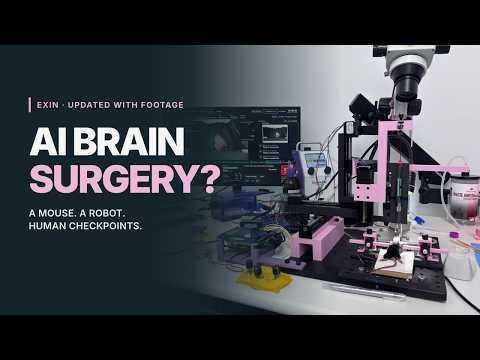
On October 28, Exin Therapeutics chief executive Gabriel Ocana-Santero posted an account of a Claude Sonnet 5 agent choosing one of 19 gene therapies, picking the lateral entorhinal cortex, and driving 250 nanoliters of the treatment into a live mouse's brain. A veterinarian opened the skull and kept a stop button within reach. Two days later, Ocana-Santero said two more models, GPT-6.1 Sol and Grok 4.7, had each done the same on separate mice, choosing different brain regions and different therapies.

The new part is that a model, not a person, chose the treatment and the target, then executed the delivery on a living animal. The three runs produced three plans and no seizure results yet. A calibration error delayed the Claude run; GPT flagged a possible bleed and handed the decision to the surgeon; Grok lost its position after a mistaken stop and refused to re-enter the brain. Exin has promised a technical report, but no peer-reviewed data has appeared.

Why it matters

If a model can pick a drug and steer a needle into a living brain, the scarce resource in animal research becomes oversight, not hands.

Questions about this story

Free account needed to ask — your question is kept and asked for you right after sign-up. Answers are public.

No questions yet — be the first to ask.

Key Indicators

19
Therapies the agent chose from
The agent picked one candidate from a spreadsheet of 19 options.
250 nL
Claude's injection volume
Delivered over five minutes; GPT and Grok chose doses about twofold apart.
3
Live animals injected by agents
One mouse per model; Exin said all three were recovering.
~60 min
Claude run time
Against roughly 45 minutes for the same surgery done by hand.
34 mm
Errant Y-axis target
Computed on a rig with 30 millimeters of travel; the Claude agent flagged it and refused to retry.

Voices

Curated perspectives — historical figures and your fellow readers.

Sign up to generate historical perspectives on this story.

People Involved

Organizations Involved

Timeline

October 2026 November 2026

4 events Latest: November 1st, 2026 · 1 week ago
Tap a bar to jump to that date
  1. WIRED reports the run; accounts differ on the code fix

    Latest Coverage

    WIRED says a second agent on Opus 5 made the code changes without being told a live surgery was underway; other accounts say humans fixed the rig mid-surgery.

  2. Exin says GPT and Grok also completed live mouse injections

    Experiment

    Ocana-Santero said GPT-6.1 Sol and Grok 4.7 each got the same 19 vectors and one mouse; the three models chose different brain regions, mechanisms and doses. A veterinarian still performed the craniotomy.

  3. Company posts account of the agent-run injection

    Statement

    Ocana-Santero describes the agent picking a therapy, a brain region and coordinates, then driving the rig.

  4. Exin posts CircuitATLAS preprint

    Research

    A knowledge graph of 3.83 million nodes, plus an agent that nominated a target for humans to test in live animals.

Scenarios

1

Exin reports that the injected therapy reduced seizures

Uncertain Resolves by Q2 2027

Discussed by: Exin Therapeutics; the company has said it is waiting for the therapy to take effect

Claude's vector raises inhibitory GABA signaling in GABAergic neurons, delivered to the lateral entorhinal cortex. GPT targeted the hippocampus with an ion-channel therapy; Grok targeted the somatosensory cortex with two vectors. If any treated mouse shows fewer seizures than controls, the demonstration becomes a result. Exin has promised a technical report; none has appeared yet.

2

Therapy fails; the run stands as a capability demonstration only

Possible Resolves by Q2 2027

Discussed by: Startup Fortune and The Rundown AI, both noting the outcome remains unknown

Gene therapies often fail in animal models. If none of the three treated mice shows fewer seizures, Exin still has a notable demonstration: an agent chose a treatment and a brain target and delivered it. The scientific value shifts from the drug to the workflow, and the company's next milestone becomes repeatability across more animals and models.

3

Exin lets an agent perform the craniotomy on a live animal

Unlikely Resolves by End of 2027

Discussed by: Ocana-Santero, who says the company is experimenting with agent-controlled craniotomies

Opening the skull is the step Exin currently reserves for a surgeon, calling a mistake there capable of seriously harming the animal. The company says it wants to be sure of safety before moving to live surgeries. A successful supervised run would extend the agent's role from injection to the irreversible step itself.

Historical Context

3 moments from history that rhyme with this story — and how they unfolded.

January 2022

STAR robot sutures live pig intestine (2022)

A Johns Hopkins team led by Axel Krieger reported in Science Robotics that its STAR robot had sewn together sections of intestine in live pigs, working laparoscopically, with the animals followed for a week.

Then

The surgeries succeeded, and the pigs recovered.

Now

The system let an operator pick among autonomously generated surgical plans. The machine executed; the human chose the operation.

Why this matters now

This is the line Exin says it crossed. The robot's precision was not the new part; the agent deciding what operation to perform was.

July 2025

SRT-H removes gallbladders outside a body (2025)

Krieger's lab and collaborators presented SRT-H in Science Robotics. It performed steps of a gallbladder removal on eight gallbladders, described as fully autonomous with a 100% success rate.

Then

The demonstrations worked on organs that were not inside a living body.

Now

Autonomy claims in surgery became routine enough that the meaningful question moved to what the machine decides, not whether it can move.

Why this matters now

Exin's run differs on two counts: a living animal, and an agent choosing the treatment and target rather than executing a human's plan.

December 2023

Coscientist runs chemistry experiments (2023)

Carnegie Mellon researchers described an AI agent, Coscientist, that planned chemical reactions and carried them out on robotic lab hardware, including work on palladium-catalyzed cross-coupling.

Then

The agent completed reactions on commercial cloud-lab equipment.

Now

It established a template: models connected to instruments, with humans setting the boundaries of what they may do.

Why this matters now

Exin applies the same pattern to animal surgery, where the boundaries are veterinary oversight and a physical kill switch rather than a fume hood.

Sources

(8)