


Pull to refresh
Logo
3SBio's PD-1/VEGF bispecific shows near-14-month median PFS in lung cancer trial

3SBio's PD-1/VEGF bispecific shows near-14-month median PFS in lung cancer trial

New Capabilities

ESMO 2026 Phase II follow-up strengthens the case behind Pfizer's $1.4 billion licensing bet

Overview

Updated Oct 29

At the 2026 European Society for Medical Oncology congress, 3SBio reported a median progression-free survival (the time patients live without the disease worsening) of 13.6 months in squamous and 13.8 months in non-squamous advanced lung cancer. The drug, tivunatamig, was combined with chemotherapy, and the control groups received tislelizumab plus chemotherapy, reaching 8.3 and 9.7 months.

The drug combines PD-1 blockade and VEGF blockade in one molecule. The trial is non-randomized, and the groups are small, so the comparison is not conclusive. Pfizer licensed global rights in 2025 for $1.4 billion upfront, and 11 international trials are now registered. The Phase III Symbiotic-Lung-01 trial, which compares the drug with pembrolizumab plus chemotherapy, started January 6, 2026.

Why it matters

If Phase III confirms these numbers, one drug could replace two separate therapies in first-line lung cancer — and Pfizer's $6 billion bet rides on it.

Questions about this story

Free account needed to ask — your question is kept and asked for you right after sign-up. Answers are public.

No questions yet — be the first to ask.

Key Indicators

13.8 months
Median PFS, non-squamous NSCLC
Tivunatamig plus chemotherapy, versus 9.7 months in the tislelizumab control arm. Non-randomized comparison.
80.7%
Confirmed ORR, squamous NSCLC
Objective response rate versus 67.7% in the control arm; 77.5% in non-squamous disease versus 44.7%.
$1.4B
Pfizer upfront payment
Largest upfront payment in a single out-licensing deal for a Chinese innovative drug; total potential value exceeds $6 billion.
11
International clinical trials registered
Pivotal Phase III and earlier-stage studies, evaluated at more than 1,500 medical institutions worldwide.

Voices

Curated perspectives — historical figures and your fellow readers.

Sign up to generate historical perspectives on this story.

Organizations Involved

Timeline

2025 October 2026

5 events Latest: October 28th, 2026 · 2 weeks ago
Tap a bar to jump to that date
  1. ESMO 2026 long-term follow-up

    Latest Data

    261 patients; median PFS 13.6 months (squamous) and 13.8 months (non-squamous) versus 8.3 and 9.7 in controls.

  2. ASCO 2026 update

    Data

    Updated results at the FDA-aligned dose: 67.6% confirmed ORR and 12.4-month median PFS.

  3. Phase III Symbiotic-Lung-01 begins

    Trial

    Pfizer's randomized trial starts, comparing tivunatamig with pembrolizumab plus chemotherapy. Primary endpoints are overall survival and progression-free survival.

  4. Initial Phase II data at SITC

    Data

    First disclosure of the Chinese Phase II study at the Society for Immunotherapy of Cancer annual meeting.

  5. Pfizer licenses SSGJ-707

    Deal

    3SBio grants Pfizer global rights for $1.4 billion upfront, up to $6 billion total — a record for Chinese biotech out-licensing.

Scenarios

1

Pfizer's pivotal program confirms the Phase II signal

Likely Resolves by Q2 2028

Discussed by: PRNewswire release; industry analysts tracking the PD-1/VEGF bispecific class

One or more global pivotal Phase III trials in first-line NSCLC reports a statistically significant PFS or overall survival benefit for tivunatamig plus chemotherapy versus the control arm. The safety profile holds, the drug wins regulatory approval, and it enters a market currently dominated by checkpoint inhibitor plus chemotherapy combinations.

2

Phase III fails to replicate the magnitude of benefit

Possible Resolves by Q2 2028

Discussed by: Oncology trial observers citing the gap between Phase II and Phase III results in bispecific development

The larger, geographically diverse pivotal studies produce a smaller or non-significant benefit, or VEGF-class toxicity emerges as a limiting factor. Pfizer narrows the program, drops indications, or discontinues development. The ESMO data set becomes a cautionary Phase II success that did not translate.

3

A competitor reaches first-line NSCLC approval first

Possible Resolves by End of 2028

Discussed by: DelveInsight bispecific landscape analysis; ESMO 2026 abstract reviews

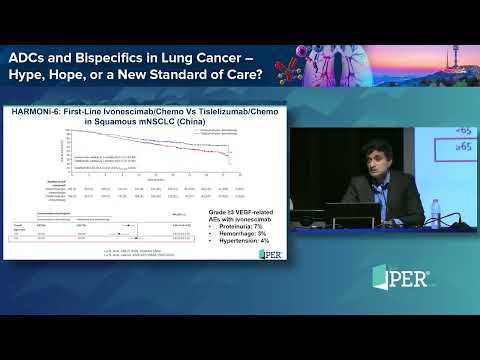
ivonescimab (Summit Therapeutics/Akeso), which already has positive Phase III HARMONi readouts in NSCLC, gains regulatory approval for first-line disease ahead of tivunatamig. BioNTech/BMS's PD-L1/VEGF candidates also advance. Tivunatamig becomes a later entrant facing an established competitor, potentially limiting pricing power and market share even if approval follows.

Historical Context

3 moments from history that rhyme with this story — and how they unfolded.

September 2014

Pembrolizumab's first approval (2014)

The FDA approved pembrolizumab (Keytruda), the first PD-1 checkpoint inhibitor, for advanced melanoma after trials showed durable responses in a subset of patients. It later became the backbone of first-line lung cancer treatment.

Then

Checkpoint blockade became the new standard for multiple tumor types, with response rates around 20-30% as monotherapy.

Now

The drug class transformed oncology, but single-agent responses plateaued — driving the push toward combinations that tivunatamig represents.

Why this matters now

Shows how a new drug class can reset the standard of care, the path tivunatamig hopes to follow — and the plateau it aims to break through.

2021

Bintrafusp alfa's Phase III failure (2021)

Merck KGaA's bintrafusp alfa, a bispecific antibody targeting PD-L1 and TGF-beta, showed promising early data then failed multiple Phase III trials, including a lung cancer study where it underperformed the standard checkpoint inhibitor.

Then

Merck KGaA discontinued development after the drug missed its endpoints.

Now

The failure became a standing reminder that dual-targeting bispecifics don't automatically beat single-target drugs in late-stage trials.

Why this matters now

The cautionary counterpoint: strong Phase II data in a bispecific does not guarantee Phase III success, which is exactly the hurdle tivunatamig now faces.

2024-2025

Ivonescimab's HARMONi Phase III readouts (2024)

Akeso and Summit Therapeutics' ivonescimab, a PD-1/VEGF bispecific, reported positive Phase III results in non-small cell lung cancer, with the drug outperforming a comparator in head-to-head testing.

Then

The results validated the PD-1/VEGF bispecific mechanism and set a high bar for the class.

Now

ivonescimab positioned itself as the frontrunner in the class, giving tivunatamig a direct competitor in the same trials space.

Why this matters now

Defines the competitive benchmark: tivunatamig's Phase II PFS must eventually face off against a rival that has already demonstrated Phase III benefit.

Sources

(11)