
Pull to refresh
Logo
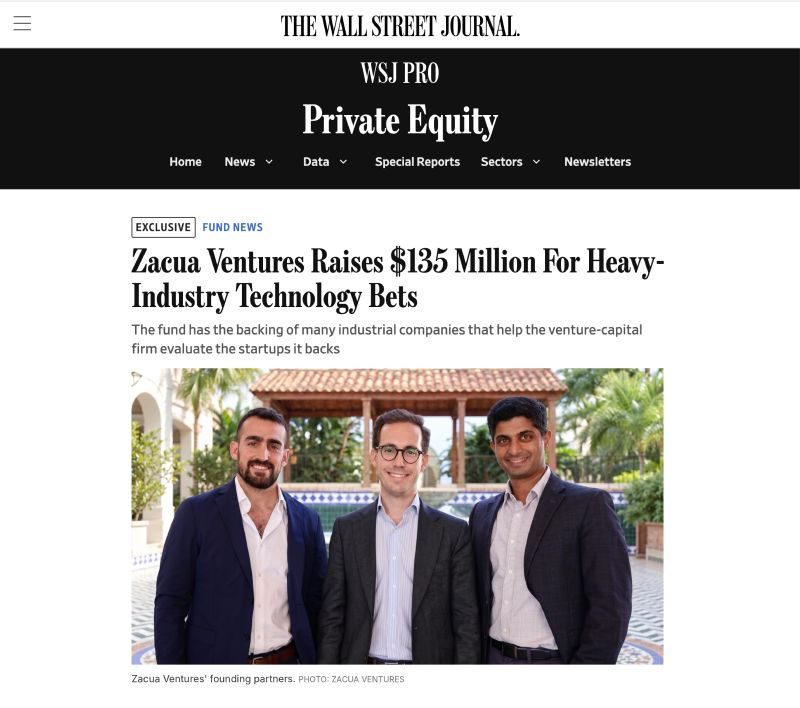
Zacua Ventures closes $135 million fund for construction and infrastructure tech

Zacua Ventures closes $135 million fund for construction and infrastructure tech

Money Moves

The San Francisco firm's second fund more than doubles its first and widens its focus from construction to energy, mining and manufacturing

Overview

Updated 13 hours ago

Zacua Ventures closed its second fund at $135 million on November 10. The raise was 35% oversubscribed and more than double the $56 million debut fund the San Francisco firm built around construction technology.

Most of the money comes from companies that buy what construction produces: Volvo Group Venture Capital, Holcim, Hilti, Trimble, Acciona, DPR Construction, Mortenson. That gives Zacua's portfolio companies a customer list most early-stage investors cannot offer, and it is the reason the firm says it can push hardware past the prototype stage.

Why it matters

Construction, power and mining have absorbed far less venture money than software. A $135 million fund tests whether that gap is closing.

Questions about this story

Free account needed to ask — your question is kept and asked for you right after sign-up. Answers are public.

No questions yet — be the first to ask.

Key Indicators

$135M
Size of Zacua Fund II
Closed November 10, 2026, more than double the firm's first fund.
35%
Oversubscription
Investor demand exceeded the fund's target by 35%.
$56M
Size of Zacua Fund I
The debut fund, which the firm describes as the largest early-stage construction tech fund raised.
30+
Corporate and institutional investors in Fund II
Spread across more than 20 countries.
34
Companies in the Fund I portfolio
Across 11 markets, with no down rounds reported as of the Fund II close.
$106T
Global infrastructure investment needed through 2040
McKinsey estimate cited by Zacua as the demand backdrop for the fund.

Voices

Curated perspectives — historical figures and your fellow readers.

Sign up to generate historical perspectives on this story.

People Involved

Organizations Involved

Timeline

2026 November 2026

5 events Latest: Yesterday
Tap a bar to jump to that date
  1. Fund II closes at $135 million

    Latest Fundraising

    Thirty-five percent oversubscribed; more than double the $56 million first fund.

  2. First Fund II checks disclosed

    Deployment

    CURA Climate, Origin Robotics and Neuron Factory named as early recipients.

  3. Toda Corporation signs on to Fund II

    Investment

    First Japanese company to invest in a Zacua fund.

  4. Trimble buys Document Crunch

    Exit

    Zacua's first portfolio exit; platform was deployed on more than 10,000 projects.

  5. Gravis Robotics raises $200 million from SoftBank

    Funding

    ETH Zurich spinout building autonomous construction equipment valued at $1 billion.

Scenarios

1

A Fund II company gets bought by one of the fund's own corporate investors

Possible Resolves by End of 2029

Discussed by: Zacua's own fundraising materials, which lead with the Trimble-Document Crunch exit as proof the model works; construction trade press covering corporate venture arms

The clearest test of Zacua's pitch is whether its corporate backers become buyers. Trimble already did it once, acquiring Document Crunch from Fund I. If Volvo, Holcim, Hilti, Acciona or DPR follow, the fund's argument that its investor base is a sales channel gets harder to dispute. If no Fund II company is acquired within three years, the exit record rests on a single deal.

2

CURA Climate's cement pilot reaches commercial production

Uncertain Resolves by Q2 2029

Discussed by: Zacua Ventures announcement materials and cement-industry decarbonization coverage

CURA's $10 million round is financing a pilot plant that the company says can cut cement emissions by up to 85%. Cement is among the hardest industrial processes to clean up, and pilot plants frequently stall on cost and heat management. A commercial-scale plant would be the strongest evidence that Fund II's alternative-materials bets can clear the deployment gap Zacua itself describes.

3

Zacua raises a third fund larger than $135 million

Possible Resolves by End of 2029

Discussed by: Venture fundraising analysts tracking the built-environment sector; Dealroom and Law360 coverage of the Fund II close

Fund II doubled Fund I and closed oversubscribed, the pattern firms cite before raising again. A larger Fund III would mean the corporate-investor model scales beyond construction into energy and mining. A flat or smaller fund would suggest the appetite is concentrated in a handful of industrial giants rather than broad.

Historical Context

2 moments from history that rhyme with this story — and how they unfolded.

2015 - June 2021

Katerra (2015-2021)

Katerra launched with a plan to vertically integrate architecture, factory-built components and on-site assembly, promising to cut construction costs and schedules. SoftBank's Vision Fund poured money in, and the company grew to thousands of employees across multiple factories. It filed for bankruptcy in June 2021.

Then

Projects stalled, factories were sold or closed, and hundreds of millions in invested capital was written down.

Now

Investors moved away from capital-heavy construction companies and toward software and narrowly scoped hardware, a shift that shaped the funds that followed.

Why this matters now

Katerra is the cautionary case behind Zacua's stated preference for early-stage checks and equipment that gets validated on real job sites rather than factory networks built in advance.

2017 - May 2020

Sidewalk Labs Quayside, Toronto (2017-2020)

Alphabet's Sidewalk Labs proposed a sensor-rich waterfront district in Toronto, with modular buildings, heated sidewalks and data-driven street design. The project drew sustained objections over data collection and public control of the land, and the financing terms were never settled.

Then

Sidewalk Labs withdrew in May 2020 and the waterfront plan reverted to a conventional development process.

Now

The episode became the standard example of how built-environment technology fails on politics and procurement rather than engineering.

Why this matters now

Zacua's partners argue that a technology's survival depends on whether it fits existing workflows and risk rules. Quayside shows what happens when it does not.

Sources

(8)