
Pull to refresh
Logo
AI model trained on millions of fossils challenges 'big five' extinction story

AI model trained on millions of fossils challenges 'big five' extinction story

New Capabilities

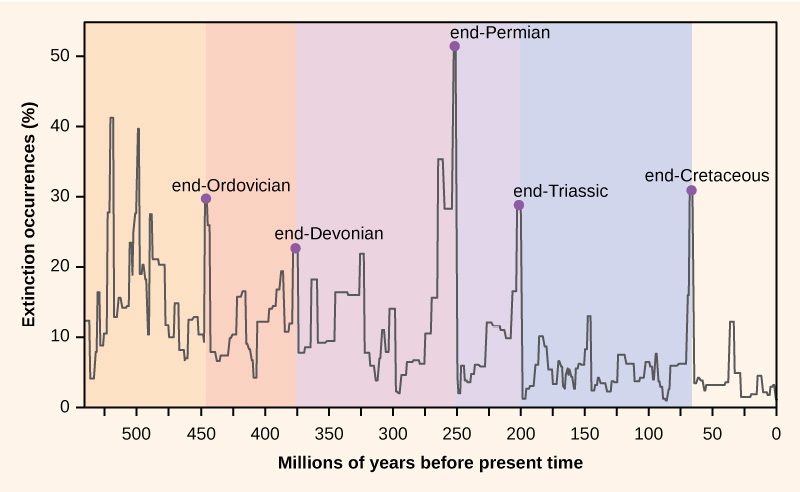
Three of Earth's five great mass extinctions may have been gradual declines, not sudden cataclysms

Overview

Updated Oct 26

An artificial-intelligence model trained on nearly four million fossils suggests three of Earth's 'big five' mass extinctions were gradual declines rather than sudden cataclysms. The model, OneStrata, estimates when more than 110,000 species appeared and vanished over 540 million years.

Coverage of the presentation named different events: ANSA reported the gradual three were the Late Devonian, end-Triassic and end-Cretaceous extinctions. Matthew Clapham of the University of California, Santa Cruz, told Nature the model has uses but questioned whether it was a breakthrough. Researchers with detailed local records say those sequences already show sharp losses.

Why it matters

If the pace of past extinctions depends on how fossils are averaged, forecasts of today's biodiversity loss carry the same uncertainty.

Questions about this story

Free account needed to ask — your question is kept and asked for you right after sign-up. Answers are public.

No questions yet — be the first to ask.

Key Indicators

4 million
Fossils in training set
The OneStrata model was trained on nearly four million fossil specimens.
3 of 5
Extinctions possibly gradual
The model suggests three of the five were gradual declines; ANSA named the Late Devonian, end-Triassic and end-Cretaceous events.
110,000
Species in the timeline
OneStrata estimates the appearance and extinction of more than 110,000 species over the past 540 million years.
26,000 years
Resolution of 2020 analysis
An earlier supercomputer run achieved 26,000-year resolution for 11,000 marine species over 300 million years.

Voices

Curated perspectives — historical figures and your fellow readers.

Sign up to generate historical perspectives on this story.

People Involved

Organizations Involved

Timeline

2006 October 2026

5 events Latest: October 20th, 2026 · 3 weeks ago
Tap a bar to jump to that date
  1. Nature reports OneStrata model findings

    Latest Publication

    Nature reports that an AI model trained on nearly four million fossils suggests three of the Big Five mass extinctions were gradual declines, without naming which three.

  2. Shen presents OneStrata at Geological Society of America meeting

    Presentation

    Shuzhong Shen presented the model's results at a Geological Society of America meeting in Denver, Colorado.

  3. OneStrata presented at stratigraphy congress in China

    Presentation

    Shuzhong Shen's team presented the OneStrata model at an international congress on rock strata in China, according to Dutch science outlet WATTBA. The model was built with Zhejiang Lab in Hangzhou.

  4. Supercomputer analysis sharpens extinction timeline

    Research

    Shen and colleagues run an algorithmic method on a supercomputer, achieving 26,000-year resolution for 11,000 marine species over 300 million years.

  5. OneStratigraphy compilation gets under way

    Research

    Nature describes Shen and colleagues as having worked 'for the past two decades' compiling fossil and geological data from tens of thousands of sites; the report does not give a start year.

Scenarios

1

Gradual extinction view gains broad acceptance

Possible Resolves by End of 2028

Discussed by: Nature report and paleontologists cited in it

Follow-up studies using OneStrata or similar AI approaches confirm the gradual-decline pattern for the Late Ordovician, Late Devonian, and end-Permian events. The model's timeline becomes the standard reference for deep-time biodiversity.

2

Local records challenge the model

Possible Resolves by End of 2028

Discussed by: Researchers cited in the Nature report who note existing high-resolution local reconstructions

Paleontologists with detailed local records push back, arguing OneStrata's global averaging obscures sudden events visible at specific sites. A published rebuttal shows a specific extinction was sudden at a well-documented location.

3

Debate continues without resolution

Uncertain Resolves by End of 2028

Discussed by: The broader paleontology community

Both sides publish supporting evidence, and no consensus emerges. The field remains divided as more data accumulates.

4

Data skew undercuts the global claim

Possible Resolves by End of 2027

Discussed by: Extinct, a palaeontology blog

OneStratigraphy draws heavily on high-resolution rock sections in China. Whether those sections stand in for the whole ocean has not been settled in published work, the blog notes, so the global timeline could shift as records from other regions are folded in.

Historical Context

3 moments from history that rhyme with this story — and how they unfolded.

December 2001

Paring Down the Big Five (2001)

Science published an article by Richard Kerr questioning whether all five of the 'Big Five' mass extinctions were truly distinct events. Kerr noted that some of the five might not qualify as separate mass extinctions.

Then

The article sparked debate but the Big Five framework remained standard.

Now

The framework persisted, but the debate over what counts as a mass extinction continued.

Why this matters now

Shows the Big Five framework has been questioned before, setting the stage for the OneStrata challenge.

2024

End-Permian land-sea timing debate (2024)

Robert Gastaldo and colleagues at Colby College published research from South Africa's Karoo Basin showing the end-Permian extinction of land life happened hundreds of thousands of years before the marine extinction, and gradually.

Then

The findings contradicted the long-held view that land and sea life perished together.

Now

Raised questions about the sudden-cataclysm narrative of the largest mass extinction.

Why this matters now

Shows the end-Permian's timing is already contested at the local level, the kind of record researchers will compare against OneStrata's global timeline.

1980

Alvarez asteroid hypothesis (1980)

Luis and Walter Alvarez and colleagues published evidence of an iridium layer at the Cretaceous-Paleogene boundary, linking the end-Cretaceous extinction to an asteroid impact.

Then

The hypothesis was controversial for years before gaining acceptance.

Now

Transformed understanding of the end-Cretaceous extinction and showed how new evidence can rewrite extinction narratives.

Why this matters now

Demonstrates how new evidence can fundamentally change the story of a mass extinction, as OneStrata may do for three of the Big Five.

Sources

(7)