




Dorothy Parker
Fictional AI pastiche — not real quote.
"How novel — the government has finally found a way to ground deadbeat fathers that doesn't involve their children's tearful phone calls."
After 30 years of acting only at renewal, the State Department starts canceling existing passports of parents with significant arrears
May 8th, 2026: State Department begins proactive revocationsNew here? Follow stories to track developments over time. Create a free account to get updates when stories you care about change.
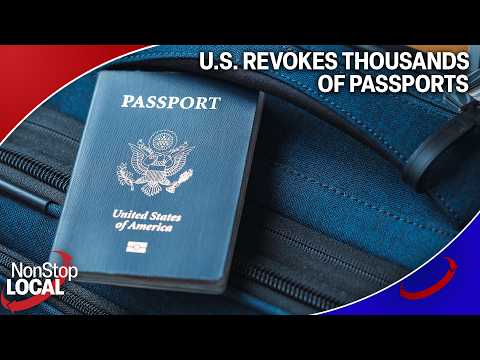
Federal law has let the State Department revoke a passport over unpaid child support since 1996. For nearly three decades, the department only acted when someone applied to renew or asked for consular help. On Thursday, that changed.
The first wave targets about 2,700 Americans who owe $100,000 or more. The program will then expand to anyone with arrears above $2,500, the threshold Congress set 30 years ago. The Department of Health and Human Services will feed names to State, and an existing passport can be canceled before the holder ever tries to use it.
Why it matters
If you owe more than $2,500 in child support, your valid passport can now be canceled at any time, not just when you try to renew it.
Exploring all sides of a story is often best achieved with Play.
Fictional AI pastiche — not real quote.
"How novel — the government has finally found a way to ground deadbeat fathers that doesn't involve their children's tearful phone calls."
Your progress in this debate will be lost.
Choose one persona for each side of the debate
Select debater for this side:
No debate personas available right now.
Select debater for this side:
No debate personas available right now.
Make your prediction before the referee scores
Pick the question both personas must answer in the final round
Debate Oracle! You called every round!
Sharp Instincts! You know your debaters!
The Coin Flip Strategist! Perfectly balanced!
The Contrarian! Bold predictions!
Inverse Genius! Try betting the opposite next time!
Issues U.S. passports and is the only entity that can revoke them.
Federal office that aggregates child support debt data from all 50 state enforcement agencies.
First wave cancels passports of about 2,700 Americans owing $100,000 or more in child support, with expansion to the $2,500 threshold to follow.
States report $30 million collected in 2024 alone through the passive child-support passport program, with total collections nearing $621 million since 1996.
Three years after the FAST Act, the IRS starts sending names of taxpayers with delinquent debt to the State Department for passport action.
Congress authorizes passport revocation for seriously delinquent federal tax debt, modeling the mechanism on the 1996 child support program.
President Clinton signs the welfare reform law authorizing passport denial or revocation for child support arrears above $2,500.
Predict which scenario wins. Contrarian picks score more — points lock in when the scenario resolves.
Once HHS feeds the full delinquent list to State, hundreds of thousands of parents could fall within range. If collections track the 2024 ratio (about 5,000 payments from passive enforcement alone), proactive revocation could deliver a multi-fold jump in payments, with State pointing to higher recovery as proof the shift worked.
A revoked parent sues, arguing the cancellation of a valid passport without notice or a hearing violates the Fifth Amendment. Courts already upheld the 1996 statute as applied at renewal. A challenge to mid-cycle revocation could force State to add notice, cure periods, or hardship exemptions for work travel.
If parents who travel for work, drive trucks across borders, or staff offshore rigs lose jobs after revocation, payments could fall rather than rise. Research on driver's-license suspensions for the same offense found short-term compliance bumps but lower long-term payments. State could add carve-outs for employment-tied travel.
Restoring a passport requires the parent to pay, the state agency to update records, HHS to remove the certification, and State to reissue. Each step has lag, and the published minimum is two to three weeks. If the queue lengthens, stranded travelers and missed family obligations may become the political flashpoint, not the revocations themselves.
Congress passed the Fixing America's Surface Transportation Act in December 2015, letting the IRS certify taxpayers with seriously delinquent debt (then over $50,000, now $66,000) to State for passport action. The IRS waited until 2018 to start certifying names, then ramped up notices and revocations gradually.
Tens of thousands of taxpayers received CP508C certification notices; many resolved debts to keep travel rights. The program survived early constitutional challenges in tax court.
By 2025 the IRS-State Department pipeline had become routine, with the threshold indexed to inflation and reinstatement procedures formalized.
The child support program now activates the same infrastructure that the IRS used for tax debt: one agency certifies, State revokes. The FAST Act rollout took three years from law to enforcement. The 1996 child support law took 30 years to reach the same operational point.
The same 1996 welfare reform law that authorized passport revocation also required every state to suspend driver's, professional, or recreational licenses for unpaid child support. States quickly moved to enforce this, often suspending licenses after 90 days of delinquency.
Many states reported initial spikes in payments after suspension threats. California alone has used the tool against millions of parents over the years.
Research from Minnesota and academic studies found that actually following through on suspensions correlated with lower payments long-term, since losing a license cut off work. California passed a 2025 law shielding low-income parents from suspension.
This is the closest mechanical and political parallel: a 1996 sanction designed to coerce payment that ran into a problem of its own making, namely that taking away the tool a parent uses to earn money can reduce, not increase, what they pay. Passport revocation may face the same dynamic for parents whose jobs require travel.