
Pull to refresh
Logo
Supreme Court to review Reconstruction-era ban on home distilling

Supreme Court to review Reconstruction-era ban on home distilling

Rule Changes

Justices will weigh Congress's taxing power, not the commerce power, in a circuit split over the 1868 ban

Overview

Updated Oct 25

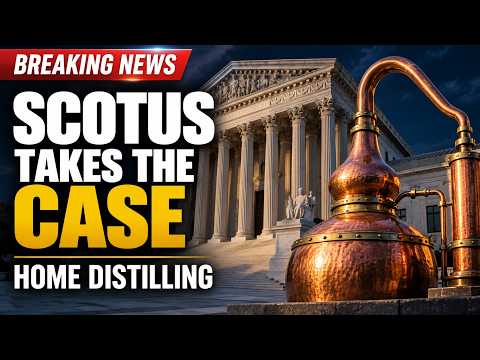
The Supreme Court agreed on Oct. 19 to decide whether the 1868 ban on distilling spirits at home is constitutional. The case, Department of Justice v. McNutt, turns on whether the ban is a valid use of Congress's power to tax.

The justices limited review to that taxing-power question, and the government no longer defends the ban under the commerce power. Fifteen Republican-led states, including Ohio and Florida, filed a brief backing the challengers, and the government says the ban protects billions in yearly excise tax revenue. Arguments are expected early next year, with a ruling by late June 2027.

Why it matters

If the Court strikes down the ban, Americans could legally distill spirits at home for personal use for the first time in 158 years.

Questions about this story

Free account needed to ask — your question is kept and asked for you right after sign-up. Answers are public.

No questions yet — be the first to ask.

Key Indicators

158
Years the ban has been in place
Congress enacted the home-distilling prohibition in 1868.
5 years
Maximum prison sentence for home distilling
Violators face up to five years in prison and a $10,000 fine.
$10,000
Maximum fine for home distilling
The penalty applies to producing distilled spirits at home without a license.
2
Federal appeals courts split on the ban
The 5th Circuit struck it down; the 6th Circuit upheld it.
15
States backing the challengers
Fifteen Republican-led states, including Ohio, filed a brief supporting the challenge.

Voices

Curated perspectives — historical figures and your fellow readers.

Sign up to generate historical perspectives on this story.

People Involved

Organizations Involved

Timeline

1868 October 2026

6 events Latest: October 19th, 2026 · 3 weeks ago
Tap a bar to jump to that date
  1. Congress enacts home-distilling ban

    Legislation

    Congress passed the ban as part of a tax reform measure to curb fraud by commercial distillers.

Scenarios

1

Supreme Court upholds home-distilling ban

Possible Resolves by Q2 2027

Discussed by: Solicitor General D. John Sauer and government attorneys

The Court rules the ban is a valid exercise of Congress's taxing power under the Necessary and Proper Clause. This would resolve the circuit split in favor of the government and keep the 1868 law in place. The ruling would reaffirm that Congress can restrict where spirits are distilled to prevent tax evasion.

2

Supreme Court strikes down home-distilling ban

Possible Resolves by Q2 2027

Discussed by: Hobby Distillers Association and 5th Circuit Judge Edith Hollan Jones

The Court rules the ban exceeds Congress's enumerated powers. Home distilling for personal use becomes legal, though commercial distilling remains regulated. The ruling would be the most significant Necessary and Proper Clause decision since NFIB v. Sebelius in 2012.

3

Court issues narrow ruling, leaves question open

Unlikely Resolves by Q2 2027

Discussed by: Legal analysts

The Court rules on narrow grounds, perhaps remanding to the lower courts or limiting the scope of the decision. The broader question of home distilling's legality remains unsettled, and Congress could respond with new legislation.

4

Court takes up Ream's case along with McNutt

Possible Resolves by Q2 2027

Discussed by: SCOTUSblog and lawyers for John Ream

John Ream's separate petition, Ream v. Department of the Treasury, is also pending. It asks the justices to clarify or overrule Gonzales v. Raich, the 2005 medical marijuana decision, and 15 states have backed him. If the Court grants that petition, the term's home-distilling review would cover both the taxing-power question and the reach of federal power over local, noncommercial activity.

Historical Context

3 moments from history that rhyme with this story — and how they unfolded.

June 2012

NFIB v. Sebelius (2012)

The Supreme Court considered whether the Affordable Care Act's individual mandate was constitutional. The Court ruled 5-4 that the mandate could not be justified under the Necessary and Proper Clause, though it upheld the law under Congress's taxing power.

Then

The individual mandate survived as a tax, but the Court limited the scope of the Necessary and Proper Clause.

Now

The ruling established that a law must be 'ancillary' to an enumerated power, not a 'great, substantive and independent' power.

Why this matters now

This is the most recent major Necessary and Proper Clause decision. The home-distilling case will likely further clarify what counts as a 'great and independent' power.

June 2005

Gonzales v. Raich (2005)

The Supreme Court ruled that federal law banning marijuana applied to locally grown plants used for personal medical purposes. The Court held that Congress could regulate intrastate activity under the Commerce Clause.

Then

The federal marijuana ban was upheld even for personal, noncommercial use.

Now

The case established broad federal power over local activity that could affect interstate markets.

Why this matters now

The home-distilling challenge asks whether Congress's power extends to local, noncommercial conduct. The Court's ruling could clarify or limit the reach of federal power over such activity.

1794

The Whiskey Rebellion (1794)

President George Washington called out 13,000 troops to suppress a rebellion in western Pennsylvania against the federal excise tax on distilled spirits. The tax was the first major test of federal taxing power under the new Constitution.

Then

The rebellion was suppressed without major bloodshed, demonstrating federal authority to enforce tax laws.

Now

The episode established that the federal government could tax distilled spirits, a revenue source that continues today.

Why this matters now

The home-distilling ban is rooted in the same federal interest in taxing distilled spirits that sparked the Whiskey Rebellion. The case tests how far that taxing power extends.

Sources

(18)