



Pull to refresh
Logo
Daily Brief
Following
Why Ranks Sign Up
Stanford emerging technology review

Stanford emerging technology review

New Capabilities

Annual briefings bridge Silicon Valley research and Washington policy

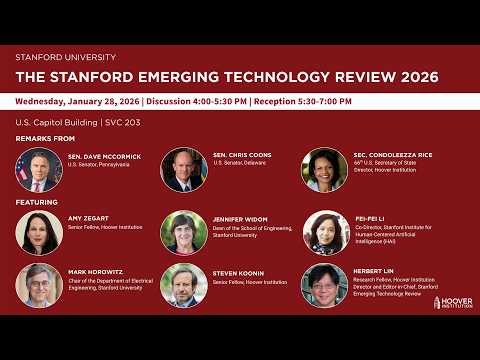
February 4th, 2026: Hoover Institution Highlights SETR Washington Event

Overview

Congress defunded its own technology assessment office in 1995. Three decades later, Stanford University is trying to fill that gap. The third annual Stanford Emerging Technology Review debuted in Washington on January 28, 2026, with Hoover Institution scholars briefing senators, White House officials, and agency leaders on ten frontier technologies reshaping national competitiveness.

The report synthesizes research from over 100 Stanford faculty across 40 departments into actionable intelligence for policymakers. Key findings: China now publishes eight times more top-cited synthetic biology papers than the United States, quantum computers are approaching the capability to break current encryption, and AI infrastructure demands are straining critical mineral supply chains controlled largely by Beijing. The bipartisan audience—including Senators Chris Coons and Dave McCormick, who have co-sponsored AI infrastructure legislation—suggests growing congressional appetite for systematic technology guidance.

Play on this story Voices Debate Predict

Key Indicators

10
Frontier technologies surveyed
AI, biotech, quantum, semiconductors, energy, robotics, space, neuroscience, materials science, and cryptography
100+
Stanford scholars contributing
Faculty from 40 departments and research institutes across the university
350 vs 41
China vs US biotech papers (2023)
Top-cited synthetic biology publications, highlighting competitiveness gap
3
Annual editions published
2023 inaugural, 2025, and 2026 editions (no 2024 edition due to election transition)

Interactive

Exploring all sides of a story is often best achieved with Play.

Ever wondered what historical figures would say about today's headlines?

Sign up to generate historical perspectives on this story.

People Involved

Organizations Involved

Timeline

  1. Hoover Institution Highlights SETR Washington Event

    Publication

    Hoover Daily Report features the 2026 SETR Washington debut, marking the event's documentation in the institution's official communications.

  2. McCormick Receives AI Policy Award

    Recognition

    Washington AI Network honors Senator Dave McCormick with First Mover Award for early leadership on AI policy and infrastructure.

  3. 2026 SETR Debuts at U.S. Capitol

    Policy Engagement

    Senators Coons and McCormick join Hoover and Stanford scholars at Capitol Hill event marking third edition's release. Briefings follow at White House, State Department, NSC, and OSTP.

  4. Coons-McCormick AI Infrastructure Bill Introduced

    Legislation

    Senators Chris Coons and Dave McCormick introduce the Liquid Cooling for AI Act, signaling bipartisan interest in technology infrastructure policy.

  5. Technology Policy Accelerator Launches

    Institutional

    Hoover formalizes the TPA to coordinate SETR production, congressional briefings, and policy research across multiple technology domains.

  6. 2025 SETR Debuts in Washington

    Policy Engagement

    Second edition launches in the capital with public events and private briefings for policymakers. No 2024 edition was published due to the presidential transition.

  7. Inaugural SETR Launch at Stanford

    Launch

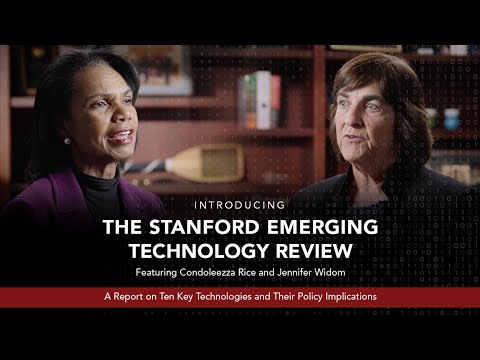
    Hoover Institution and Stanford Engineering unveil first Stanford Emerging Technology Review with Condoleezza Rice, Jennifer Widom, Marc Andreessen, and Richard Saller.

  8. Congress Defunds OTA

    Historical

    Republican-led Congress eliminates OTA funding, ending Congress's dedicated technology assessment capability after 23 years and 750 reports.

  9. Congress Creates Office of Technology Assessment

    Historical

    The Technology Assessment Act establishes OTA to provide Congress with independent analysis of emerging technologies.

Scenarios

Predict which scenario wins. Contrarian picks score more — points lock in when the scenario resolves.

Log in to predict. Track your picks, climb the leaderboard. Log in Sign Up
1

SETR Becomes Standard Congressional Reference

Annual SETR briefings become institutionalized as a primary source for congressional technology committees. Committee chairs formally request coverage of specific topics. SETR findings are cited in committee reports and floor debate. This scenario is supported by growing bipartisan engagement and the absence of dedicated congressional technology assessment since 1995.

Discussed by: Technology policy analysts, including commentary in MIT Technology Review on reviving OTA-style assessment
Consensus
2

Congress Revives Internal Technology Assessment

SETR's success demonstrates demand for technology assessment, prompting Congress to expand the GAO's Science, Technology Assessment, and Analytics team or recreate a dedicated OTA-style office. External academic reports continue but complement rather than substitute for congressional capacity. This would require appropriations action.

Discussed by: MIT Technology Review (February 2025), Government Accountability Office STAA team advocates
Consensus
3

SETR Influence Remains Limited to Awareness

SETR continues producing high-quality research that raises awareness but does not translate into specific legislative action. Congressional attention remains fragmented across competing priorities. The report serves educational rather than policymaking functions. This reflects historical patterns where academic research often fails to directly shape legislation.

Discussed by: Skeptics of think-tank policy influence generally
Consensus
4

SETR Findings Drive Specific Legislation

Specific SETR findings—such as the biotech competitiveness gap with China or critical mineral vulnerabilities—directly inform committee hearings and draft legislation. The 2026 finding that China publishes eight times more top-cited synthetic biology papers prompts targeted response. This scenario is supported by existing Coons-McCormick collaboration on AI legislation.

Discussed by: Senators Coons and McCormick, who have already acted on AI infrastructure concerns
Consensus

Historical Context

Office of Technology Assessment (1972-1995)

1972-1995

What Happened

Congress created the Office of Technology Assessment in 1972 to provide independent analysis of emerging technologies. Over 23 years, OTA produced 750 reports on topics from acid rain to biotechnology, informing legislation without recommending specific policies. Studies were initiated only at committee chairs' request.

Outcome

Short Term

The Republican-led Congress defunded OTA in 1995 as part of Newt Gingrich's 'Contract with America' budget cuts, eliminating Congress's dedicated technology assessment capability.

Long Term

Congress has relied on outside sources—think tanks, agencies, industry—for technology guidance since. The GAO established a small Science, Technology Assessment, and Analytics team in 2019 with roughly 100 staff, far smaller than OTA's peak capacity.

Why It's Relevant Today

SETR explicitly aims to fill the gap OTA left. The report's structure—comprehensive assessment without policy recommendations—mirrors OTA's approach. Success could revive pressure to restore congressional technology assessment capacity.

RAND Corporation and Defense Policy (1948-present)

1948-present

What Happened

The RAND Corporation was established in 1948 as a nonprofit think tank to provide research and analysis to the U.S. military. RAND analysts developed foundational concepts in nuclear strategy, game theory, and systems analysis that shaped Cold War policy.

Outcome

Short Term

RAND became the model for policy-focused research organizations, demonstrating that academic-style analysis could directly influence government decisions.

Long Term

The 'RAND model' spawned dozens of federally funded research and development centers (FFRDCs) and established the template for bridging academic research and policy application.

Why It's Relevant Today

SETR follows RAND's model of translating academic expertise into policy-relevant intelligence, though operating from a university rather than a dedicated research organization. The Technology Policy Accelerator's structure mirrors RAND's role as connector between researchers and policymakers.

Sources

(13)