

Pull to refresh
Logo
FDA clears combined use of Solventum's Restrata matrix and V.A.C. therapy

FDA clears combined use of Solventum's Restrata matrix and V.A.C. therapy

New Capabilities

First-of-its-kind clearance pairs synthetic tissue matrix with negative pressure wound therapy

Overview

Updated 2 hours ago

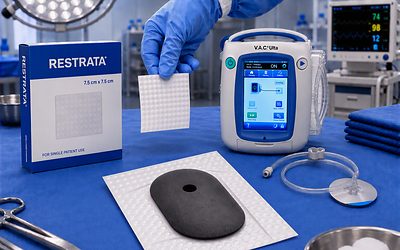
The U.S. Food and Drug Administration cleared Solventum to use its Restrata synthetic tissue matrix with its V.A.C. negative pressure wound therapy on October 19, 2026, the first clearance combining the two. Clinicians can place a fully synthetic, resorbable scaffold under a vacuum dressing that stays on for up to seven days.

The clearance came 11 months after Solventum agreed to buy Restrata's maker, Acera Surgical; the deal closed in December 2025. Solventum released no clinical outcome data with the clearance. In its November 5 third-quarter report, the company's Advanced Wound Care unit posted $528 million in sales, up 7.2% organically, and Solventum raised full-year adjusted earnings guidance to $7.20 to $7.30 a share.

Why it matters

A synthetic matrix that survives a full seven-day vacuum cycle means fewer dressing changes for complex wounds, if hospitals adopt it.

Questions about this story

Free account needed to ask — your question is kept and asked for you right after sign-up. Answers are public.

No questions yet — be the first to ask.

Key Indicators

$725M
Acera Surgical acquisition price
Solventum paid $725 million in cash plus up to $125 million in contingent milestone payments.
$90M
Acera's expected 2025 sales
Acera was projected to generate about $90 million in sales in 2025 before the acquisition closed.
7 days
V.A.C. dressing wear time
The V.A.C. Peel and Place Dressing can stay on for up to seven days per application.
100%
Restrata's synthetic composition
Restrata is a fully synthetic, resorbable matrix that resists enzymatic degradation.
7.2%
Advanced Wound Care organic growth
Solventum's wound care unit grew 7.2% organically in the third quarter of 2026 on $528 million in sales.

Voices

Curated perspectives — historical figures and your fellow readers.

Sign up to generate historical perspectives on this story.

People Involved

Organizations Involved

Timeline

2013 November 2026

5 events Latest: 6 days ago
Tap a bar to jump to that date
  1. Solventum posts 7.2% wound care growth, raises guidance

    Latest Earnings

    Advanced Wound Care sales rose 7.2% organically to $528 million in the third quarter. Solventum raised full-year adjusted earnings guidance to $7.20-$7.30 a share and said its major ERP system cutovers were complete.

  2. FDA clears combined Restrata + V.A.C. use

    Regulatory

    FDA grants 510(k) clearance for combined use of Restrata matrix and V.A.C. therapy, a first-of-its-kind pairing.

  3. Acquisition completed

    Acquisition

    Solventum completes its acquisition of Acera Surgical, adding Restrata to its wound care portfolio.

  4. Solventum announces Acera acquisition

    Acquisition

    Solventum agrees to buy Acera Surgical for $725 million cash plus up to $125 million in milestone payments.

  5. Acera Surgical founded

    Founding

    Acera Surgical founded to develop synthetic tissue matrices for regenerative wound care.

Scenarios

1

Combined therapy becomes standard for complex acute wounds

Likely Resolves by End of 2027

Discussed by: Solventum's press release and investor communications

Solventum's specialized wound care sales force pushes the combined therapy into acute care settings. The seven-day wear time and resistance to enzymatic degradation reduce dressing changes and streamline workflows, driving adoption across hospitals and wound care centers.

2

Reimbursement and cost barriers slow adoption

Possible Resolves by End of 2027

Discussed by: Healthcare analysts covering medical device reimbursement

Hospitals face budget pressure and the combined therapy carries a premium price. Without clear reimbursement pathways, adoption stays limited to specialized wound care centers and major trauma hospitals, capping the therapy's market reach.

3

Rivals develop competing synthetic matrix + NPWT combinations

Possible Resolves by Q2 2028

Discussed by: Industry analysts tracking the wound care market

Competitors develop their own synthetic matrices cleared for use with negative pressure wound therapy, eroding Solventum's first-mover advantage. The FDA's 510(k) pathway allows substantially equivalent devices to reach market more quickly.

4

Combined label shows up in Solventum's wound care sales

Uncertain Resolves by Q1 2027

Discussed by: Solventum management on earnings calls and investors tracking the wound care segment

The October 2026 clearance gives Solventum's negative pressure therapy sales force a matrix to pair with every V.A.C. conversation. The question is whether that pulls through to reported revenue, since the company has not broken out sales tied to the combined indication.

Historical Context

2 moments from history that rhyme with this story — and how they unfolded.

1990s

V.A.C. Therapy's rise as the first NPWT system (1990s)

V.A.C. Therapy became the first commercially available negative pressure wound therapy system. It has since helped treat 11 million wounds worldwide and remains the most studied NPWT solution.

Then

Negative pressure wound therapy became a standard tool for complex wound management in acute care.

Now

V.A.C. Therapy's dominance established NPWT as a core wound care modality, with 11 million wounds treated to date.

Why this matters now

Shows how a first-of-its-kind wound care technology can become a standard of care — the pattern Solventum hopes to repeat with the combined Restrata + V.A.C. therapy.

Ongoing

Collagen dressings' limits under negative pressure (ongoing)

Collagen-based dressings have been a standard for soft tissue repair but degrade prematurely under negative pressure wound therapy. Restrata's fully synthetic profile resists enzymatic degradation, addressing this known limitation.

Then

Clinicians had to change dressings more frequently when using collagen matrices with NPWT.

Now

The FDA clearance positions synthetic matrices as a viable alternative for combined use with NPWT, potentially shifting clinical practice.

Why this matters now

Explains why the combined clearance matters — it directly addresses a documented weakness of collagen-based dressings in NPWT applications.

Sources

(8)