Pull to refresh
Logo
Researchers surpass solar energy's quantum ceiling using singlet fission and spin-flip emitters

Researchers surpass solar energy's quantum ceiling using singlet fission and spin-flip emitters

New Capabilities

Japanese-German team achieves 130% quantum yield, opening a new path beyond the theoretical limit that has constrained solar cells since 1961

March 28th, 2026: Kyushu-Mainz team achieves 130% quantum yield with spin-flip emitter

Overview

Updated May 30

Every conventional solar cell hits the same wall: a single photon can knock loose one electron, at most. That constraint, formalized in 1961, caps silicon panels at roughly 33% efficiency.

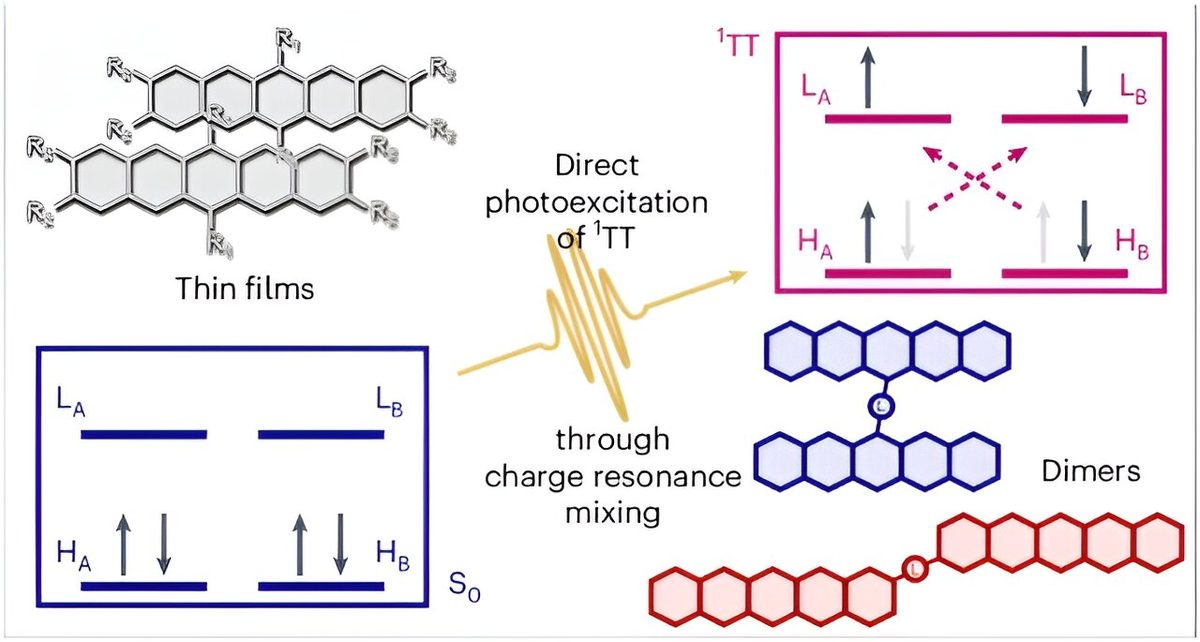
A team from Kyushu University and Johannes Gutenberg University Mainz demonstrated a system producing 1.3 energy carriers per photon—a 130% quantum yield. It splits one photon's energy through singlet fission and captures it with a molybdenum-based emitter. This is a proof-of-concept in liquid solution, not a finished solar panel.

But the result validates a specific mechanism, pairing singlet fission with spin-flip emitters, that theorists long predicted could push silicon solar cells from today's 27% practical ceiling toward 42%. With major manufacturers investing in related singlet fission research, the focus shifts from whether the physics works to how fast it can be engineered into solid-state devices.

Why it matters

If singlet fission reaches commercial panels, every rooftop and solar farm could harvest up to 50% more electricity from the same sunlight.

Questions about this story

Free account needed to ask — your question is kept and asked for you right after sign-up. Answers are public.

No questions yet — be the first to ask.

Key Indicators

~130%
Quantum yield achieved
Energy carriers produced per absorbed photon, exceeding the conventional maximum of 100%.
33.16%
Shockley-Queisser limit
The theoretical maximum efficiency for a conventional single-junction solar cell, established in 1961.
~42%
Theoretical ceiling with singlet fission on silicon
The projected maximum efficiency if singlet fission is successfully integrated into silicon solar cells.
2.2 TW
Global installed solar capacity
Total solar photovoltaic capacity deployed worldwide as of 2024, all operating below the single-junction limit.
5–15 years
Estimated time to commercialization
Approximate timeline before any singlet fission technology could reach mass-produced solar panels.

Voices

Curated perspectives — historical figures and your fellow readers.

Benjamin Franklin

Benjamin Franklin

(1706-1790) · Enlightenment · wit

Fictional AI pastiche — not real quote.

"How fitting that Nature, ever the coy mistress, should hide within a single sunbeam twice the treasure we presumed — and how like mankind to spend two centuries knocking politely at a door before discovering it opens from the other side."

Ever wondered what historical figures would say about today's headlines?

Sign up to generate historical perspectives on this story.

People Involved

Organizations Involved

Timeline

March 1961 March 2026

8 events Latest: March 28th, 2026 · 6 months ago
Tap a bar to jump to that date
  1. Kyushu-Mainz team achieves 130% quantum yield with spin-flip emitter

    Latest Research Milestone

    Scientists from Kyushu University and JGU Mainz publish in the Journal of the American Chemical Society, demonstrating that a molybdenum-based spin-flip emitter can selectively capture multiplied excitons from singlet fission, achieving approximately 130% quantum yield in solution.

  2. UNSW develops photostable singlet fission material for silicon cells

    Research Milestone

    UNSW Sydney publishes a breakthrough: DPND, a singlet fission material that is stable in air, unlike tetracene. Backed by JinkoSolar, JA Solar, LONGi, and Canadian Solar, the team files patent protection.

  3. LONGi sets 34.85% perovskite-silicon tandem record

    Efficiency Record

    Chinese manufacturer LONGi achieves 34.85% efficiency with a perovskite-silicon tandem cell, surpassing the Shockley-Queisser limit via a multi-junction approach rather than singlet fission.

  4. Fraunhofer ISE sets 47.6% multi-junction concentrator record

    Efficiency Record

    Germany's Fraunhofer Institute for Solar Energy Systems achieves the highest solar cell efficiency ever recorded—47.6%—using a four-junction concentrator cell, though this approach is too expensive for consumer panels.

  5. First 133% quantum yield demonstrated on silicon photovoltaic

    Research Milestone

    Researchers produce the first evidence of singlet fission delivering a combined quantum yield of 133% on a silicon photovoltaic device, confirming viability for SF-enhanced solar cells.

  6. Silicon-singlet fission tandem exceeds 100% external quantum efficiency

    Research Milestone

    Researchers demonstrate that a silicon solar cell sensitized with singlet fission materials can achieve external quantum efficiency above 100%, proving the concept works in a photovoltaic device.

  7. First observation of singlet fission in anthracene crystals

    Discovery

    Singh and colleagues detect singlet fission through delayed fluorescence measurements in anthracene crystals, establishing that one photon can generate two lower-energy excitons.

  8. Shockley and Queisser publish the single-junction efficiency limit

    Foundation

    William Shockley and Hans-Joachim Queisser publish their detailed balance calculation in the Journal of Applied Physics, establishing the 33.16% maximum efficiency for single-junction solar cells. The paper was initially rejected and largely ignored for years.

Scenarios

1

Singlet fission coatings boost commercial silicon panels past 30% efficiency within a decade

Possible

Discussed by: Theoretical analyses in ACS Energy Letters; UNSW's commercialization roadmap with industry partners JinkoSolar, LONGi, JA Solar, and Canadian Solar

If the spin-flip harvesting mechanism can be translated from solution to solid-state films and paired with photostable materials like UNSW's DPND, singlet fission could be applied as a thin coating on existing silicon manufacturing lines. This avoids the current-matching complexity of tandem cells and could push mass-produced panel efficiencies from today's 22–27% range past 30%. The AUD 4.8 million in Australian government funding and involvement of four major manufacturers suggest industry considers this plausible. The Kyushu-Mainz result validates the physics; the engineering challenge is integration and durability over a 25-year panel lifetime.

2

Perovskite-silicon tandems reach market first, marginalizing singlet fission

Likely

Discussed by: LONGi, Oxford PV, and industry analysts tracking the perovskite commercialization timeline

Perovskite-silicon tandem cells have already achieved 34.85% efficiency in the lab and are closer to manufacturing scale-up. If tandems reach cost parity with conventional panels before singlet fission solves its materials stability and solid-state integration challenges, the market window for SF could narrow significantly. Manufacturers may not adopt two competing approaches. The tandem path has more industry investment, more pilot lines running, and fewer fundamental science questions remaining.

3

Stability problems keep singlet fission confined to the laboratory

Possible

Discussed by: Materials science researchers studying tetracene degradation; solar industry durability analysts

Tetracene, the singlet fission material used in the Kyushu-Mainz demonstration, degrades rapidly in air and moisture. While UNSW's DPND addresses this for one class of SF material, the spin-flip emitter approach may face its own stability challenges with the molybdenum complex. If no durable combination of SF material and spin-flip harvester can survive 25 years of outdoor exposure, the technology remains an elegant laboratory demonstration without commercial impact. Solar cell manufacturing requires extraordinary reliability—modules must withstand decades of ultraviolet exposure, thermal cycling, and humidity.

4

Singlet fission and tandems combine for 40%+ commercial panels

Unlikely

Discussed by: Theoretical photovoltaics researchers exploring multi-mechanism approaches; NREL efficiency roadmaps

Rather than competing, singlet fission and tandem architectures could be combined. A perovskite-silicon tandem cell enhanced with a singlet fission layer could theoretically approach or exceed 40% efficiency. This would require solving the engineering challenges of both approaches simultaneously, but would represent the maximum possible harvest from sunlight in a flat-plate panel. Some researchers view this as the long-term endgame for photovoltaics, though it likely requires breakthroughs that are still a decade or more away.

Historical Context

3 moments from history that rhyme with this story — and how they unfolded.

March 1961

Shockley-Queisser limit publication and delayed recognition (1961)

William Shockley (co-inventor of the transistor and Nobel laureate) and Hans-Joachim Queisser published their detailed balance calculation in the Journal of Applied Physics, establishing that a single-junction solar cell could never exceed roughly 33% efficiency. The journal initially rejected the paper, and it was largely ignored for years after publication.

Then

The solar industry was too small for the finding to matter much. The paper accumulated citations slowly.

Now

The Shockley-Queisser limit became the most fundamental constraint in photovoltaics—the ceiling that every subsequent breakthrough, from multi-junction cells to perovskite tandems to singlet fission, has been designed to circumvent.

Why this matters now

The Kyushu-Mainz result directly attacks this 65-year-old constraint. Rather than working around it with multiple junctions (tandems) or concentrated sunlight, singlet fission breaks the underlying assumption: that one photon can produce only one useful energy carrier.

2009–present

Perovskite solar cells emerge as a commercial contender (2009–present)

In 2009, Tsutomu Miyasaka's group in Japan demonstrated the first perovskite solar cell at 3.8% efficiency. By 2025, perovskite-silicon tandems reached 34.85% efficiency (LONGi), and Oxford PV began shipping the first commercial perovskite-silicon tandem panels. The speed of improvement—from under 4% to over 34% in 16 years—was unprecedented in photovoltaics.

Then

Perovskite tandems are now the leading near-term candidate to replace conventional single-junction silicon as the standard commercial technology.

Now

The perovskite trajectory demonstrates that a laboratory breakthrough in photovoltaic materials can reach commercial production within roughly 15 years if industry investment follows.

Why this matters now

Singlet fission is roughly where perovskites were in the early 2010s—proven in the lab, with major manufacturers beginning to invest. The perovskite timeline suggests a 5–15 year path to commercialization, but also shows that competing approaches can leapfrog each other during that window.

1990s–2022

Multi-junction cells for space applications (1990s–2000s)

Researchers at the National Renewable Energy Laboratory (NREL) and Fraunhofer Institute for Solar Energy Systems developed multi-junction solar cells that stacked layers of different semiconductor materials to capture different wavelengths of light. By 2022, Fraunhofer achieved 47.6% efficiency with a four-junction concentrator cell—well above the Shockley-Queisser limit for any single junction.

Then

Multi-junction cells became standard for satellites and space probes, where the cost per watt matters less than efficiency per square meter.

Now

The approach proved the Shockley-Queisser limit could be beaten in practice, but the cells remained too expensive for rooftop or utility-scale use, preserving single-junction silicon's commercial dominance.

Why this matters now

Singlet fission offers a fundamentally different path to beating the same limit—rather than stacking expensive semiconductor layers, it could be applied as a coating on cheap existing silicon cells, potentially democratizing high-efficiency solar in a way multi-junction never could.

Sources

(8)