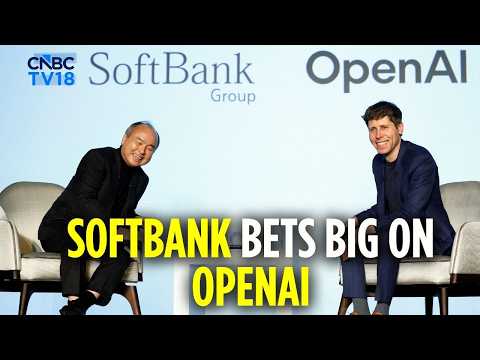
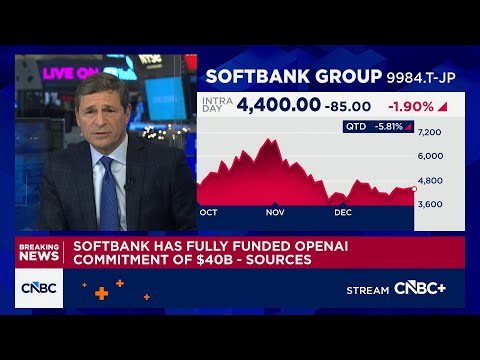
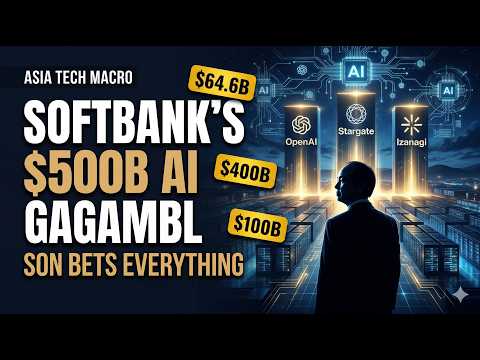
SoftBank's talks to borrow $6 billion against its OpenAI shares stalled on June 10 after banks balked at pricing private-company collateral. SoftBank had gathered roughly $5 billion in soft commitments before the pause.
OpenAI filed a confidential S-1 with the SEC on June 8, targeting a public debut as early as September 2026 with Goldman Sachs and Morgan Stanley as lead underwriters. That filing nudged some lenders back toward the deal — but the bigger stakes are the March 2027 maturity on SoftBank's $40 billion bridge facility. If OpenAI lists before then, SoftBank gets tradeable collateral. If the IPO slips, CNBC reported June 4 that analysts see a real liquidity crunch.
Why it matters
SoftBank's March 2027 bridge maturity is now a race against OpenAI's IPO clock — if that listing slips or prices low, asset sales follow.
Questions about this story
Free account needed to ask — your question is kept and asked for you right after sign-up. Answers are public.
No questions yet — be the first to ask.
Key Indicators
Stalled
Margin loan status
$6B target; talks broke down June 10 after ~$5B in soft commitments. OpenAI's IPO filing may revive lender interest.
$64.6B
SoftBank's OpenAI commitment
Cumulative investment after the February 2026 follow-on, making OpenAI SoftBank's largest single bet.
13%
Expected stake in OpenAI
SoftBank's ownership share once latest commitments are fully funded.
7.88%
Indicative loan rate
Roughly 425 basis points over SOFR, the U.S. dollar lending benchmark.
$852B
OpenAI private valuation
Set in March 2026 after a $122 billion round. OpenAI's S-1 targets a similar valuation at IPO.
Sep–Nov 2026
OpenAI IPO target window
OpenAI filed a confidential S-1 on June 8 with Goldman Sachs and Morgan Stanley. A listing before March 2027 would let SoftBank refinance its bridge loan against public shares.
Images from Openverse under Creative Commons licenses.
Videos from YouTube.
Voices
Curated perspectives — historical figures and your fellow readers.
Andrew Carnegie
(1835-1919) ·Gilded Age · industry
Fictional AI pastiche — not real quote.
"When a man borrows sixty-four billion dollars to wager upon a company that has yet to earn its valuation, he has not built a steel mill — he has built a cathedral of credit upon sand, and prayed the congregation never asks to see the foundation."
0% found this insightful
Ever wondered what historical figures would say about today's headlines?
Sign up to generate historical perspectives on this story.
15 events
Latest: June 8th, 2026 · 3 months ago
Showing 8 of 15
JK to step
Tap a bar to jump to that date
Jump to
June 2026
OpenAI files confidential S-1 with SEC
LatestIPO Filing
OpenAI submitted a confidential draft S-1 targeting a public debut as early as September 2026. Goldman Sachs and Morgan Stanley are lead underwriters. The filing came eight days after Anthropic's own S-1.
Analysts flag SoftBank liquidity crunch risk
Analysis
CNBC reported that equity analyst Richard Windsor said 'If OpenAI fails to deliver there could easily be a liquidity crunch at SoftBank.' Son defended the bet, calling AI '50x bigger' than the dot-com boom.
Anthropic files confidential S-1 with SEC
Competitor Development
Anthropic submitted its own confidential S-1 after raising $65 billion at a $965 billion valuation in a Series H round. OpenAI filed its own S-1 one week later.
May 2026
OpenAI CEO and CFO reported at odds over IPO timing
Business Development
TechTimes and IBTimes reported that CFO Sarah Friar told colleagues she does not believe OpenAI will be ready to go public in 2026, citing $600 billion in future compute commitments and the organizational work required. CEO Sam Altman is pushing a Q4 2026 listing. The internal disagreement became public weeks after OpenAI missed revenue targets.
April 2026
$40B bridge loan syndication draws at least eight banks
Financing
HSBC, BNP Paribas, and Intesa Sanpaolo joined as sub-underwriters, each committing around $5 billion, bringing the total participating bank count to at least eight.
OpenAI misses internal revenue and user-growth targets
Business Development
The Wall Street Journal reported OpenAI fell short of several monthly sales and user targets in early 2026, with Anthropic taking share in coding and enterprise. CFO Sarah Friar warned colleagues that slower revenue growth could make it harder to fund future compute agreements. Oracle and chip stocks fell on the news.
SoftBank seeks $10B margin loan against OpenAI shares
Financing
Bloomberg reports a two-year facility at roughly 425 basis points over SOFR. SoftBank credit-default swaps widen about 10 basis points.
Lead banks invite more lenders into $40B loan
Financing
Underwriters look to syndicate the bridge facility, an early test of broader creditor appetite for SoftBank's OpenAI exposure.
March 2026
OpenAI closes $122B round at $852B valuation
Valuation
Amazon commits $50 billion, Nvidia and SoftBank $30 billion each, setting the price reference for SoftBank's collateral.
$40 billion bridge loan signed
Financing
JPMorgan, Goldman Sachs, Mizuho, SMBC, and MUFG underwrite SoftBank's largest dollar lending facility, maturing March 2027.
February 2026
SoftBank announces additional $30B follow-on
Investment
Cumulative commitment to OpenAI rises to roughly $64.6 billion, expected ownership of about 13%.
December 2025
SoftBank completes initial $40B commitment
Funding
Final tranche of about $22.5 billion arrives at OpenAI, after Son sells SoftBank's entire Nvidia stake and part of its T-Mobile holding to fund it.
October 2025
OpenAI secondary sale at $500B
Valuation
Employee secondary tender prices OpenAI at $500 billion, marking up SoftBank's stake on paper.
April 2025
SoftBank leads $40 billion OpenAI round
Investment
OpenAI raises a record private financing at a $300 billion pre-money valuation, with SoftBank as lead investor.
January 2025
Stargate announced at the White House
Strategic Announcement
SoftBank, OpenAI, and Oracle unveil a $500 billion AI infrastructure venture, with Son as chairman and SoftBank holding financial responsibility.
Scenarios
1
OpenAI IPO unlocks SoftBank's bet
Possible
Discussed by: TechCrunch, Asia Business Outlook
OpenAI files for a public listing within 12 to 18 months. A successful IPO converts SoftBank's private holding into a marketable security, eases collateral concerns, and lets SoftBank refinance the bridge and margin loans against publicly traded stock at lower rates. This is the scenario lenders appear to be pricing into the current loan terms.
2
OpenAI valuation slips, margin calls cascade
Possible
Discussed by: Bloomberg credit desks, Om Malik, FinTech Weekly
A drop in OpenAI's secondary-market price or in the next funding round triggers collateral calls under the margin loan. SoftBank would be forced to post additional Arm or other shares, or to sell holdings into a falling market. With credit-default swaps already near a one-year high, a stress event could compound borrowing costs across SoftBank's outstanding debt.
3
AI capex slowdown forces SoftBank retreat
Uncertain
Discussed by: TradingKey, Nikkei Asia
Hyperscaler AI spending plateaus and OpenAI revenue growth disappoints. SoftBank cannot execute the IPO exit, faces credit downgrades, and is forced to scale back the Stargate buildout. Son's 'all-in' bet becomes the defining test of whether AI infrastructure can sustain the leverage that has been used to build it.
4
Loan closes uneventfully, debt stack expands
Likely
Discussed by: Reuters, Yahoo Finance
Banks finalize the margin loan on roughly the indicated terms. SoftBank uses the proceeds for general corporate purposes and continued OpenAI funding, while pursuing further debt issuance through 2026. Markets treat the deal as part of an established pattern, and attention shifts to the next round of bond sales.
5
OpenAI IPO slips to 2027, SoftBank's bridge loan becomes a forcing event
CFO Sarah Friar told colleagues she does not believe OpenAI will be ready for a 2026 IPO, citing $600 billion in future compute commitments and the missed revenue targets. Morningstar analysts said a 2026 listing is now unrealistic, with mid-to-late 2027 the more likely window. A delay would matter to SoftBank directly: the $40 billion bridge facility matures in March 2027, meaning SoftBank would need to refinance it before OpenAI shares become publicly tradeable collateral — likely at worse terms.
6
OpenAI IPO closes before SoftBank's March 2027 bridge maturity
Possible
Resolves by Mar 27, 2027
Discussed by: Bloomberg, Fortune, TechTimes
OpenAI is targeting a September–November 2026 listing. If it closes on schedule, SoftBank holds publicly traded shares before its $40 billion bridge facility matures in March 2027. That converts illiquid collateral into a marketable security and likely restarts the stalled margin loan at tighter spreads.
Historical Context
3 moments from history that rhyme with this story — and how they unfolded.
1 of 3
August-September 1998
Long-Term Capital Management collapse (1998)
The hedge fund LTCM held positions worth more than $1 trillion against $4.7 billion of capital, financed by margin loans from major banks. When Russia defaulted on its debt, LTCM's collateral fell sharply, triggering margin calls it could not meet. The Federal Reserve organized a $3.6 billion bank-led rescue.
Then
Fourteen banks took over LTCM's portfolio to wind it down without forced sales that could have damaged broader markets.
Now
Established that highly leveraged positions in correlated assets create systemic risk even when the underlying trades look sound. Influenced bank capital rules and counterparty risk management for decades.
Why this matters now
Cautionary template for what happens when concentrated, levered exposure to a single thesis encounters a sudden mark-to-market shock. SoftBank's exposure is concentrated in one private company rather than thousands of correlated trades, but the leverage dynamic is similar.
2 of 3
April 2017
SoftBank's $8B Alibaba margin loan (2017)
SoftBank pledged part of its Alibaba stake as collateral for an $8 billion margin loan from a syndicate of banks at LIBOR plus 150 basis points. It was one of the largest margin loans ever and established the template SoftBank still uses: borrow against marketable holdings rather than sell them.
Then
SoftBank gained liquidity for Vision Fund and other investments without realizing capital gains taxes on Alibaba.
Now
The structure became a recurring tool, later replicated against Arm Holdings shares with $11.5 billion of margin loan capacity by 2025.
Why this matters now
The OpenAI margin loan extends the same playbook to a private company, where the collateral cannot be marked to a public market price. That is the structural difference making the new deal riskier.
3 of 3
August-November 2019
Vision Fund's WeWork bet (2019)
SoftBank had invested over $10 billion in WeWork ahead of a planned IPO. The S-1 filing exposed governance and financial concerns, the IPO was pulled, and WeWork's valuation fell from $47 billion to under $8 billion. SoftBank was forced to lead a $9.5 billion rescue and write down billions more.
Then
SoftBank booked a $4.6 billion loss on the WeWork stake in fiscal 2019 and ousted founder Adam Neumann.
Now
Vision Fund 2 raised far less external capital than planned, and SoftBank entered a multi-year period of debt reduction before pivoting back to aggressive AI investment.
Why this matters now
Demonstrates how fast a private valuation can collapse when public-market scrutiny arrives. SoftBank's OpenAI position is several times larger than its WeWork exposure.