

Pull to refresh
Logo
Daily Brief
Following
Why Ranks Sign Up
World Bank reclassifies the Philippines as upper-middle-income

World Bank reclassifies the Philippines as upper-middle-income

Money Moves

Rising average incomes push the country past a global income threshold it had sat below since 1987, changing its borrowing terms and investment profile.

July 3rd, 2026: Marcos and Carney flag private sector in Vancouver meeting

Overview

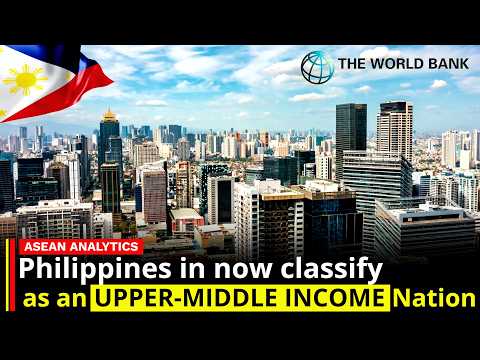
On July 1, 2026, the World Bank raised the Philippines to upper-middle-income status for the first time since 1987. Income per person reached $4,850, clearing the $4,636 cutoff after 39 years in the lower tier.

President Marcos called the upgrade 'a vote of confidence in our country's future,' crediting four years of economic policy. The milestone comes with an asterisk: headline inflation hit 6.8% in May 2026, well above the central bank's 2–4% target, driven partly by global energy costs. The reclassification can still lower borrowing costs and attract investors, while phasing out cheap development loans the country has long relied on.

Why it matters

Upper-middle-income status can boost the Philippines' credit profile and draw investors, while phasing out the cheap development loans it long relied on.

Questions about this story

No questions yet — be the first to ask.

Key Indicators

$4,850
GNI per capita (2025)
Average income per person, the figure that crossed the threshold.
$4,636
Upper-middle-income cutoff
The lower bound of the World Bank's upper-middle band for fiscal 2027.
5.8%
Average annual GDP growth
Pace of expansion from 2021 to 2025, spread across industries.
39 years
Years in the lower tier
The Philippines had been lower-middle-income since 1987.
$26
Prior-year shortfall
In the 2025 classification, income per person fell $26 short.
6.8%
Headline inflation (May 2026)
Above the central bank's 2–4% target, partly fed by global energy costs; a headwind for real income gains.

Voices

Curated perspectives — historical figures and your fellow readers.

Ever wondered what historical figures would say about today's headlines?

Sign up to generate historical perspectives on this story.

Play

Exploring all sides of a story is often best achieved with Play.

Log in to play. Track your picks, climb the leaderboards. Log in Sign Up
Predict 4 ways this could play out. Contrarian picks score more — points lock when the scenario resolves. Log in to play
Higher or Lower Two numbers from this story. Guess which is bigger. 5 rounds to set a streak. Log in to play
Connections Sixteen names from the news. Find the four hidden groups of four. Log in to play

People Involved

Organizations Involved

Timeline

January 1987 July 2026

7 events Latest: July 3rd, 2026 · 1 week ago
Tap a bar to jump to that date
  1. Marcos and Carney flag private sector in Vancouver meeting

    Latest Diplomatic

    At a joint press conference in Vancouver, President Marcos and Canadian Prime Minister Mark Carney said the Philippines' push to involve the private sector in national development strengthens its appeal as an investment destination.

  2. Marcos calls the upgrade a 'vote of confidence'

    Statement

    President Marcos issued a statement calling the reclassification 'a vote of confidence in our country's future,' saying it validates economic policies pursued over the past four years.

  3. Philippines graduates to upper-middle-income

    Milestone

    Income per person hits $4,850, above the $4,636 cutoff. The World Bank moves the country up a tier alongside four others.

  4. World Bank signals the country is closing in

    Statement

    A World Bank update notes the Philippines has moved nearer the upper-middle-income threshold.

  5. A $26 miss

    Milestone

    Income per person reaches $4,470, falling $26 short of that year's threshold.

  6. Planners brace for the trade-offs

    Policy

    The planning agency warns that moving up will cost the country concessional loans and some tariff perks.

  7. Philippines enters the lower-middle band

    Milestone

    The country is classified lower-middle-income and stays there for decades.

Historical Context

3 moments from history that rhyme with this story — and how they unfolded.

2010

China graduates to upper-middle-income (2010)

China crossed into the upper-middle-income band around 2010 after two decades of fast growth. Its income per person kept climbing, and the country later became a lender rather than a borrower of development aid.

Then

Access to the softest World Bank lending narrowed as China's income rose.

Now

China stayed in the upper-middle band and turned into a major creditor to other developing nations.

Why this matters now

It shows the upside path: a big economy can clear the threshold on broad growth and keep rising, while cheap official loans fade.

July 2020

Sri Lanka's demotion (2020)

Sri Lanka reached upper-middle-income in 2019, then a contracting economy pushed income per person back down. The World Bank demoted it to lower-middle-income the next year, before a later crisis deepened the damage.

Then

The reversal restored some aid eligibility but signaled economic weakness.

Now

Sri Lanka needed years and an IMF program to recover; it re-graduated to upper-middle-income in the same 2026 cohort as the Philippines.

Why this matters now

It is the cautionary case: crossing the line is not permanent, and a shock can undo it within a year.

2011

Thailand and the middle-income trap

Thailand reached upper-middle-income around 2011 and has stayed there ever since. Slower productivity growth and an aging population have kept it short of the high-income tier for over a decade.

Then

Thailand gained the status but lost some concessional financing.

Now

It became a standard example of the middle-income trap, where growth stalls before high-income status.

Why this matters now

It frames the harder next phase: the jump the Philippines just made is often easier than the climb that follows it.

Sources

(12)