

Pull to refresh
Logo
Olin and Huntsman combine to form OlinHuntsman chemicals company

Olin and Huntsman combine to form OlinHuntsman chemicals company

Money Moves

An all-stock merger of equals moves toward August shareholder votes and a 2027 close

August 25th, 2026: Special shareholder meetings to vote on the deal

Overview

Updated Jul 14

Two of America's oldest chemical makers are trying to become one. On July 14, Olin and Huntsman said the Securities and Exchange Commission cleared the paperwork for their all-stock merger, sending the deal to shareholders for a vote on August 25.

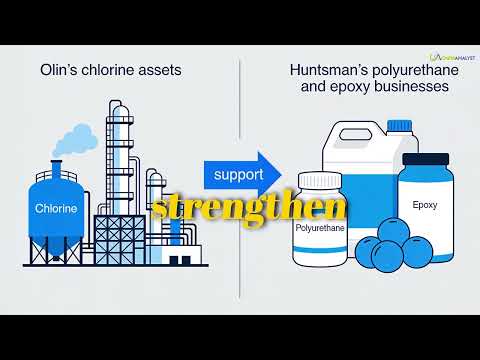
If both sets of owners approve, the companies plan to close in the first half of 2027 and rename the combined business OlinHuntsman. The pitch is vertical integration: Olin makes chlorine and caustic soda, Huntsman turns similar chemistry into polyurethanes and coatings. Together they claim more than $400 million in yearly cost savings.

Why it matters

The merger would concentrate North American chlor-alkali and polyurethane supply in one firm, shaping prices for plastics, foams, and coatings used across manufacturing.

Questions about this story

Free account needed to ask — your question is kept and asked for you right after sign-up. Answers are public.

No questions yet — be the first to ask.

Key Indicators

$12.5B
Combined 2025 revenue
The two companies' 2025 sales added together.
0.5476
Exchange ratio
Olin shares each Huntsman share converts into.
$400M+
Identified annual cost savings
Synergies and integration benefits the companies say the merger will produce.
54.5% / 45.5%
Ownership split
Olin holders own about 54.5% of the combined company, Huntsman holders about 45.5%.

Voices

Curated perspectives — historical figures and your fellow readers.

Ever wondered what historical figures would say about today's headlines?

Sign up to generate historical perspectives on this story.

People Involved

Organizations Involved

Timeline

June 2026 August 2026

4 events Latest: August 25th, 2026 · 3 weeks ago
Tap a bar to jump to that date
  1. Special shareholder meetings to vote on the deal

    Latest Vote

    Huntsman stockholders vote on the merger; Olin shareholders vote on the share issuance and related proposals. Both approvals are required to proceed.

  2. SEC declares merger registration effective, votes scheduled

    Regulatory

    The SEC declares Olin's Form S-4 effective, clearing the way for proxy mailings. Both companies set special shareholder meetings for August 25, 2026.

  3. Record date set for shareholder votes

    Procedural

    Holders of Olin and Huntsman shares as of this date are entitled to vote. Olin's close on this day implies about $11.06 per Huntsman share.

  4. Olin and Huntsman announce merger of equals

    Announcement

    The companies unveil an all-stock deal to form OlinHuntsman, with about $12.5 billion in combined 2025 revenue and more than $400 million in projected cost savings. Huntsman shares fall about 11%.

Scenarios

1

Both shareholder groups approve the merger on August 25

Likely Resolves by Aug 31, 2026

Discussed by: Company proxy statements; deal coverage from C&EN and Manufacturing Dive

Olin and Huntsman boards both back the deal, and management has cast it as a merger of equals with a majority stake for each side. Absent a rival bid or a proxy revolt, both votes clear on August 25 and the deal moves to regulatory review. Huntsman's post-announcement share drop is the main sign of investor unease.

2

OlinHuntsman merger closes in the first half of 2027

Possible Resolves by Q2 2027

Discussed by: Company guidance; Jefferies analyst Laurence Alexander

After shareholder approval, the deal still needs regulatory clearances, including antitrust review of overlapping chlor-alkali and epoxy lines. If reviewers raise no blocking concerns, the companies complete the merger on their stated timeline and begin operating as OlinHuntsman from The Woodlands, Texas.

3

Regulators force divestitures or delay the deal past mid-2027

Uncertain Resolves by Q2 2027

Discussed by: Antitrust commentators noting chlor-alkali and epoxy overlap

The two firms compete in some of the same product lines. If the Federal Trade Commission or Department of Justice sees the combination reducing competition, it could demand asset sales as a condition or push the review past the planned close. A second request for information would signal this path.

4

Deal collapses before completion

Unlikely Resolves by Q2 2027

Discussed by: Shareholder-rights law firms probing deal fairness

Several law firms opened fairness investigations after the announcement, and Huntsman's share slide hints at investor doubt about the terms. A failed shareholder vote, a superior competing offer, or a regulatory block could unwind the merger and return both firms to standalone status.

Historical Context

2 moments from history that rhyme with this story — and how they unfolded.

August 2017

Dow and DuPont merger (2017)

Two chemical giants combined in a $130 billion merger of equals, then split into three focused companies. Regulators in the U.S. and Europe demanded asset sales in pesticides and plastics before clearing it.

Then

The merged DowDuPont held together for about two years while it reorganized business lines.

Now

It broke into Dow, DuPont, and Corteva in 2019, showing that a headline merger can be a step toward later separation.

Why this matters now

It is the recent template for large chemical mergers of equals, including the regulatory demands and integration work OlinHuntsman would face.

May 2017 to October 2018

Huntsman's failed merger with Clariant (2017-2018)

Huntsman agreed to a $20 billion all-stock merger of equals with Swiss chemical maker Clariant. Activist investors built a stake in Clariant and opposed the deal, and the two sides called it off.

Then

Both companies stayed independent, and Huntsman later spun off and sold parts of its business.

Now

The collapse showed how shareholder opposition can kill a chemical merger even after boards agree.

Why this matters now

Huntsman has walked away from a merger of equals before. It highlights the shareholder-vote and investor-sentiment risk hanging over the Olin deal.

Sources

(5)