


Pull to refresh
Logo
NYCHA completes $636M renovation of East Brooklyn public housing

NYCHA completes $636M renovation of East Brooklyn public housing

Built World New York, NY local

PACT converts 15 aging developments to private management as NYCHA chases an $80B repair backlog with 45,700 more apartments in the pipeline

Overview

Updated Oct 29

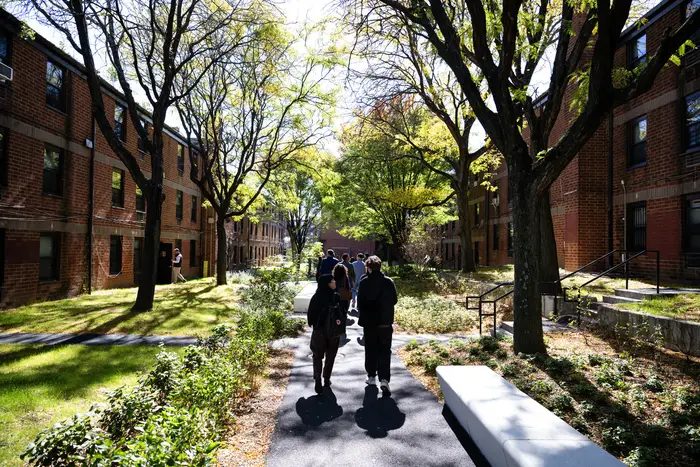
Nearly 3,000 people in East Brooklyn public housing are living in renovated apartments after NYCHA finished a $636 million rehabilitation of the Reid & Park Rock developments. The work covered 1,696 homes in 87 buildings across 15 developments, with new kitchens, bathrooms, heating and ventilation.

The project runs through the Permanent Affordability Commitment Together program, or PACT, which converts public housing to the Section 8 rent subsidy and brings in private firms to renovate and manage. NYCHA says 170 developments with more than 45,700 apartments are somewhere in the PACT pipeline, nearly $17 billion in repairs, and it wants to add 62,000 more apartments. Residents say the finished homes are transformed but report lifting floor tiles, chipping paint and smoke alarms that go off on their own.

Why it matters

New York's $80 billion public housing backlog depends on whether the PACT private-partnership model fixes homes faster than they deteriorate.

Last Monday's email for New York, NY

Sent Nov 9. It carried:

Get next Monday's: one short email a week. Free. Unsubscribe in one click.

Questions about this story

Free account needed to ask — your question is kept and asked for you right after sign-up. Answers are public.

No questions yet — be the first to ask.

Key Indicators

$636M
Reid & Park Rock renovation cost
Total cost of the completed rehabilitation across 15 developments.
1,696
Homes renovated
Apartments modernized with new kitchens, bathrooms, floors and appliances.
87
Buildings modernized
Buildings spanning 15 public housing developments in East Brooklyn.
45,700
Apartments in the PACT pipeline
Apartments across 170 developments in pre-development, under construction or finished, as of NYCHA's October 2026 release.
$80B
NYCHA repair backlog
Projected cost of needed improvements across the authority's entire housing stock.
62,000
Apartments NYCHA plans to add to PACT
Additional apartments the housing authority says it wants in the program.

Voices

Curated perspectives — historical figures and your fellow readers.

Sign up to generate historical perspectives on this story.

People Involved

Organizations Involved

Timeline

2016 October 2026

3 events Latest: October 26th, 2026 · 2 weeks ago
  1. Report details completion and resident concerns

    Latest Report

    Gothamist reports on the finished renovation, the $80 billion backlog, the 62,000-apartment PACT expansion target, and quality complaints from tenants.

  2. Ribbon cutting at Reid & Park Rock

    Milestone

    NYCHA and partners celebrate completion of the $636 million rehabilitation of 1,696 homes across 87 buildings in East Brooklyn. Resident leaders chose Black Veterans for Social Justice as the social services provider, a first for a completed PACT project.

  3. NYCHA launches PACT program

    Policy

    The housing authority creates PACT, converting public housing to Section 8 to unlock private financing and management.

Scenarios

1

NYCHA moves 62,000 more apartments into PACT

Likely Resolves by End of 2027

Discussed by: NYCHA leadership, housing policy analysts

If the model delivers durable repairs and financing holds, NYCHA converts far more public housing to Section 8. The agency has already stated the 62,000-apartment target. Each conversion brings private capital for repairs but shifts day-to-day management to private owners. Watch for new PACT conversion announcements in the annual budget and HUD filings.

2

Resident complaints trigger formal oversight

Possible Resolves by Q2 2027

Discussed by: Tenant associations, New York City Council members

Complaints about lifting floors, faulty smoke alarms and chipping paint could escalate into a formal inquiry. The City Council's public housing committee might hold hearings, or NYCHA could order corrective work and audit how it monitors its PACT partners. That would test whether the agency's oversight role has teeth.

3

PACT expansion stalls on cost or quality

Unlikely Resolves by End of 2027

Discussed by: Housing advocates, public housing critics

Skeptics argue the private model cannot fix an $80 billion backlog and may erode resident protections. If quality problems persist or financing costs rise, NYCHA could slow or quietly rebrand its PACT expansion goals. A slowdown would mean fewer Section 8 conversions than projected and more units left in the traditional public housing system.

Historical Context

3 moments from history that rhyme with this story — and how they unfolded.

2012-present

HUD Rental Assistance Demonstration (2012-present)

Congress authorized HUD's Rental Assistance Demonstration, letting public housing authorities convert Section 9 public housing to project-based Section 8. The shift makes properties financeable, unlocking private debt and tax credits. Hundreds of thousands of units have converted nationally.

Then

Many conversions delivered long-deferred repairs; residents kept rent protections under Section 8.

Now

RAD became the standard federal tool for public housing preservation. PACT is NYCHA's version of it.

Why this matters now

RAD is the exact mechanism PACT uses. Results at RAD properties nationwide are the main evidence base for whether Section 8 conversion preserves affordable housing or just defers problems.

2000-2015

Chicago Housing Authority Plan for Transformation (2000-2015)

Chicago redeveloped its distressed public housing into mixed-income communities, converting much of it to Section 8 vouchers and private management. Tens of thousands of high-rise units were demolished.

Then

Roughly 25,000 families received vouchers; many moved to different neighborhoods and did not return.

Now

Chicago's public housing stock fell sharply, and researchers documented displacement and uneven outcomes for residents.

Why this matters now

It is the largest U.S. case of converting public housing to Section 8 with private partners, showing the displacement risks PACT residents face during and after renovation.

1992-2010

HOPE VI (1992-2010)

Congress funded demolition of severely distressed public housing, replacing it with lower-density mixed-income developments built with private partners.

Then

Hundreds of developments were revitalized, but roughly 100,000 public housing units were not replaced.

Now

The program entrenched the mixed-finance model and left a lasting debate about whether revitalization shrinks the deep-affordability stock.

Why this matters now

HOPE VI is why resident advocates watch PACT for net loss of affordable units, even though Reid & Park Rock was renovated in place rather than demolished.

Sources

(4)